By Chris Chavez
October 26, 2026
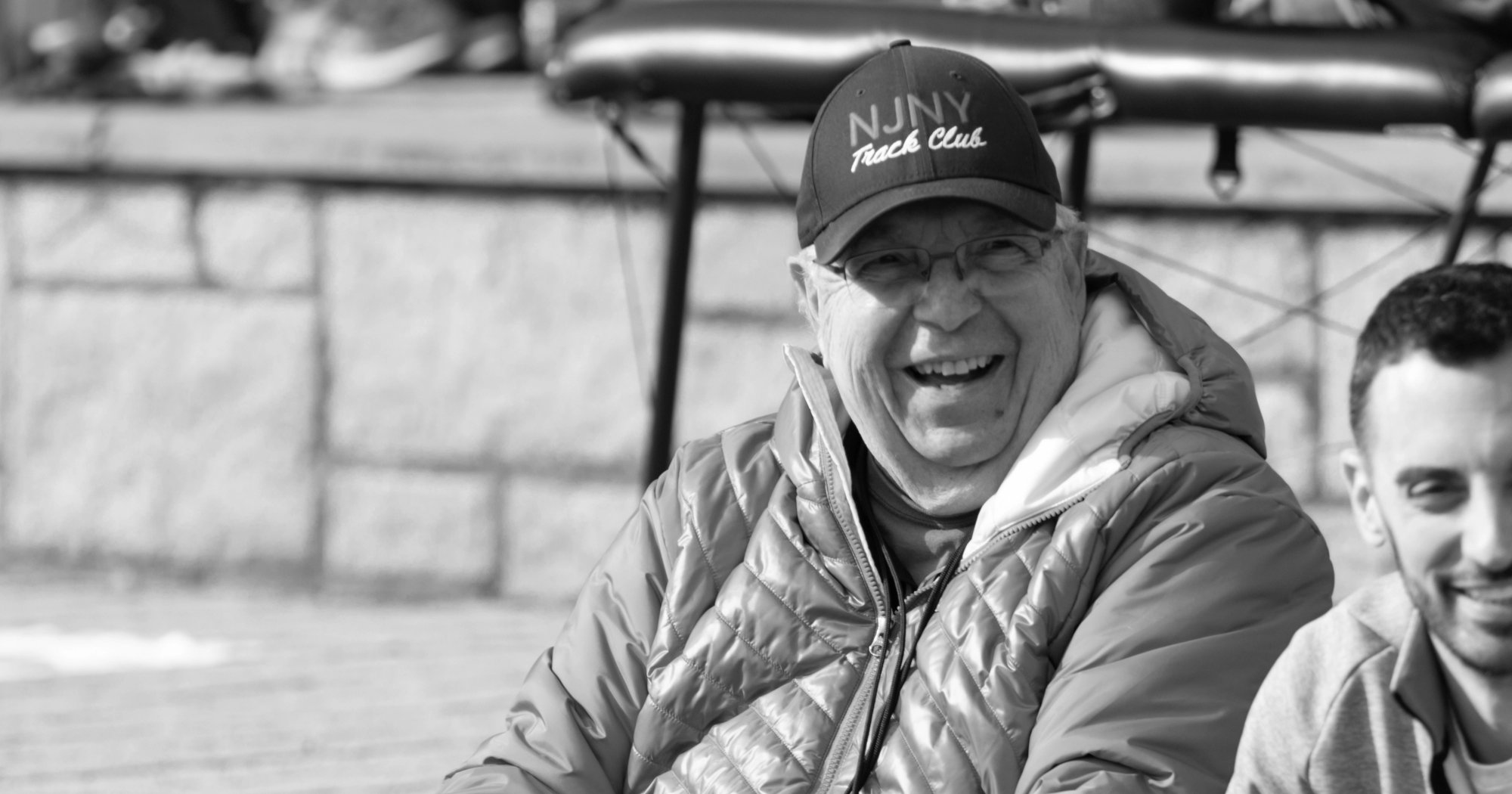
Frank Gagliano, a former Bronx quarterback who stumbled into coaching track and field and went on to guide N.C.A.A. champions and more than a dozen Olympians over six decades, died on Sunday night. He was 89.
Known throughout the sport as “Gags,” Gagliano helped Manhattan College win an N.C.A.A. indoor title in 1973, built Georgetown into a national power over 18 years, and then, at an age when most coaches retire, became one of the country's leading coaches of professional runners, first in Palo Alto, Calif., then in Eugene, Ore., and finally back home in the New York Tri-state area.
For decades he was a fixture at the Penn Relays and the Millrose Games, stopwatch in hand, planted near the final turn with about 300 meters to go. When his runners heard him shout "Hit it!" they knew to change gears and come home hard.
His philosophy and methodology were not overly complicated. When a runner once asked whether he believed in aerobic or anaerobic training, he admitted he didn't know what the words meant.
"I believe in strength and speed," he said in a 2014 interview with me.
What he knew was people. He kept notebooks on his athletes, sat in their parents’ living rooms, and told them at the start of every season to “live by the clock.” Asked once to name his greatest accomplishment, he skipped the Olympians and pointed to Georgetown’s graduation rate.
******
Francis Xavier Gagliano was born on March 20th, 1937, in the Bronx and grew up a few blocks from Mount St. Michael Academy, where he was an All-Metropolitan quarterback who threw the javelin to stay in shape. He played quarterback at the University of Richmond from 1956 to 1959. There he met Roberta on a blind date to a fraternity party; they married on April 15, 1961.
After brief stints with the Hamilton Tiger-Cats and the minor-league London Lords in Canada, he came home and in 1960 took a job at Roselle Catholic High School in New Jersey, which promised to start a football team. It never did. Instead, he was asked to start a track team.
"I didn't know anything about track," he said, "But I accepted the offer because I really wanted to coach."
He taught himself by reading and calling other coaches with "a million questions." His first team lost its first dual meet, 112-15. In 1965, Roselle Catholic won both the distance medley relay and the two-mile relay at the Penn Relays, the first high school to sweep the two races.
In 1969, he joined Manhattan College as an assistant to Fred Dwyer, a former rival with whom he had once nearly come to blows at the 168th Street Armory. He taught driver's education in the mornings to make ends meet and spent afternoons recruiting the city's best runners to stay home. In 1973, Manhattan, a commuter school in the Bronx, won the N.C.A.A. indoor team title while scoring in only four events.
At Rutgers, where he became an assistant in 1974 and head coach in 1982, he produced his first Olympian, the steeplechaser Mike Roche, in 1976, and his first sub-four-minute miler, Ron Spears, who called him about once a year for decades to remind him of it. He once sent Elliott Quow, a sprinter who would not run the curve hard enough, to a hypnotist. That summer, Quow won the silver medal in the 200 meters at the 1983 world championships in Helsinki, behind Calvin Smith.
Georgetown hired him that fall. Over 18 years, the longest tenure of any track coach in the school's history, his Hoyas won 23 Big East championships and produced 140 All-Americans, and he was twice named national coach of the year. He wanted a complete team, not a collection of stars. "A hammer thrower scores 10 points just like an 800-meter runner," he recalled.
In the early 1990s, he began coaching Georgetown graduates as professionals, and two of them, John Trautmann and Steve Holman, made the 1992 U.S. Olympic team. In 2001, at 64, he moved to Palo Alto to coach the Nike Farm Team, where Nicole Teter set the American indoor record in the 800 meters and, along with Jonathon Riley, made the 2004 Olympic team.
In 2006, Vin Lananna, then at the University of Oregon, persuaded him to move the group to Eugene ahead of the 2008 Olympic trials. "You're nuts," Roberta Gagliano told her husband. They packed a U-Haul anyway.
At the trials, his advice was often for runners to change gears at the Bowerman statue on the backstretch. In the men's 800-meter final, his runner Nick Symmonds came from last to win. Andrew Wheating of Oregon was second, and Christian Smith, another Gagliano runner who had entered as the last qualifier in the field, edged a three-time national champion Khadevis Robinson at the line for third. The Hayward Field crowd roared so long that officials delayed the next event. It became known as the Oregon Sweep.
When reporters asked whether he had expected Smith to make the team, Gagliano said, "No way," and Smith stopped speaking to him for weeks. They made up at the Olympic training camp in China. "You're an Olympian," Gagliano told him, "and you'll always be one."
After the Beijing Games, he moved back East. His daughter-in-law, Meighan, was dying of cancer, and he bought a house across the street from his son David's in Rye, N.Y., to help raise his grandchildren. He did not stop coaching.
"I don't own golf clubs," he would say, "only stopwatches."
In 2010, he founded the New Jersey-New York Track Club. With no shoe sponsor at first, he ran it as a nonprofit and called it "the United Nations of shoe companies." It became one of the country's top middle-distance groups, producing Olympians Julie Culley and later Donn Cabral, a world indoor record in the 4x800 meters in 2018, and, in 2019, a 3:49.98 indoor mile by Johnny Gregorek, whose father, John, had run for Gagliano at Georgetown.
He was inducted into the U.S. Track & Field and Cross Country Coaches Association Hall of Fame in 2003.
In July 2026, USA Track & Field named the men's 800 meters at its national championships in his honor.
*****
12 years ago, I attended a New Jersey-New York Track Club practice to finish reporting on a project on Gagliano that would help me get my final credits to graduate. At 77, Gagliano was still at practice at least twice a week, still clicking his stopwatch and yelling at runners less than a quarter his age. When I asked why, he gave the answer he had given for half a century.
"There is still a fire burning within me to coach," he said.
Chris Chavez
Chris Chavez launched CITIUS MAG in 2016 as a passion project while working full-time for Sports Illustrated. He covered the 2016 Olympics in Rio de Janeiro and grew his humble blog into a multi-pronged media company. He completed all six World Marathon Majors and on Feb. 15th, 2025 finally broke five minutes for the mile.