By David Melly
June 3, 2026
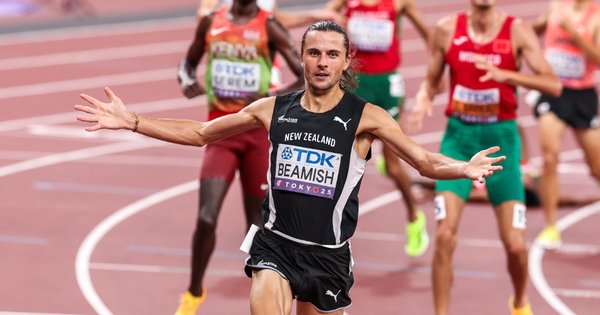
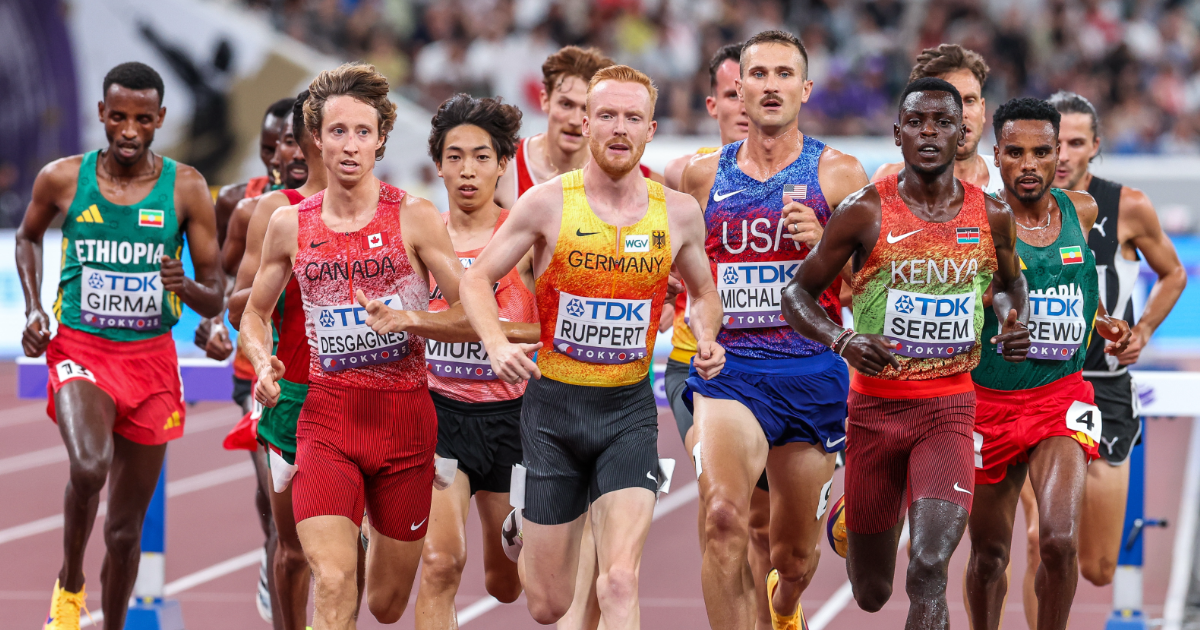
The biggest steeplechase news out of Rabat wasn’t Soufiane El Bakkali getting back to his winning ways. It also wasn’t World champion George Beamish finishing 13th, albeit in a perfectly respectable 8:16.30 season opener. It was runner-up Frederik Ruppert.
Just like he did at Rabat last year, Ruppert used a strong last lap to reel in, but not quite overtake, El Bakkali and got a big PB in the process. Unlike last year, however, where the winning time was 8:00.70 and Ruppert ran 8:01.49, this time the 29-year-old German knocked another 3+ seconds off his best, clocking a 7:57.80.
That time landed Ruppert at 12th on the all-time list, and he, along with third-placer Simon Koech, joined the still-small club of sub-eight-minute steeplers that now has 15 members. Most notably, however, Ruppert became the first man not born in Africa to crack the barrier.
Of those 15 sub-eight runners, ten are Kenyan (eleven if you count Saif Saaeed Shaheen, who was born in Kenya but represented Qatar internationally), two are from Morocco, and only one, surprisingly, is Ethiopian. That one, of course, is world record holder Lamecha Girma, who’s run ten full seconds faster than the second-fastest Ethiopian in history.
After Mahiedine Mekhissi-Benabbad and Evan Jager both got tantalizingly close, running 8:00 in 2013 and 2015, respectively, it seemed like a matter of time before an American or European broke the barrier. When Jager took his fateful fall over the final barrier in Paris en route to his 8:00.45 PB, it seemed like a foregone conclusion he would be the guy… alas, the cruel track gods had other plans. Instead, it took nearly eleven more years and a guy from a different continent.
Since 2015, 15 of the 20 American and European Olympic distance records (men’s and women’s 800-10,000m) have been broken. The ones that haven’t are Wilson Kipketer’s and Jarmila Kratochvílová’s European 800m marks, Bernard Lagat’s 1500m American record (depending on what you count), and both men’s steeplechase marks. In the age of supershoes, Wavelights, and bicarb, the men’s steeplechase has remained a stubborn outlier to the trend of past times getting blown out the window.
It’s not a steeplechase problem: the women’s sub-nine list has gone from one name to 17 in the last decade, and eight of the fastest marks have been run since 2024. In 2020, running 9:27 would get you on the U.S. all-time top-10 for women; now that cutoff is 9:10.72. In the same race as Ruppert, Matthew Wilkinson moved up to U.S. #7 all-time with his 8:09.56 run, but only one of the six men in front of him (Kenneth Rooks) ran his PB this decade. By comparison, every member of the women’s top-10 ran her PB in the last eight years, and seven of the ten did so in the last three.
Does bicarb simply not work on American men’s stomachs? Do European men respond differently to carbon-spike technology? If you look at the trajectory of all the other mid-distance and distance events, that certainly doesn’t seem to be the case. Unless we’ve discovered some sort of crazy scientific anomaly where the combination of running, jumping, and splashing affects one gender and one regional subset in a totally different way than every other athlete and event, a simpler explanation must be true: we’re overdue.
The steeplechase is one of those events where big time jumps are possible, and in championships they’re downright common. Look at Ruppert last year, going from 8:15 to 8:01 in one race. Or Doris Lemngole deciding to take the kid gloves off and improve the NCAA record from 9:15 to 8:58 in one season. Kenneth Rooks’s silver-medal winning run in Paris was a nine-second PB; Courtney Frerichs’s 2017 Worlds breakout was a 15-second improvement. Other men will follow Ruppert under the barrier, and it might not even be someone who’s particularly close at the moment.
The 800m and 1500m have gotten faster not just because of technology but because more races are paced for faster times, and more fields are full of athletes who have both the belief and capability to run in the 1:42s and 3:20s. For the better part of the last decade, the men’s steeplechase on the elite international level has been El Bakkali, Girma, and then a huge gap, which can create race-within-a-races where the chase pack has no help from rabbits. But just like Faith Kipyegon and the women’s 1500m, the rest of the world is starting to be able to stick closer to the frontrunners for longer, and the times will follow.
In Rabat, Frederik Ruppert became a Roger Bannister of sorts, and in the next year or two, Bannister’s famous words—“après moi, le déluge,” French for “after me comes the flood”—will start to feel true. The number of Europeans and Ethiopians under eight minutes will not stay at one for long, and an American sub-eight is coming sooner than we might imagine.
David Melly
Since David began contributing to CITIUS in 2018, he's done a little bit of everything, from podcast hosting to newsletter writing to race commentary. Currently, he coordinates the social media team and manages both the CITIUS MAG newsletter and The Lap Count, supplying hot takes and thoughtful analysis in both short- and long-form. Based on Boston, David breaks up his excessive screen time by training for marathons, crewing trail races, baking sweet desserts, and mixing strong cocktails.