By Anderson Emerole
December 18, 2025
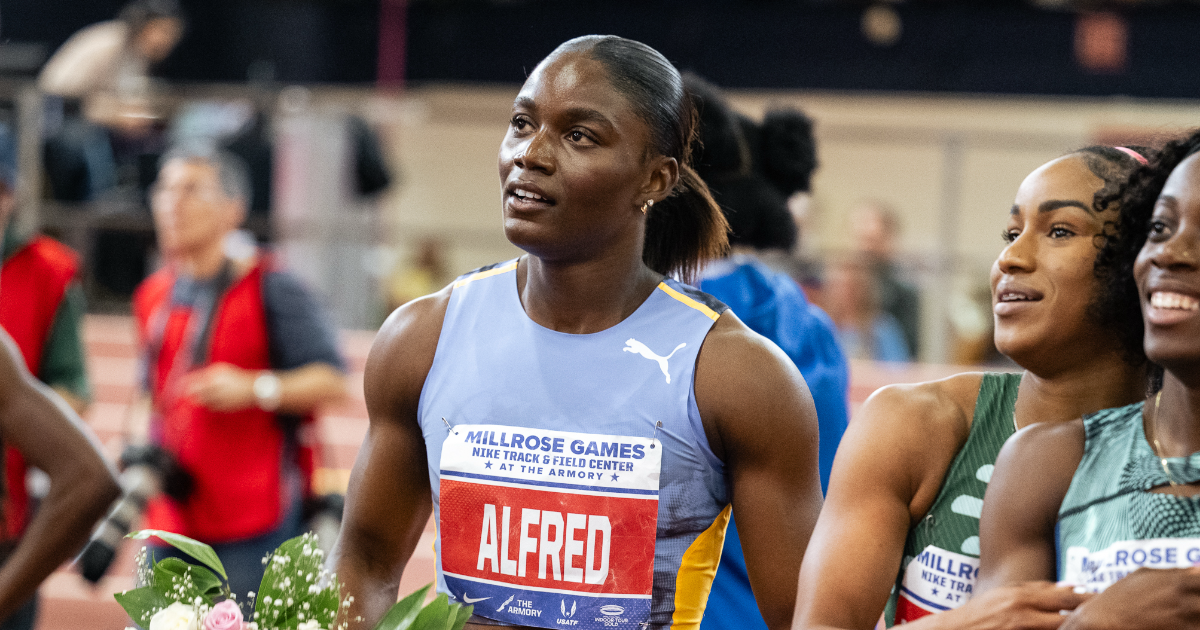
Olympic 100m Gold medalists and 60m World Indoor Champion Julien Alfred of Saint Lucia will return to The Armory in New York City on February 1st, 2026, headlining the Women’s 60m at the 118th edition of the Millrose Games.
Julien last competed at Millrose in 2024 when she won the 60m in a meet record of 6.99 seconds. She would go on the following spring to become World Indoor champion and later Olympic Champion, both a first for her country of Saint Lucia. Her 60m personal best of 6.94 puts her at No. 2 all-time. She has not lost a 60m race since 2022.
She will race against 2019 200m World champion Dina Asher-Smith (7.03 PB, British record holder), Aleia Hobbs (tied with Alfred for No. 2 on the all-time list with a 6.94 PB) and Jacious Sears (7.02 PB, Tied for No. 8 on the U.S. all-time list).
Organizers also noted that 60m hurdles world record holder and two-time World Indoor champion Devynne Charlton will headline the women’s 60m hurdles at the meet. Charlton ran 7.67 to break the world record in 2024 and then lowered it to 7.65 at the 2024 World Indoor Championships in Glasgow.
Alfred sat down with CITIUS MAG to discuss her goals for the indoor season, her history and goals in the sport, as well as what she learned about herself in 2025. The following interview has been edited lightly for clarity:
CITIUS MAG: Julien Alfred, how has the off season been and when did you get back into training?
Julien Alfred: I did maybe a few days in October, and I left practice for about two weeks to go to Germany and to also fulfill my duties as a tourism ambassador. I came back and I started around November 9th or 10th. So it hasn't been a long time, maybe about a month since I've been back in practice.
And you said that Coach [Edrick] Flo[réal] is already working you!
Yes. He doesn't play any games. But I'm all here for it if he's going to allow me to be my best self come 2026, God willing. So I'm not complaining.
2026 is going to be your third year as a professional. Before you start fall training, do you and Coach Flo sit down and map out your goals for the year?
The thing about it is that, before the season actually ends, we start talking about what we want to do the following year. This year we had a chance to talk here and there about what we expect going into 2026. So we usually do start the year having a little chat as to what exactly we will be looking forward to and maybe after practice when I'm done with my workouts, after he's done killing me in the workout, maybe we'll start talking about what the expectations are for the following year.
How do you balance that? If you're doing a little bit of thinking of 2026, but you're still locked in on performing in 2026. How do you balance both those things?
It's something that I've always done, to be quite honest. Maybe at our last championships or when I'm close to being done, he will probably hint at what our plans are for the next year. So let's say I'm at a championship, he’ll probably be like next year, we’re probably going to work on this. Or like this year, I'm not doing any 400s anymore. So he'll probably mention that. But it's nothing that's going to distract me from what I'm doing that same year. It's not going to distract me whatsoever.
So you will be competing at the Millrose Games in 2026 at the Armory, which should be really exciting. You competed last year in 2024 and set the meet record in the 60m. What went into the decision to jump back into the 60m and compete at Millrose this year?
It's a down year for one. My coach, he did ask me, hey, what do you want to do next year? And of course I love the 60m. I did the 60m a lot in college and also my first year as a professional athlete. And it's really a fun year for me doing the things that I actually love and enjoy. And considering that the 60m is something I really love, I decided that it was going to be part of my plans for 2026. So I'm really looking forward to competing in the 60m again after running a 300m and 400m indoors. So I'm actually really excited.
From what I heard when you were at Texas, even the 200m was not your favorite.
No. no, it wasn't
When Coach Flo comes up to you in the fall of 2024 and says at the top of 2025, we got to do some 300s and 400s, what's going through your mind at that point?
At first I didn't believe him until I had an interview with Ato Boldon and he announced it. On an Instagram Live he announced “Julien’s going to be running the 400m next season.” And it was like, okay that means it has to be true. But although I know it's just not something that I actually like, I trust my coach's plan. And if it's going to make me be my best self, and be the best athlete that I can be, and he sees that’s what I need on the track, then I'm going to do it, even though it's going to be hard for me to do it. But I think that because of my trust in him, I just go ahead and just do it. As much as I hated every single moment of it, including the training. But I did it. It's done now and I hope I don't do it anymore. I think maybe a 4x400, but just not a 400. Sorry. No individual 400.
I wonder if the Millrose Games 60m is going to be a stepping stone towards getting back to World Indoors in 2026?
We haven't thought so far as yet as it pertains to running World Indoors. Maybe, maybe not. I'm not sure yet. However, I'm taking it one meet at a time, and so far Millrose is the first on the list to compete at, and that's my main goal right now. I'm not really thinking about World Indoors as of now, so I'm just thinking about just attending Millrose as I did, as I competed there in 2024. That's really our main focus as of now.
Looking back in 2024 when you did win World Indoor Gold in the 60m, you eventually became Olympic champion in the 100m, Olympic silver in the 200, and all of those were firsts for your country. Was there any pressure to perform, to represent your country, to put on for your country?
No, there wasn't any. Entering that year, 2024, there wasn't any pressure. I think the pressure really came about after I won World Indoors, hence why I took a long break. I took a long break in May and late April to just really focus on training and dial back and get myself together mentally as well. But I think the pressure really came about after World Indoors and of course, going into the Olympics, because now they're expecting me to go out there and deliver. But when I entered 2024, there wasn't any pressure. If anything, it was on myself because I always put pressure on myself to go out there and perform and be my best self. But outside pressure? No, there wasn't any.
You got the gold medal at World Indoors and I remember you had gone home for a little bit after that. I can imagine you're seeing people there celebrating you, but you're like, now I got the Olympics.
Yeah. At that time, to just see how everybody celebrated me and the Minister of Sports, Honorable Kenson Casimir, he made a comment “so now we're expecting a gold medal at the Olympics.” And that freaked me out. I'm not going to lie. I was freaked out internally and I didn't mention it to anybody, but I was just so hard on myself. It's like, now I have to go out there because now they expected me to deliver a gold medal, and thankfully it came to fruition. I worked hard to get to that point, but it did psych me out.
After the Olympics you got a chance to be featured in the Netflix documentary SPRINT. We saw that moment after you won the gold medal, and you're crying. I wonder if that was the release of everything that was building up that year?
It was. I think there were so many things that I held inside that I released at the time. One, my dad not being there to celebrate me. And I think the realization that I actually did it because earlier on that year, I almost gave up. Thankfully, Coach gave me a call and asked me to get myself together and come to training, even if it meant taking a break from competing. But during that time, I just had to release my emotions. I couldn't believe that I had won at the time. It was just so many things that I had to really just let go during that time.
What is going through your mind as you're like, I'm going to give up. Literally leave the sport, or is it taking a break?
Sometimes it means leaving the sport and literally going back home. It just gets to that point. To be honest, when you feel like you've given your all to something and, even in training, when training kicks my butt, it's like, I don't know what else to do. I'm trying my very best every single day, making the sacrifices, and it's like, I don't know what else to do. But to me, sometimes it means leaving the sport and just being done with it, or just really taking a step back and realizing how far I've come and taking the time to realize the good things that's actually happening. It's so easy for us to think about the negativity and to think about even like now. Like when I have a hard day at practice, I think of just the negative things that's happening. And my coach always says to me, look at how many good things that's happening. Like everything else around, your life is going good, so you cannot really dwell on the negative part. But sometimes it depends on how bad it is. It means leaving the sport, sometimes it just means just taking a step back and just giving myself a break and detaching, which I did. This summer I got a chance to really detach from the sport and be with my family, my friends and just forget about track and field for a little bit and come back into training fully in November
After the Olympics in 2024, did the pressure ease off or did you feel, I have to go into 2025 and either match this or replicate it?
I think the pressure didn't stop there. It definitely continued. It was even worse, to be quite honest, because now you're in the spotlight and now you're expected to go into 2025 and do well. I'm a very shy person. I'm very private as well. So having the cameras on you or your name being in the headlines all the time, it felt like a lot of pressure to me as well. I was really just taking some time to get myself together in the background and just lean on my support system to help me during those times. But it was a lot of pressure heading to 2025, which I felt every moment. Indoors, not so much because I did 300s and 400s. I don’t even run those events. I didn't really care. But as it pertains to the 200m and 100m, yes, I felt the pressure a lot.
I would say that before Coach Flo hears this and he's like, oh, no pressure in the 300s and 400s. Let me throw you back in!
No, no, no pressure. I wasn't even doing those events, but I was training for it. However, I wouldn't put pressure on myself to run a 300 and a 400.
You've had a really eclectic journey where you're from Saint Lucia, you were in Jamaica, and now of course in the US in Texas. What impact have all of those places had in your life?
I think growing up in Saint Lucia, I can speak from a point of who I had around me, and there were examples of people around me I didn't want to be like and who fell by the wayside, who gave up their talent to just be on the streets or do things that they enjoy. But it allowed me to be a bigger person. I had to grow up very fast and I'm really glad I made that decision at a young age, even though it was one of the hardest decisions that I had to make in my career. Leaving Saint Lucia early with the support of my mom, my siblings, my coach at the time. To just leave Saint Lucia and take the opportunity to go to Jamaica. And I'm really glad I did. In Jamaica, I spent three years there by myself, no family members. I spent an entire year, I even spent Christmas in Jamaica and didn't get a chance to go home. I didn't go home until maybe summertime. I spent that entire year without seeing my family, which was pretty hard for me. I really had to grow up and be more responsible because I was the last child at the time. My mom, my siblings, they did everything for me when I was growing up. They cooked, they cleaned, and I had no worries. All I had to do was go to school, get good grades and focus on training. Even though sometimes I would not go to training and my coach would come to look for me in my community. But I really had to grow up and become more responsible and really know what I want. I was very focused at a young age. You know, sometimes in your teenage years, yes you want what you want. But you also care about your friends and going out with them and having fun. But I was just so dialed in at a very young age. I was so focused on not thinking about what my friends had going on because I already knew what I wanted and what came with it.
As you've gotten older, considering what your mom, your siblings and everyone did for you, do you feel a responsibility to give back to them?
Yeah. Fun fact, my family and I, we don't talk about track and field whatsoever. I just don't like mixing the two because I would love to step away from track and field and not hear about it. My family is my family. And then track and field, it's work. So we don't really talk about it. However, I just think that God has blessed me to be in this position and it's always good to give back. Not just to my family, but the youth, which is something I'm big on. Giving back to the youth in Saint Lucia. I think nonetheless, whether it's family or not, it's always good to give back to those who you care about.
And you started a foundation in Saint Lucia. How did that come about?
I did. I studied youth and community studies in college in Texas. That was something I really wanted in my contract with Puma. Puma actually sponsors that foundation. I launched it last year in April, after I won World Indoors, when I went to take that trip to Saint Lucia for the celebration. I launched it at that time and so far we've been in the process of getting the foundation together, the board members, and trying to put it together. The account actually just opened after we went through that long process of finally putting it together. So the account is now open, and I'm just looking forward to giving back, whether through education or sports. I think they go hand in hand and not everybody is going to do sports, but also giving back through education as well. It’s just me wanting to give back and, based on what I studied in college, that's just something I'm very passionate about.
You spent three years in Jamaica. After a year or two, did you start to feel more comfortable and feel I can make something of my talent in track and field?
Yeah, I think I felt that the first year in Jamaica. They have Boys and Girls Champs, which is so big in Jamaica and my first year I got two silver medals. I think being in that environment, it definitely made me stronger. In that environment, you cannot be soft. It prepared me to compete on the global stage, because being a young child competing in an environment like that, the horns, the crowd, it’s like no other, just the energy. It was just an amazing experience overall and I would say each year I got better at knowing who I am as an athlete and where I want to go. And though it was very hard being away from family, I would definitely say that it made me realize what I want and how bad I want it. Because I could have given up during that time, being away from my family, being away from my loved ones, and go back home, because it was difficult for me. But I just realized how bad I wanted it.
And of course you ended up at Texas in the US. Did you imagine that you'd be competing in the NCAA in the United States as one of the top NCAA athletes?
Not until my last year in Jamaica. I started looking at schools that I would want to be at. One of them was Oregon. I think around the time Oregon won a national championship. Obviously as a child, you want to be in an environment where people are winning. So I was looking at Oregon and after I left Jamaica, I went to Saint Lucia for six months. And during that time, I was trying to figure out what my next step would be and I visited UTSA. Fun fact, I took a visit to UTSA, I was in contact with Kareem [Streete-Thompson] during that time. And then coach Flo reached out to me. I was looking at coach Flo during my time in Jamaica as well because of Sydney [Mcluaghlin-Levrone]. At the time she was just doing so well, breaking collegiate records, I was just watching videos that they will have on YouTube. So when he gave me the call, I was very hesitant because I was already thinking of going to UTSA. So I'm glad I didn't. When I took my visit, I just told people like, yes, I'm going to come. And didn't visit anywhere else after that.
That would have been a crazy parallel universe!
I’m glad I didn't go there!
In January 2020, you really started to hit some good times and then COVID hit and that shut everything down. How did that affect you?
December 2019 I ran around 7.18 for the very first time, that was in Houston. Then after that, I think January, I ran 7.10 in Albuquerque. I think I ran against [Mikiah] Briscoe, if I remember clearly. And then Covid hit whilst we were at Nationals. We had to go back to Austin, and I flew to Philadelphia to be with some people that I knew from Jamaica. And I got stuck there because Saint Lucia closed their borders. I was stuck there from March until June. So not until my birthday I left to go back to Saint Lucia where I still had to quarantine for a long time before I could actually see my family. And then I had to turn right back around to go back to Austin because we had to be there I think about two weeks before school started. We had to be quarantined and get tested before everything started. But it was so hard for me. Coach Flo called me every single day to check up on me because I was stuck. And I was just so depressed during that time because I was by myself. I had no family members and seeing people with their loved ones, it really had an effect on me because I was by myself again and I was so tired of being alone. It was just such a difficult moment for me. But I learned from that.
Growing up in Saint Lucia having to literally grow up quicker than you know you might have expected, being in Jamaica on your own without being able to see your family, going through COVID not being able to see your family. Do you ever reflect back on those experiences to see where you've come from and what you've been through?
I do all the time. I do all the time. And hence why I always try to protect my family because they're my safe place. Whenever I get a chance to go see them I always run to them. I always take a chance to just reflect on how far I've come. And my coach always reminds me every single time I go through a hard time. Just giving myself the credit to see how strong I am and just realizing that you've come such a long way and you've grown up a lot. Because, before anything, I would cry and I would want to go home every single time. But I just think that I've come such a long way and realizing that it's been a journey to get to this point in my life. But never forget, never forget what happened. And always be grateful for where you're at now.
2025 was a very long year. You dealt with a lot throughout the year in various different capacities. You were talking about the pressure coming into this year, but you still ran very, very fast. Outdoors in the 200m you opened up with almost a personal best and you were running 10.7 very consistently. Did you expect that or did you ever surprise yourself with the performances through the year?
I did, especially the first 200m of the season. It's like, sometimes your coach tells you you're ready to run something, but then you'd be like, oh, am I really? But I think that was really when I was surprised. Recording 21.88 in my first 200m of the season. I only ran two 200s last year, and it felt like I ran so many 200s, but it was just the 300s and 400s. I wasn't expecting to run 10.7 that consistently throughout 2025. But I knew that it was somewhere in there. I'm somebody I have to see to believe it, and I saw it throughout the time I was running this year. But I think given the training that I was doing during that time, I was just a stronger athlete than I was in the previous years. That 400 training really helped with me being very consistent, running those fast times.
The last race before world champs was the Zurich Diamond League. You had taken some time off to go train, but you 10.7, and I don't know if you saw, but online people were commenting, it looked like you were chewing gum. You crossed the line and you were chilling. I don't know if you felt as comfortable as people saw?
Yeah. So I chew gum sometimes to help with just the outside noise so I have something to focus on. Like I said, the pressure was getting to me at one point in time, given that the news also came out that I was hurt and that was like, okay, so now I took a break and I'm back in the spotlight, Diamond League final. And I was being asked questions during the press conference that I didn't really like, and I won't say I was comfortable, because I'm never comfortable when it comes to racing. I'm always on my A-game and always very focused. However, chewing gum really just helped me remain focused and have something to focus on instead of the outside noise that's happening at the time. 2025 I was in the best shape of my life and it didn't end that way, unfortunately. But I think that running 10.7 just became a lot easier for me to do given the training that I was actually doing. But to stay comfortable, I'm always focusing on my A-game whenever it's time for me to compete. So I think it's almost disrespectful to like my other competitors saying that I was comfortable. I just never want people to think that it's disrespectful. That's never the case because I'm always super focused on working towards what I want. So that was never the case.
There was news that came out, incorrect information about you being injured. Did going through that experience, having to deal with the media, having to deal with the questions, did that prepare you on how to deal with being such a high profile athlete in the sport?
I would say so. I’m not somebody who's big on social media. I'm going to be honest with you. I like to mind my own business and do my own thing. That's just how I am. But I think having gone through that this year, it definitely prepares me for what's to come and what to expect, what not to expect from other people, especially those who are online and who has the most to say about athletes especially and their performances. So I'll definitely say this year prepared me for what's to come, knowing what to expect and what not to expect from the outside world.
This year, a lot of your races you were solo in the sense that you were very far ahead of the field at certain points. But then there were a few races, like the Prefontaine Classic or World Championships, where you're going head-to-head with all the best women like Melissa Jefferson-Wooden, who was running 10.7 and 10.6 as well. Do you prefer to be the the top of the field and just focus on executing, or do you prefer that head-to-head, being able to test yourself against the best?
To be quite honest, either one, it doesn't really matter who is in the race, because either way, I'll have to face them on the biggest stage, which is World Championships. However, what I would say, it starts from practice and I'm going to be very honest. This year, even though it wasn't out there in the media, I have been training by myself. So when it comes to competition, it's very hard to switch that mentality where it’s not competitive in practice, to go into a race where it's competitive.
I think I've been training by myself since February. So when it comes to actually going into a race, I really had to switch that mindset into being competitive, which was very hard for me. And it's not an excuse, but I would say that, to others, it can be an advantage having that environment every single day where it's always competitive, you're always on your A-game, you have to bring your A-game to practice every single time. And thankfully this year I have a training partner, but I just think that being by myself made it very hard for me to actually switch that mindset. Hence why like later on in the season my coach had me training with somebody to actually prepare me for that.
But it was very hard for me to run alongside somebody else, especially in a race like Prefontaine, when you're not used to that all the time. You're by yourself. You're thinking, okay, yeah, it's good. But when it comes to running in a race where everybody is just as good and it's you're not by yourself, it can be very difficult, like I said, because you're not used to somebody being next to you in practice. All you know is just yourself. So hence why, maybe it was easier for me to run very well solo as compared to when I got into a race and somebody else is just as good as me.
I know in 2025 you had a little sprint group. Why were you on your own, essentially since February?
I think that everybody had a different plan going into the year. As you saw some people ran Grand Slam and they ran 400s and then others ran sprints. And to me, after I was done with that 400 and 4x400 at Clemson, I was strictly focused on sprinting. I was not going back to running a 400 outdoors or at Grand Slam or even at any other meet whatsoever. So after that, I started focusing on just running the 100 and 200. So we really had separate programs during that time. And then of course, things changed after that. So I was really just the only sprinter training with Coach Flo at the time. So I had to just really focus on myself and run alone in practice. Even long reps, even blocks sometimes, until later on in the season I had somebody doing blocks with me. But different programs at the time and a change in the environment really caused that to happen.
Knowing you were by yourself but you still had to execute on the highest level, how do you balance the nerves and the mental side of it?
You know, just talking to my coach, at the time that's really who I could have leaned on. Of course, myself and then God. But talking to my coach because he's the one who coaches me and who knows me inside out, and he knows what we've been working on. So before I go out there and race, if he's not there or if somebody else like his son is there with me, who also helps with coaching, I just think that it really helps me. It reminds me of what I'm capable of doing and also reminds me of just the plan that we had going into the races.
I think it might have been either Paris or Oslo, one of one of the meets you had done this year, you ran extremely fast, but I could tell you were a little hard on yourself, like you didn't execute in the way that you wanted to.
Yeah, I think it was my first 100 of the season you're talking about. I was very disappointed. I think I expected a faster time, but I just think that, at the time, I was just disappointed in my execution. I went out there, I didn't know what I was doing. I was just so used to the rhythm of running the 400, and I think my head just wasn't on my body. I just wasn't super focused in that race in particular, and the execution just wasn't the very best. But I was able to go back to speak to my coach, and we spoke about what we have to work on for the next round. And I think I went from 10.89 to ten 10.75 the next race. So that's just being able to switch that around, just leaning on to my coach. That's really what I try to do during those times.
Do you focus on time a lot? More often than the execution aspect?
No, that has changed. To be quite honest, I used to think about times all the time, like I want to run this time. I want to run that time. But my coach always says to me that you can’t get those times if you don't execute. So I try to focus more now on execution, hence why the meet right after was so much better because I was just focusing on execution and what he asked me to do, which was just to push, get out the blocks aggressively and to really hold on and be aggressive in the last sixty metres. So I just think that now I focus more on execution because, I mean, times they come and they go. But if you're consistently working on execution, time is going to come back eventually.
Many people see you as one of the best starters. Obviously, you're one of the greatest 60m runners in history. While you were in the NCAA, every other week, you were running 6.9, 6.9, 6.9. It was crazy! But then there are times where the second half of your race seems flawless, like you are executing on all cylinders. Do you feel you're more of a starter, or if you feel you are better in the second half?
That's funny because last year, well, 2025, I was so hard on myself to get this start right and it didn't come until World Championships. It always does when it comes to championships. My start always shows up, but during the season it's like, I don't know what's happening. I don't know, I just couldn't get it right. I would say that previous years my start was much better, but then I would fade towards the ending of the race. Like my first sixty would be so good, and then I'll just get tired and then people would start closing up on me and I'd have to start fighting to the line because they're about to catch me. However, now my ending is so much better. But I would definitely say that my start, it needs some work. But it comes at the right time. I would say, throughout this season, my start was meh, like here and there it will come. But then it wasn't consistent and I wasn't aggressive in the start, until World Championships, it just came together. In the first two rounds, it came together until I got that cramp. But I'm not really thinking about the start right now. It comes when it comes and whatever my coach has when it comes to that, then we'll work on that.
Yeah. It's a full race! The 100m or even the 60m, It's short in theory, but there's so much that goes into it that.
Yeah. I would rather have a good ending. I don't want to be caught at the end. I'm sorry. That's embarrassing. I used to get caught so badly before and I don't want that embarrassment. So if it takes having a great ending, I'm here for it. My start is not that bad. I would say it's not bad. I'm just very hard on myself, to the point where I think that it could be a lot better, but I think it needs some work.
Does anything go through your mind at 50-60m meters, when you get an excellent start, does worry sometimes come into your mind like, oh my gosh don't let me get caught. Don't let me get caught!
Not anymore. No. If anything, and my coach would probably say this, I probably complain more about my start than anything else. I complain more about that than anything else. I'm not worried about that ending, it's going to handle itself. But the first part of my race is definitely what I'm always worried about.
When I look at the stats from Diamond Leagues, they usually have the stats of the first sixty and the 10 meter increments and stuff like that, I usually analyze those. So it shows that it's there. But I think that I'm probably comparing it to like years before, but I'm just not that type of runner anymore. So I think I need to give myself a little leeway when it comes to how I was back then and give myself credit for the way in which I run now.
Were you always analytical? Did you always look back at the splits and the stats to see where you were at, or is that something that's come on more recently as a pro?
I would say that as a pro, yes. Actually I think I started my last year in Texas when my coach and I were working on the sixty, and we were looking at the different increments of the world record in the 60m and just how she ran it and her first 10 meters. I think that's when it really started on trying to analyze every single thing. I think that's when I started paying attention to the way I run and just analyzing, like my race pattern. I think it started my last year in Texas.
Hey, maybe we'll see that world record come sooner than we think. You're super, super close, so who knows!
Yeah. Who knows!
2026, it's an off year. But possibly you have World Indoors, there's even Commonwealth Games on the schedule. I know you got silver in 2022 in the 100m. And then even World Ultimate Championships. So there are a bunch of things on the calendar. But by the time 2026 is over, what is something that you want to look back on and say, okay, I'm proud of what I did this year?
I think for me, the mental aspect of it. I think this year I was just so hard on myself. I think once I'm good mentally, then everything else will fall into place. But just give myself the credit and just not killing myself. Just not being so hard on myself. And I would admit it has already started. I'm already hard on myself in practice, but I think I think the mental aspect of it, giving myself a little pat on the back here and there and realizing the good things that's happening and not putting so much pressure on myself. I would say it has worked, but I don't think it's working anymore. I think I'm killing myself in that aspect to always go out there and do well, always perform and always try to please others. I think after the season in 2026, I want to look back and just realize, I did a lot better in this aspect of my life and just my performances and just not really killing myself and, you know, performing for other people, but really doing it for myself and doing the things that I love to make Julien happy. I think that's what I want to look back on next year. Based on the season that I'm going to have, I think that's my main thing right now, the mental aspect.
Yeah, if you're if you're doing it for yourself, I think everything else will fall in line and it'll make you feel a trillion times better, whether you do well or whether you don't do as you expected. If you put it all in for yourself, I'm sure that you'll feel so much better at the end of the year.
Yeah, that's really what I want to do now.
Julian I appreciate you diving into so many different things. You have such an amazing journey. And you're very humble about the things that you've gone through. But you should be very proud of everything that you've gone through and accomplished. Thank you!
Keep up with all things track and field by following us across Instagram, X, Threads, and YouTube. Catch the latest episodes of the CITIUS MAG Podcast on Spotify and Apple Podcasts. For more, subscribe to The Lap Count and CITIUS MAG Newsletter for the top running news delivered straight to your inbox.
Anderson Emerole
Anderson Emerole is an analyst and contributor to CITIUS MAG. He runs The Final Leg, a YouTube channel with up-to-date commentary on track and field news.