By Fasil Bizuneh
April 29, 2026
Amir Monroe Talbi was born in March of 2025 while his father was in a foxhole in South Carolina, fifty pounds on his back, with stars overhead that looked nothing like the ones above his native Morocco. He was granted special leave from basic training. His son was two days old when he held him for the first time. Small, warm, breathing against his chest. The weight of him was nothing like the pack he had carried, and not something he would ever set down.
Seventeen years earlier, he stood among his district classmates on the starting line. The destination a few miles away was out of view. The race began hard. A few boys sprinted ahead, elbows out, shouting. Within minutes the noise thinned, the other runners’ foostepss disappeared. He kept running. When he looked up, there was no one ahead of him. No one beside him. Only road.
“It is so boring,” he would say later. “You’re by yourself.”
As he rounded the final stretch, the course narrowed toward the stadium and the structure rose into view ahead of him, growing with each step. The first sounds of the crowd reached him faintly, then built to a roar as he closed the distance. The empty road behind him gave way to the pull of the stands. The noise gathered and tightened around him.
It was no longer boring. Zouhair Talbi was no longer alone.
From the time he was five, Zouhair had played soccer in the streets of Tighassaline. No coach, no season, no schedule. Just kids outside and a ball and time. He loved the team aspect, craved the noise of the sport.
Meanwhile, his uncle, Lahcen Talbi, was a marathon runner with a personal best of 2:22. Uncle Lahcen was a man who watched races the way other men watch the weather, consistently and with a deep conviction that it matters. He could detect talent early in his nephew, and he knew of the heights running could take you—after all, Jaouad Gharib, a double world marathon champion, was from the same small Moroccan town. But Zouhair loved soccer, and Lahcen was patient.
When Zouhair broke his wrist playing soccer at 13, Lahcen saw his opening. He tried convincing his nephew that running was safer. What actually convinced Zouhair was what happened after the school district race, his first point-to-point course.
He had won by a gap that everyone noticed. The congratulations poured in for weeks. Classmates. Teachers. People he had never spoken to in his life were singing his praises.
"As a kid, you know, as a 13-year-old boy, I'm like, wow, I love that feeling. I never got that in soccer."
At 15, he committed. Three months of training with Uncle Lahcen, running with a group of friends he recruited himself, doing body weight work together on the ground. Lahcen eventually organized a local festival race and put up prize money from his own pocket, roughly 400 dirhams (around $40 USD) for the open division, less for the youth category. Zouhair entered both.
He wore soccer shorts and a soccer shirt. The other boys at the regional race arrived in matching kits from name brands. Zouhair won his age group. Then with ten minutes rest he lined up against grown men in the open division and won that too.
Everyone saw a boy who kept winning. In a town that knew Jaouad Gharib, that meant something.
That same year, Zouhair won the national cross country championship. He was the top harrier in the whole country… at fifteen. The national team brought him into their training camp system. He left home. He was going somewhere. What the system gave him was structure but not much else. No sponsorship. No shoes. No clothing. He bought used shoes when he could afford them. When he got injured at nineteen, the system that had recruited him offered nothing in the way of help.
"It's like no one gave me any attention. ‘You're injured, you're out.’"
Zouhair Talbi left Morocco on the last day of 2018 and arrived in the United States on January 1st, 2019. New Year's Day in a new country. He noted it with quiet satisfaction when he told the story.
"I like to say that one."
Someone misled him about the process of enrolling in an American college—that deception made him ineligible to compete at the NCAA Division I level. He ended up in Goodland, Kansas, at a junior college. The geography there offers little to a distance runner accustomed to training in the Atlas Mountains, except wind and solitude. Then the COVID restrictions hit. There were no in-person classes. Track practices were canceled indefinitely. He watched television. He ate poorly. He gained weight. He was more alone than ever.
He decided he would not waste another day. When the COVID restrictions were lifted, he found his way to an NAIA school, Oklahoma City University, where he trained under coach Matt Aguero. This was Zouhair’s Division I. He chose to go to bed at nine instead of watching Saturday Night Live with his teammates. He chose the extra miles, the weight room sessions, and the recovery it all asked of him. He chose it again the next day.
What Zouhair didn't know when he arrived was that Aguero had trained under Scott Simmons of the American Distance Project in Colorado Springs. The methodology he was building fitness through at OCU was Simmons's system—one that produced national champions, Olympians, and even global medalists. Twenty by 400m on a rolling two-minute clock, hammering the pace further near the end.
He had never trained like this, but he found that he was built exactly for it. An athlete of Zouhair's level required creativity to accommodate within the team framework. Coach Aguero assigned him longer intervals with less rest, running a thousand meters while his teammates ran eight hundred, then rejoining the line on the same rolling four-minute clock. He won seven individual NAIA national titles. In May of 2021 at UC Irvine, he ran 27:20 in the ten thousand meters, setting the NAIA all-time record and ranking seventh in the world that season.
He turned professional and moved to Colorado Springs to train directly under Simmons. The workouts were familiar. It was twenty-five by 400m now instead of twenty. The same rolling clock. The same hammers near the end. The distances grew longer because the expectations were higher. Nothing about it was new except the volume and what it asked of him.
He ran the Paris Olympic Marathon in a Moroccan jersey in August of 2024. He already knew it was the last time he would represent a country other than America.
Zouhair's wife, Elizabeth, is American. He had a simple path to American citizenship—a green card through marriage was available. He chose instead to enlist in the U.S. Army Reserve instead.
He signed the contract. He took the oath. On the way home, his wife called and said she was not feeling well. He stopped to buy a pregnancy test. He asked Elizabeth's permission before sharing what happened next. She said yes. The test was positive. He had given something to his new country that day and within a few hours, his new country had given something back.
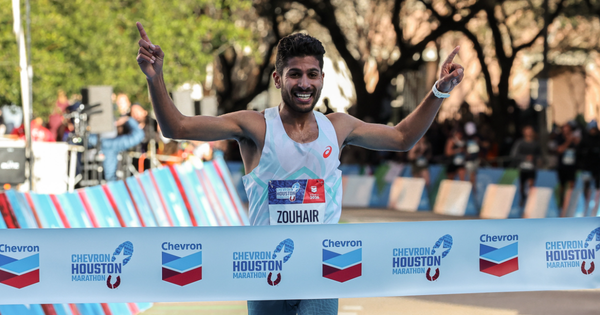
He became a citizen. He won the Houston Marathon for the second time in January 2026, this time as a US citizen, making him the first American to win that race since 2003. He ran 59:41 at the New York Half in March, mid-fasting for Ramadan.
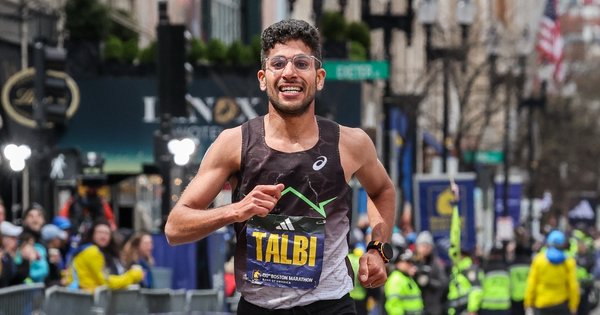
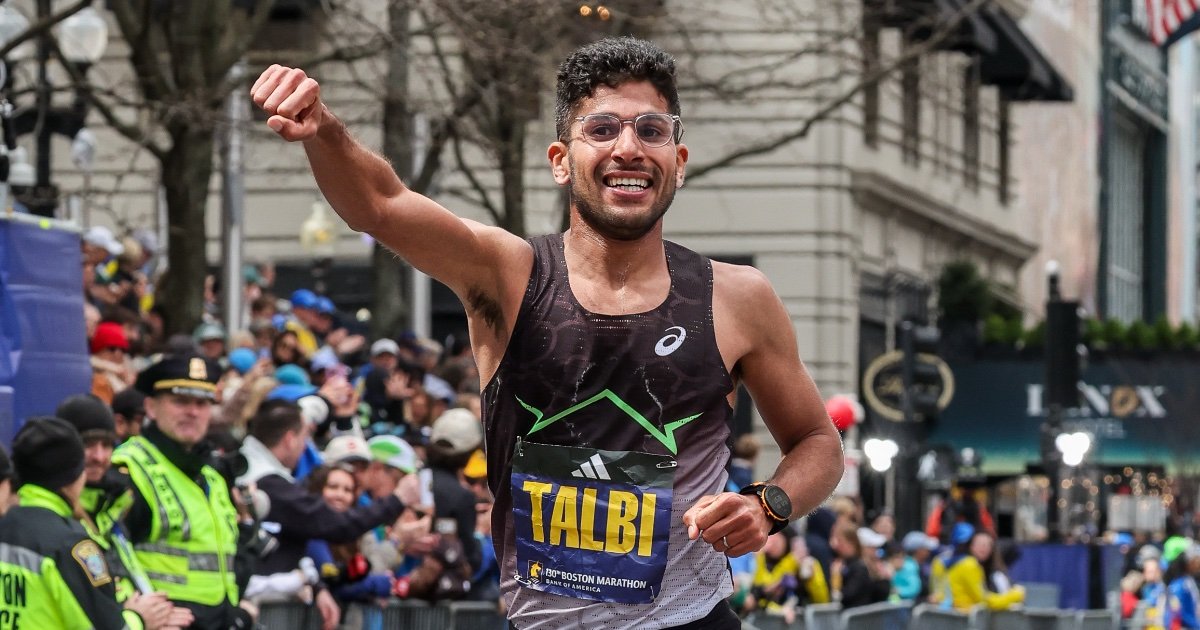
At 39k in Boston on Monday, Zouhair was exhausted and looking at fourth place just ahead. He had followed surges for 23 miles before letting the front go. Now the question was what he had left.
He locked onto the runner ahead.
“Maybe at 40k, maybe 41k, maybe the last stretch.”
The idea turned over with each step. He entered Hereford and the road tightened. The noise began to build, not from a single direction but from everywhere at once. Left onto Boylston. The tailwind continued to push against his back, as it had the whole way from Hopkinton. The street opened into the crowd and the distance collapsed. The runner ahead was no longer a place to get to, only something to measure against. The clock came into view. 2:02 clicked over to 2:03, a time beyond his own expectations.
“God, a lot of things are gonna change.”
That thought, the noise, the clock, and the effort became tangled. He kept running inside all of it.
He crossed in 2:03:45: the fastest time ever run by an American at the Boston Marathon, breaking Ryan Hall's mark from 2011 by over a minute. The time won't count as an official record. Boston's point-to-point course disqualifies it.
Zouhair’s transfer of national allegiance clears in August 2027, three years after Paris, just in time for the fall marathon season and with time to spare before the Los Angeles Olympics. There are several fast, flat, and record eligible options: Chicago, Rotterdam, or maybe Paris. Conner Mantz ran 2:04:43 in Chicago in October 2025 to set the current American record. Zouhair ran 2:03:45 six months later on a Monday morning in Boston. The record is not a question of fitness. It is a question of the calendar. He will be 32 years old.
Tighassaline at 13 and Boylston at 31. The numbers flipped. The boy who started his first race in mismatched soccer gear and used shoes crossed Monday's finish line with tiger stripes on the sides of each shoe and a matching “A” over his heart. A few steps past the finish line, the “A” was no longer visible, now covered by a baby boy. Zouhair was holding Amir in the roar of a city he chose, again and again, when the choosing was hard.
“It's just that feeling, like, we did it. He's too young to know. I think my wife was very proud of me, and the first thing I did was just kiss him and hug him, and it was a great feeling."
Keep up with all things track and field by following us across Instagram, X, Threads, and YouTube. Catch the latest episodes of the CITIUS MAG Podcast on Spotify and Apple Podcasts. For more, subscribe to The Lap Count and CITIUS MAG Newsletter for the top running news delivered straight to your inbox.
Fasil Bizuneh
Fasil Bizuneh is a former US 10 Mile champion and alumnus of Coach Scott Simmons’s program. He knows the 25-by-400 workout the same way Zouhair does, from the track, not from the stands. He writes about inheritance, lineage, and peak performance from the Kohala Coast of Hawaiʻi Island.