By Chris Chavez
March 28, 2026
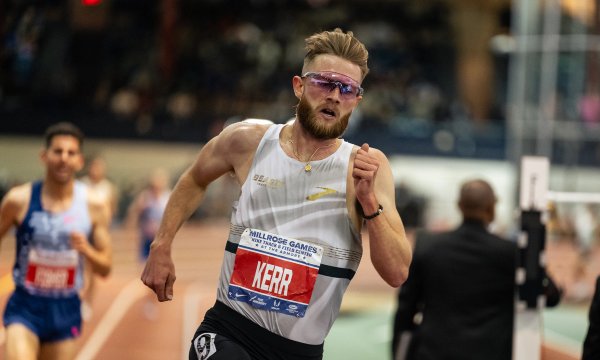
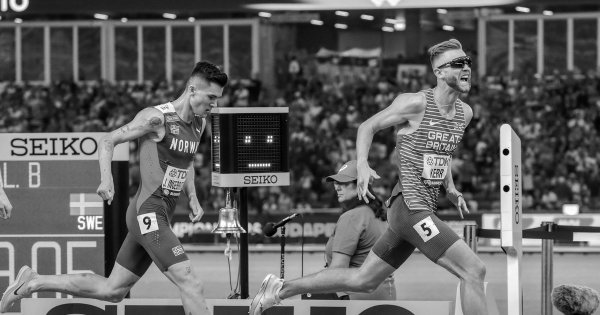
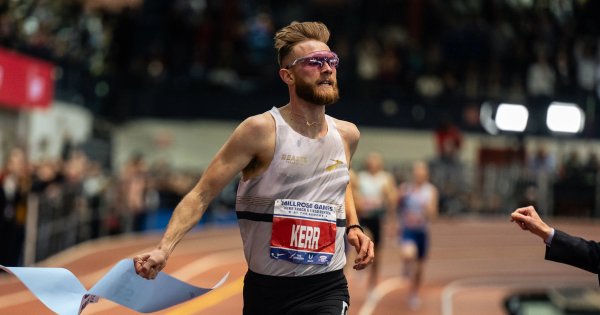
World champion Josh Kerr will attempt to break the mile world record of 3:43.13, set by Hicham El Guerrouj in 1999, at the London Diamond League on July 18, 2026. Kerr and his longtime sponsor Brooks are calling their shot publicly, dubbing the attempt "Project 222"—a reference to his goal of running the mile in 222 seconds (3:42).
Kerr’s current PB, 3:45.34, is the British national record and slots him No. 6 on the all-time list. Entering the outdoor season, he’s coming off of winning his second World Indoor Championships gold medal in the 3000m, having held off a late charge from 1500m Olympic champion and 5000m World champion Cole Hocker in Toruń, Poland.
Brooks is going all-in for Kerr, with fully personalized race-day support, including:
– A custom spike—expected to comply with all World Athletics guidelines—built around Kerr's biomechanics, featuring advanced cushioning and a tuned carbon plate system
– Three aerodynamic speed suit concepts with Kerr as the sole tester
– Physiological support from the Brooks Run Research Lab covering sleep, hydration, and recovery
Behind-the-scenes content on Kerr's preparation and the history of the mile will roll out on Kerr’s and Brooks's channels ahead of the July 18 attempt.


Josh Kerr | Photo by Carolyn Draayer
CITIUS MAG spoke with Kerr on the world record attempt and his takeaways from the indoor season. The following transcript has been edited lightly for clarity.
CITIUS MAG: After adding another global medal to the collection, how does this one feel different from all the rest?
Josh Kerr: It feels really different. In 2023 and 2024, I was on a bit of a roll and almost didn't take it for granted, but I wasn't really thinking these moments wouldn't keep coming around. I felt like I had an idea of what I was doing and that I was good at racing, so I just let them stack up. Then I went on a bit of a two-year dry streak. So yeah, just taking time to enjoy it and reflect a little bit. It's taken me 28 years to get a little bit mature, but we're getting there.
CITIUS MAG: What's the most important part about an indoor season like the one you put together, in terms of setting yourself up for a solid outdoor season?
Josh Kerr: What I learned from the late track season last year and through Japan is that if I'm healthy, have a good training camp going in, and can stay resilient, then I'm going to be tough to deal with.
There were options to race more this indoor season: I was supposed to race the British Champs, and I was also going to try and run something faster than the mile. But when both of those opportunities came around, we were more cautious than usual because the main thing's the main thing. World Indoors was the priority. Millrose was the priority. That's just what we focused on.
People sometimes criticize me for not racing as often as some of the other guys, and I understand that. But I've been making these teams since 2017. I don't have the young, spry energy of the—I don't know what they are now—twelve-year-olds running mile world records. It's just the way my career is going to be run at this point. When I'm ready to race, I'll race. I'm not trying to avoid it. The question is: Is my body capable and ready to go? When it is, I love to get out there. I do think this summer is going to be full of that—and if it isn't, it's probably because I'm not ready.
CITIUS MAG: You and Danny [Mackey] seem to have the blueprint at this point—here's the plan, follow it, peak at championships. But somehow every single time it's not exactly the same plan. How are you going about structuring 2026?
Josh Kerr: That's a really good point, because what Danny has done really well over the past eight years or so is just adapt to my big ideas. I'll sit down with him and Julian at the start of the season, spew out all these ideas, and his job is to figure out what's actually possible from them. That's the definition of a great coach—knowing how to get their athlete ready for when it matters most.
I'm a major championship guy. I love the World Championships and the Olympic Games. Everyone does, but I just don't put as much weight on the regular season as some others might. For Danny, the training this year has been so dialed. We're trying some new stuff—a new training setup—so we have a deep bag going into the next few years and can figure out what works best. Whether the season extends through September, there's a World Indoors and an Olympics, or we need to be ready to go once a month—we've navigated all of that over the last eight years. That's the sign of a good coach, and a confident one. He's doing a great job.
CITIUS MAG: We're chatting on the heels of the Project 222 announcement—a mile world record pursuit. You're someone who's not afraid to put it out there. You've jumped on this podcast before Millrose and Pre-Classic in the past to talk about your big ambitions. But this one's a little different because it's the mile world record, which has stood since 1999. Why now, and how did this come about?
Josh Kerr: This is different from anything, really.
Why now? Because I'm ready. We now have the systems in place. I believe I've been in shape to run this world record a couple of times already.
And why talk about it? This is one of the most important track world records and the oldest [outdoor track-specific record]. To give it the respect it deserves, you need to come out and say it. This is not a record that should be stolen in the night. It should have a full season built around it. I'm not going to be shy about my goals. I'm not afraid to fail, and I have incredible people backing me. Project 222 seconds, which works out to a 3:42 mile. We'll be going after it at the London Diamond League on July 18th. We needed a date. We needed the biggest and best venue in the Diamond League circuit and it needed to be at home. All of those factors together made this happen. A lot of work has already gone into it, and now we're finally talking about it.
CITIUS MAG: Why do you think the record has stood for so long?
Josh Kerr: We're in this middle distance era with some of the most exciting racing the sport has ever seen—I think some of the best middle distance runners will be remembered for generations. But I just think the mile world record is one of the most difficult to go after. The 1500 and mile records together just weren't touched for so long. A couple of years after I was born, that's when it was set. When a record can stand 27 years, sometimes it takes an athlete to come out and say they're willing to go after it before it even gets remotely challenged. I believe I can be that athlete—go after it, hopefully get it—and then you never know what comes after that.
CITIUS MAG: I think back to a couple of years ago when Jakob was asked about the 1500m world record at a Diamond League meet, and it sounded like there wasn't quite as much admiration for the circumstances under which that record was set. Does any of that complicate how you feel about chasing it? There's a certain cloudiness around records from the '80s and '90s—throws records, some of the Chinese times that Faith has openly talked about chasing. Where do you land on the mile and 1500?
Josh Kerr: It's a shaky place to be, honestly. But it's not my job to ask those questions. My job is to see what's humanly possible within the limitations of the sport and that's why I want to be as transparent as I can be through the training process. I believe I'm the best 1500-meter runner in the world. If I give my absolute best, revolve a season around this, do everything I can, and still can't break it—then that's the closest I can get. I'm not afraid to go after something that someone else might have done wrong. I know I'm not doing anything wrong.
In 2026, we have better shoe technology, better aerodynamics in uniforms, better tracks, better crowds. I'm relying on Brooks, relying on my team to give me that extra push. I do think 3:43.13 is very much within my ability. Given the times this era is running in the 1500, we're going to have a crack at it. Regardless of what was happening in the '90s—that has no relevance to me. I think it's humanly possible, so I'm going after it.

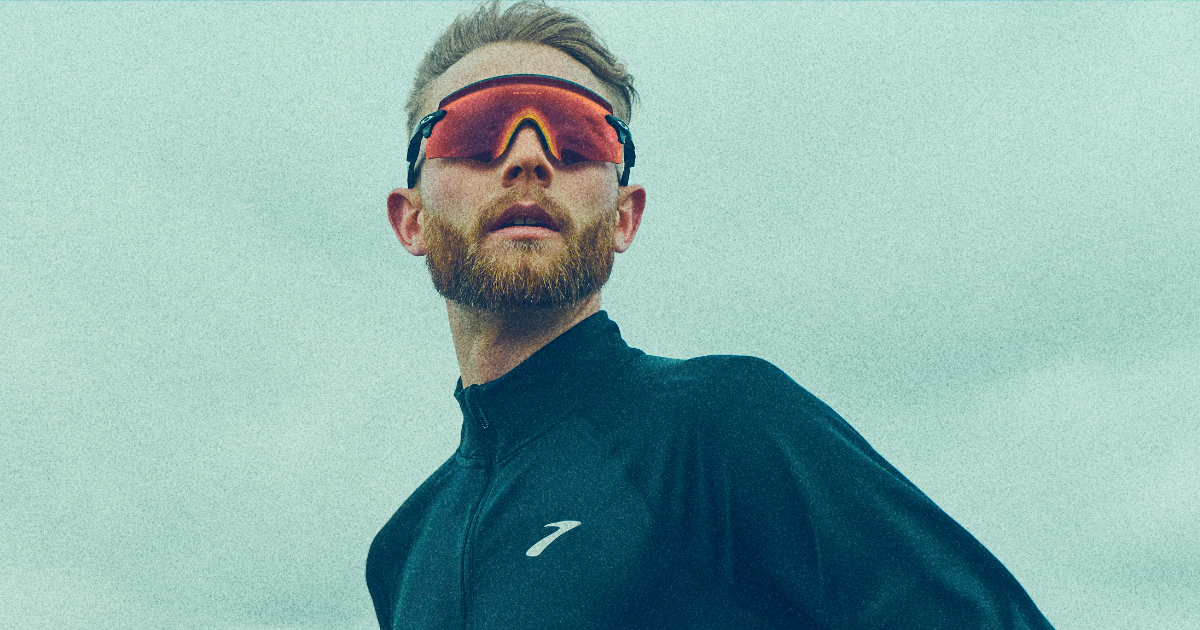
Josh Kerr | Photo by Carolyn Draayer
CITIUS MAG: You brought up shoe technology as a big factor. What advances have you seen from when you first signed with Brooks to what's on your feet now…and what could potentially be on your feet in London? How has it all changed?
Josh Kerr: When I presented this to Brooks—about five months ago now—that was a big part of the conversation. I needed investment from them. They've done an amazing job over the seven or eight years I've been part of the company, pushing on performance product and really investing in it. The difference from 2018 to now is incredible. I know they have the infrastructure to build something special for me.
To be transparent: we will have a one-off, mile-world-record-specific spike. It's not built for 800 to 3K or 3K to 5K—it's built for three minutes and 42 seconds. It's built for 222 seconds. It's my world record spike, a one-off built for this race, and it will be fully within World Athletics guidelines. This is not going to be an attempt that operates outside the standards of the sport. Between the spike and the uniform, we're working on some really special stuff. We're very close with one more round of testing next month or so, and then it'll be ready to go. I feel really confident. If it gets me an extra tenth of a second, that's enough. But I think it's going to give me more than that.
CITIUS MAG: What makes for a good mile spike specifically?
Josh Kerr: It's really interesting. The team at Brooks has been so fired up about this. We've been collaborating with the spike team for ages, so I know them incredibly well. I have a specific foot strike, a specific force profile, and I move around in spikes differently than anyone else. Every athlete has their own footprint in how they use a spike. This spike isn't built for anyone but me. Plates, running on different track surfaces, around the bends, on the straights, at a specific speed—around a 55-second split. Those are the conditions we've been working on.
And then there's the specifics of what we'll be dealing with in London. It's been a really technical exercise, very specific to my foot strike. The shoe is essentially 3D printed from my specific foot. Where I'm putting force, they're adding extra padding. The responsiveness is tuned to the power-to-weight ratio required at that speed. There's no unnecessary weight. It might look a little unusual in some areas, but a lot of work is going into it. We have a couple more tweaks from this last round of testing and then it's good to go.
CITIUS MAG: You've been a speed suit guy for a while. This attempt will have a custom speed suit too. How sleek are we going or how tight fitting? what's needed from the aerodynamics side?
Josh Kerr: I wish I could show you. We haven't got the colorways finalized yet, but it's less about what's different from a regular speed suit and more about what's similar. It's kind of wild. We're asking questions that I'm sure the London Diamond League organizers are confused by. But it's been really fun. We're in a great part of the process. We have three prototype options, and we're going to build a Frankenstein model from those three. Brooks and the apparel team are doing a great job with some really exciting ideas. You never quite know what weather you'll get in London.
CITIUS MAG: Are those three prototypes varied by weather conditions?
Josh Kerr: Exactly. We'll have different weather uniforms. We'll have one or two options depending on conditions. The challenge is we need to make decisions in April for a July race, so we won't have an exact forecast but we'll have a rough read and plan for both a warmer weather option and a cooler one. Everything comes down to aerodynamics. That's number one.
CITIUS MAG: Thinking back to Breaking2 in Monza with Kipchoge, one thing that came out of it was that the lack of a crowd was a limiting factor. Thinking about the London Diamond League with 60,000 fans and even Paris where you said you went almost deaf mid-race—how much does crowd energy factor into choosing London for this?
Josh Kerr: It's massive. Number one was that I wanted to do it in the UK. Hopefully, this is a huge cultural moment for younger athletes, club runners, and people coming through the systems I was working through as a kid. My goal is to give back to that community as much as possible. That was priority one. And then it was like—if we can get this done at the London Diamond League, that's just so special. I've raced there as much as I can throughout my career, and I think it's one of the most incredible atmospheres outside of major championships you can find anywhere.
Danny was more focused on weather and controlling the race conditions, and I just said: This record was set and raised through normal, regular season racing. That's the respect it deserves—going after it in a regular race with regular competitors. I'm just going to be peaking at that point in the season. As long as no one else can touch the pace lights or mess with the pacers, I'm good to go.
CITIUS MAG: Your fastest performances have come with the best competition in the world with Pre Classic mile, the Paris Olympics. Will the London Diamond League have most of the control over who is in this race? And are you open to the likes of Cole Hocker, Yared Nuguse, or Jakob Ingebrigtsen being part of it? We've seen your best moments come when those guys are pushing you.
Josh Kerr: This is going to be my attempt. If they want to jump in, that's their call. I'm sure Pre Classic will have its own things going on since it's a Nike race. But at the end of the day, it's a race. As long as we don't have 25 guys on the start line and more falling problems than running problems, I'm good to go. It's an open race.
CITIUS MAG: If someone runs faster at Pre before London, does the title of this project have to change?
Josh Kerr: No. For me, it's important to have that goal, to have that number to look at every single day. It's a question that comes up all the time—"what about this, what about that?" Look, this is a 27-year-old world record. We're not worried about it getting broken two weeks before. That's not a concern. I'm going after the world record, and whatever that number is on that day is going to be a time I believe I can run faster than.
CITIUS MAG: Yared already learned the hard way that even world records may not last all that long.
Josh Kerr: Hey, if you're the first athlete to kick the door off the hinges and other guys run right past you, that's fine.
CITIUS MAG: What's different about the training that has to go into this versus being in 3:27 shape for the Olympics?
Josh Kerr: It doesn't complicate it, because I'm not putting as much weight on World Ultimate Championships at this stage. We'll get there when we get there. This is my goal for the season from a regular racing standpoint. We'll have the Commonwealth Games, Europeans, and other things afterwards. But this is the peak. This is when I need to be in the best time-specific shape of the season, and that's how we're going to structure everything.
CITIUS MAG: This is super exciting, Josh. Training already seems well underway and it's going to be very entertaining for fans. What do you hope people get out of the next couple of months?
Josh Kerr: I want the mile to be as exciting a distance as it's been throughout the world history of running. We're in an era where there are multiple guys at the top of their game, and I'm not here to run in a boring event. I'm not here to have a one-dimensional season. I'm here to have tough races against great competitors and come out and talk about my goals—because here's the thing: if I go out and run 3:42 and break the world record, that's great, but I need to show the process for it to have any real effect on the sport today. You have to show what you're doing and why you're doing it.
For me, the reason is simple—I feel ready. This project is exciting. It tests my limits. Of course, it scares me a little bit. It would be much easier not to have this conversation and just quietly try to be in the best shape I can by July. But that's not who I am, and it's not what the sport deserves.
This sport is built around big moments, and I believe we can create one of those in July. This is one of the hardest world records in track and field. I'm not scared to say I'm going after it. I can't guarantee I'll get it, but I'm going to do everything in my power. I have a great team around me, an amazing coaching staff, and I think we're going to get damn close—if we don't get it outright.

Chris Chavez
Chris Chavez launched CITIUS MAG in 2016 as a passion project while working full-time for Sports Illustrated. He covered the 2016 Olympics in Rio de Janeiro and grew his humble blog into a multi-pronged media company. He completed all six World Marathon Majors and on Feb. 15th, 2025 finally broke five minutes for the mile.