By David Melly
February 25, 2026
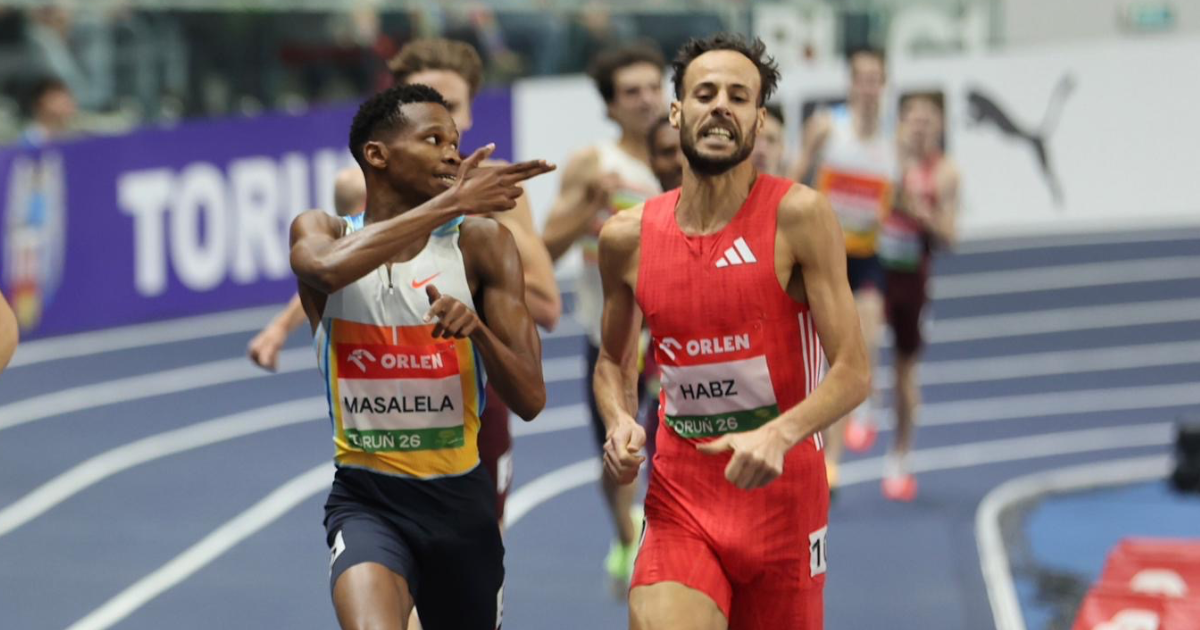
The most talked-about performance in track and field last weekend didn’t show up anywhere in the results. That’s because Tshepiso Masalela’s 1500m run at the Orlen Copernicus Cup in Torun, Poland, ended in a DQ. The Motswana middle-distance star initially clocked a 3:32.55— just 0.01 seconds up on Frenchman Azeddine Habz—but Masalela ended up on the wrong side of a referee whistle as he was ultimately disqualified for unsportsmanlike conduct.
As Masalela came down the homestretch and pulled just ahead of Habz, he pointed to his competitor’s head with a “finger-gun” motion as he crossed the line. First off, it was a pretty ballsy move. Masalela was barely half a step ahead of Habz, and the Frenchman came back at him in the final strides. But (over)confidence aside, the meet officials ruled that Masalela’s behavior was a violation of World Athletics Technical Rule 7.1, which prohibits “unsporting or improper conduct.” The rules don’t further define DQ-worthy conduct, which of course leaves things up to the subjective interpretation of each individual official.
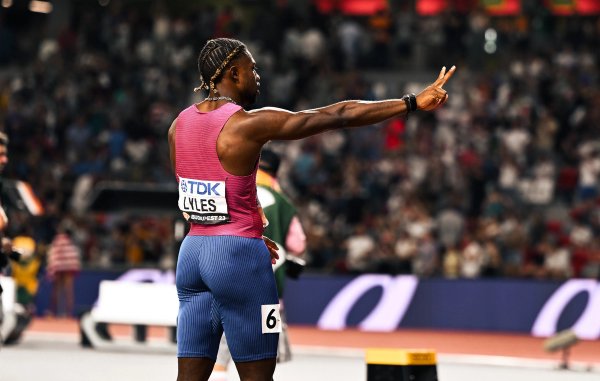
The baked-in vagueness can also lead to inconsistent application of rules, and Masalela’s defenders were quick to point out similar celebrations from stars like Noah Lyles and Mondo Duplantis. It seems that the meet officiating crew in Poland has taken a similar stance to NCAA basketball referees: a celebration that intimates that you’re shooting your competition is a big no-no. Should Lyles or Mondo have gotten DQed? Did they not get the boot because they’re bigger names, or because they were at meets being officiated differently? There’s no way to know for sure.
The complaint that referees don’t always interpret the rules consistently across time and space is as old and as real as sport itself, but it’s a necessary evil we’ll live with as long as we have humans arbitrating athletic disputes. (Unrelated: who’s excited for the debut of the automated strike zone in a few months?!)
So we’re left with two main issues: Did Masalela’s behavior violate TR 7.1 as it’s currently written? And is that rule a just one? Neither has an easy answer, but this newsletter isn’t afraid to tackle the tough questions. Our current thinking: No, and no. And here’s why.
Masalela’s celebration was cocky, and perhaps even douchey. If you’re a coach or a parent, you might not be thrilled to see your athlete or child act that way. But also… it wasn’t a genuine threat of violence by any reasonable interpretation, and it didn’t exceed the scope of race-winning celebrations we’ve come to expect from star athletes. Is the finger-gun any worse than Cole Hocker’s Steph Curry-indebted “bedtime” celebration? Or his competition-shushing? We don’t think so. If you earn the title of “winner” fair and square, go ahead and have your little moment. And the fans love a good finish line show, momentarily rescuing track and field from any allegations of being too boring or bookish.
The rule is also an unfair one. At the very basic level, it’s so broad that it basically provides zero guidance to athletes for how they should (or should not) act. If the goal is for World Athletics to prevent behavior the governing body believes crosses a line, the best way is to spell out exactly what is verboten so clearly that no athlete dares attempting any such antics in the first place. If the rulebooks proactively stated that dogs couldn’t play basketball, the Air Bud Cinematic Universe would never have made it to screen.
There’s also a more philosophical argument against a broad interpretation of TR 7.1. World Athletics may be an international entity, but we here at the Lap Count are big believers in the First Amendment to the U.S. Constitution. Freedom of expression is a value that should extend to the sporting arena, protecting powerful political statements and authentic displays of emotion, alongside yes, silly or obnoxious celebrations. Meet officials should be able to put a stop to truly reprehensible behavior, like actual acts of violence or hate speech, but again, these violations should be clearly and specifically spelled out—particularly in a sport with so much international diversity and, with it, a wide range of cultural norms. And hopefully, a clear and plainly-stated policy would act as a deterrent from any of that awfulness making it onto the oval.
Ultimately, the arbiters of poor taste shouldn’t be the officials; it should be the fans. You want to showboat and taunt your rivals after a win? Go for it, but prepare for the boos to follow. Professional track and field is ultimately an entertainment product, and a key part of captivating storylines are for heroes to face villains, for fans to feel passionately about the people they’re watching on screen. Feeling like the wrong guy won this race makes you want to tune in to the next one to watch him lose. And here’s the dirty little secret: the biggest villains of any sport, from the Yankees to the Patriots to Jake Paul, do pretty darn well in the ratings.
Masalela deserved his national record and any criticism that may have followed. That’s part of sports. If the popular consensus is that his behavior was so unsporting as to make him universally reviled, others won’t exactly jump at the opportunity to follow his lead. And if the viewers feel like he has cool, rebellious bad boy vibes now, that’s just fine too. Even better if it’s both.

David Melly
Since David began contributing to CITIUS in 2018, he's done a little bit of everything, from podcast hosting to newsletter writing to race commentary. Currently, he coordinates the social media team and manages both the CITIUS MAG newsletter and The Lap Count, supplying hot takes and thoughtful analysis in both short- and long-form. Based on Boston, David breaks up his excessive screen time by training for marathons, crewing trail races, baking sweet desserts, and mixing strong cocktails.