By Keenan Baker
February 11, 2026
“Det finns inget dåligt väder, bara dåliga kläder.”
The above, Sweden’s most popular idiom, roughly translates to “There’s no such thing as bad weather, only bad clothing.” For the Swedes, it often serves a literal purpose. The Nordic country is not always the winter wonderland full of the northern lights and draped in snow that people first picture, with weather that can be oppressively cold, and dark.
For parents and teachers, it’s justification for sending children out in the frigid, dark winters. Turns out, being told to play outside is international, regardless of the temperature.
In popular culture, “det finns inget dåligt väder, bara dåliga kläder” is used by everyone: from the Swedish Prime Minister Ulf Kristersson, welcoming (and perhaps warning) French President Emmanuel Macron to the country, to Sally Rooney quoting it in her smash hit, coming-of-age romance novel Normal People.
No bad weather, only bad clothes.
That’s the literal application. It’s also used to mean: no bad situations, only poor preparation.
Nobody lives this phrase better than current UNC-Chapel Hill Tarheel, Vera Sjöberg.
Her journey from junior Swedish tracks to World Championships is a testament to the power of mental and physical preparedness, and how track and field success is often a marathon, not a sprint.
_____________________
Vera Sjöberg did not want to be a runner.
“She wanted to come along (running),” remembers Vera’s father, Stefan Sjöberg. “And it was really after one block she was like, ‘I really hate running, this is like, the worst thing.’”
That didn’t dissuade her from taking place in a nationwide cross country competition that same year.
“I remember us being very shocked because you're standing there and you wait for your kid, and it's not like winning is important, you’re just enjoying the ride and the event,” said Vera’s mother, Annica Carllson. “And then I remember just seeing her running like crazy coming from the forest. We were so surprised!”
Her parents remember a top-10 place, and her immediate distaste for such competitions. It was a bit confusing for them. Sjöberg’s speed was of such renown that, at five years old, the boys in her class debated whether she was faster than a sports car recently observed (they determined she would be the fastest). But track and field was not her focus, yet.
“She really enjoyed playing in the woods outside a lot, with her friends from school,” said Stefan. “She was a big Harry Potterhead.”
Life in the suburbs of Stockholm meant playing with friends in the forest, spending as much time outside as possible. Re-enacting Harry Potter or The Hunger Games or some kind of fairy tale, but always moving. As Vera continued to grow into her love for the outdoors, she started horse riding.
“Horse riding is quite a subtle sport, and you have to get the technical instructions [in your mind] that you have to transform into very small movements to make a horse do things that you want the horse to do.” said Carlsson. “It's very simple, but she managed that very well, actually.”
“She's always been very good at physical stuff, and she's got a [strong] connection between intellect and physical ability.”
Horse riding morphed into basketball. Basketball stuck for a few years, but at around the age of 13, Sjöberg found herself on the track and field team.
“I was good at running, that was my strength (in basketball). And I had a lot of friends who did track and field, and we tried the different events in school, and I liked it a lot. But I guess I was a little hesitant to do it,” remembers Sjöberg. “But when all my friends did it, I just joined them at practice, and then I really liked it.”
First it was high jump, and then the 60 meter dash, then the 800 meters. It was a natural progression for Sjöberg, who preferred the variety that came with track and field. And it wasn’t long before she began to excel.

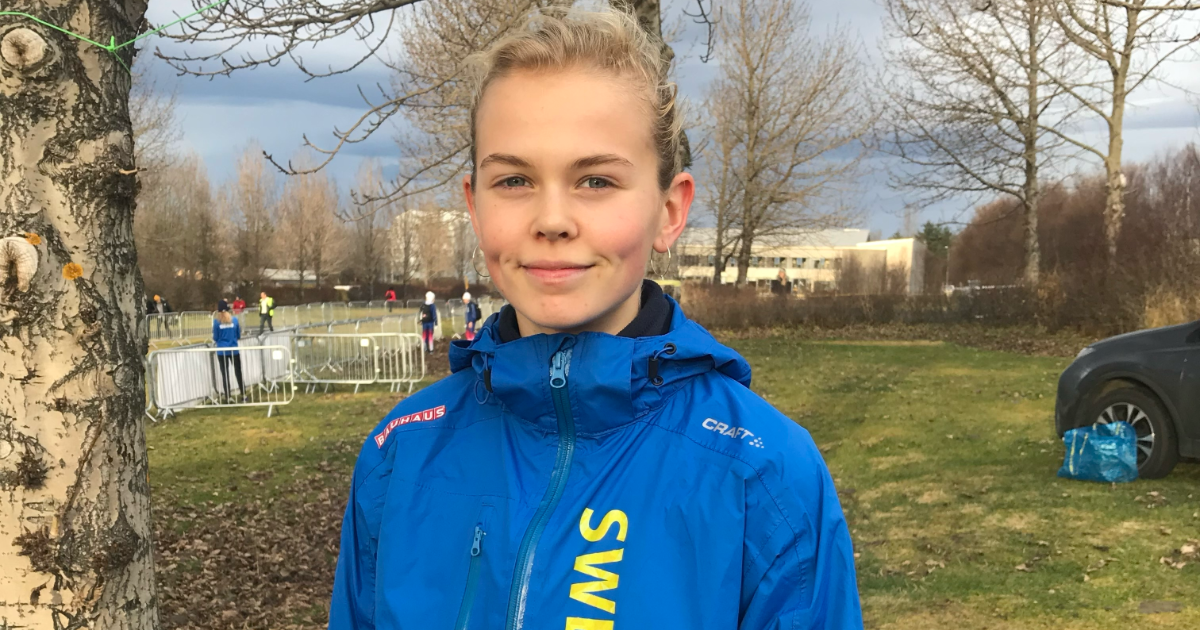
2017 (the first season with results on World Athletics) saw a then-15 year old Sjöberg run a 2:22.59 800m and a 5:06.69 1500m, indoors. In 2018, she ran a 4:37.55 to win the 1500m at the Swedish U18 Indoor Champs, also running a 2:14.84 800m. She debuted for the national team in 2018, competing for Sweden at the U20 Nordic Cross Country Championships, covering the 4.5km course in 17:47, for 10th place.
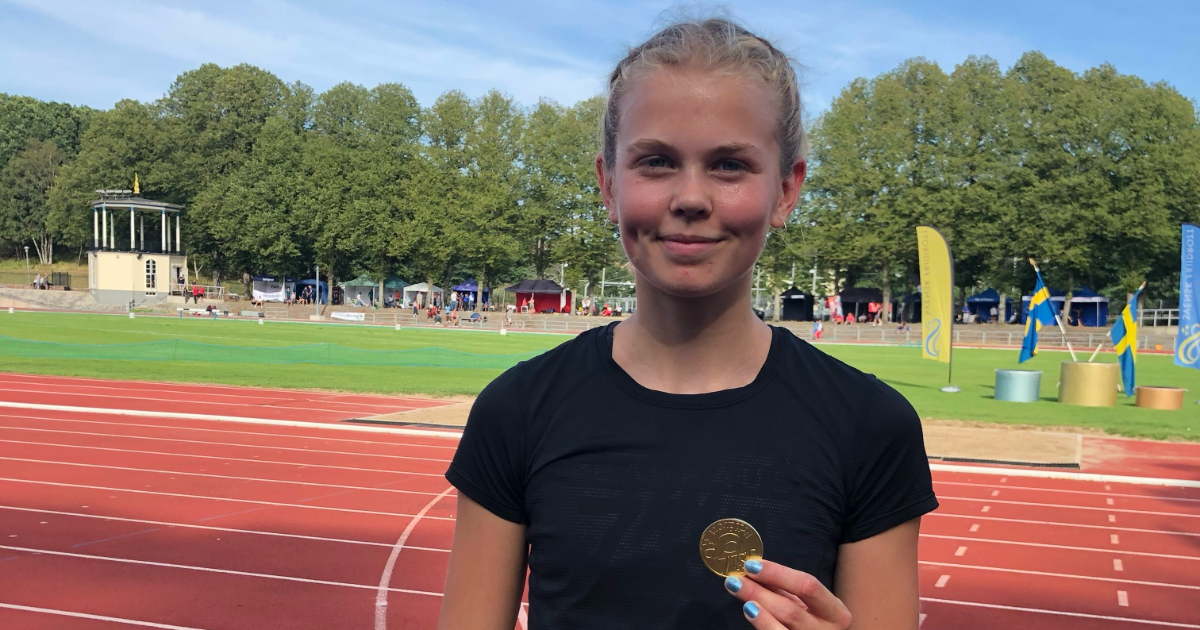
2019, the final year before Sjöberg came to America, was an explosion of PRs and podiums. By the end of the summer, she had a shiny new PR of 4:29.19 for the 1500m (ranked first in Sweden for the U20 age), 9:37.77 for the 3000m, and a national U20 Championship in the 3000m. It all culminated with a fifth place finish at the senior Swedish National Championships in the 1500m.
Vera Sjöberg was a star on the rise. It was time to go international.

In Sweden, to be a student and an athlete at school meant facing a crossroads: most universities don’t have athletics built into their programs, requiring teenagers to choose between school or sport. This leads people like Sjöberg to either put either their athletic or academic dreams on pause, or go abroad for school.
For Sjöberg, the choice was clear.
“I wanted an adventure,” said Sjöberg. “I wanted to do something completely new, and I wanted to challenge myself too, because even if I didn't like it, it would still be a great learning opportunity just to see a new culture and speak a different language and everything.”
To Stefan and Annica, the move made complete sense. Even as Vera made the transition stateside and faced over a year of injuries and sicknesses, there was no question that she’d continue to give it her best shot.
“With Vera, she is up for adventures, and to go to Boston was a big adventure,” said Carlsson. “And we said to her, ‘Okay, you’re running is not what you want it to be, but go to Boston and see what happens. You can stay for a year, you can come back home, you can do whatever you like after that, but just try it for a year.”
_____________________
Boston University is one of 36 institutions within the city limits of Boston, but it’s the only school that can possibly say they have the fastest indoor track in the world. And the fastest middle distance runner in Patriot League history.
If there’s a middle distance track and field event that Boston University keeps records for, chances are Vera Sjöberg’s name is at the top of the list. 1000m, 1500m, 1 mile, 3000m indoor records: all Sjöberg. Outdoor records? Give a guess to who’s at the top of the 1500m, 5000m, and 4x800m lists.
“Vera has always been super talented, but we thought she was having a breakout year two years ago (in 2023),” said Abby Waddington, a current Boston University track athlete (and contributor to the Stride Report). “Then she had this massive, massive breakout year last year.”
In 2023, Sjöberg won first in the mile, 3000m, and 5000m at the Patriot League Indoor Championships, after finishing 26th at the NCAA Northeast Cross Country Regionals. Year-over-year improvements were common with Sjöberg, but a triple win? For a middle distance athlete? If anyone could see it coming, it would be Waddington.
She was a freshman to Sjöberg’s junior, and as a fellow high-mileage runner, formed a bond with the reserved Swede. Their shared time gave Waddington a bird’s eye view as to how Sjöberg became the world championship competitor she is today.
“Vera would always like to say I was her podcast on a run, because I would just talk at her,” laughed Waddington. “But we do have a lot in common, because we were the only two English majors on the team. So that was nice.”
Waddington watched as Sjöberg finished seventh at the NCAA Northeast Region and 42nd at the NCAA Cross Country national championships in 2024. And, just in case she needed a reminder, Waddington watched Sjöberg win triple gold at the Patriot League Indoor Championships for the second consecutive year (once again, mile, 3000m, and 5000m). Business as usual for Vera, so it seemed.
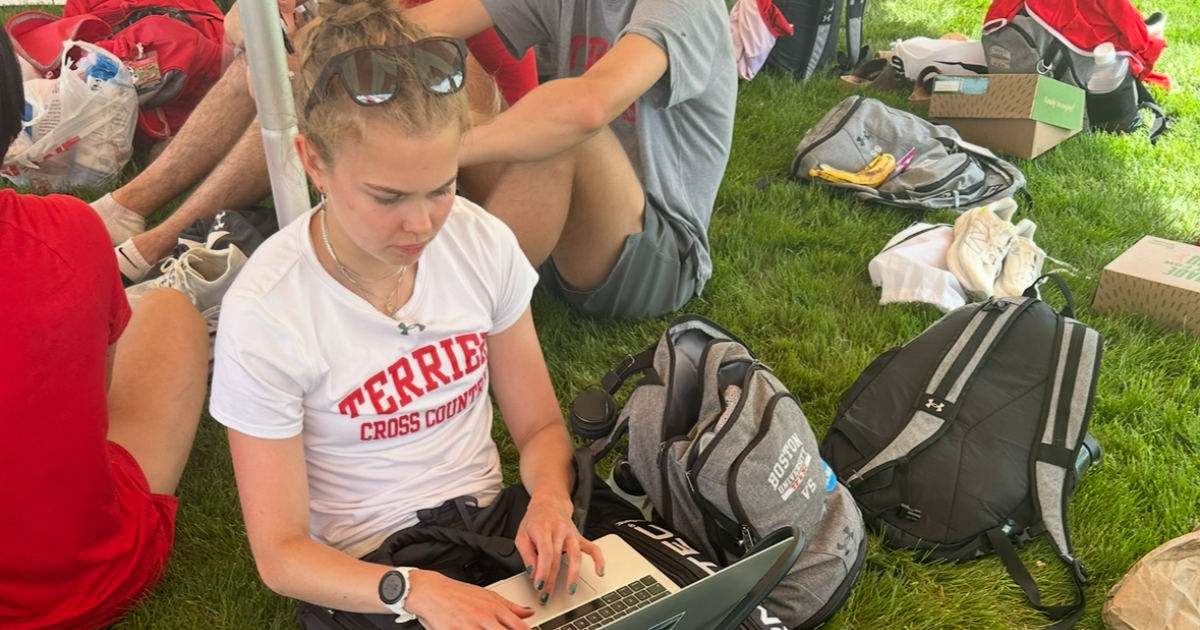
“In between races at conference, she was in the recovery boots writing an essay,” said Waddington. “Then she would take them off, warm up, go win a race, then come back, and just start writing her essay again. It was crazy.”

Track and field glory is not attained in a single moment.
These races, seconds to minutes at a time, are the results of years of preparation—for the mind, and the body. It takes deliberation, intentionality, sacrifice, and prioritization. There’s a balance that must be maintained. Nobody can be all go, all the time, but they must perfect their craft. You can’t half-ass greatness.
Mountains of intentional moments mold athletes into stars: Vera is no exception.
She won first place in the 1500m and the 5000m at the Patriot League Championships, then turned around and qualified for the NCAA Championships by running a 4:07.39 1500m and 15:27.51 5000m in the regionals. Both runs were massive outdoor PRs.
And yet, for all of the proof of progress on the track, it’s Sjöberg’s commitment to recovery and taking care of her body off the track that might’ve made the most impact.
“Outside of running, I think she just really values taking her time and doing things very carefully, and just not rushing herself and causing unnecessary stress,” said Waddington.
“She hates being rushed, and she always likes to talk about ‘living slow.’”
It’s hard not to think it’s the dedication to perfecting the hours spent off the track that makes her an inevitable track and field star. Recovery, from a holistic view, and everything with a balance. For Sjöberg, finding the balance is second nature.
“She's like, the queen of leisure,” said Maelyn Higgins, a current teammate of Sjöberg’s at UNC-Chapel Hill “She's just so soft and just so steady and just peaceful all the time.”
“She's like, ‘Well, I'll get there when I get there, and then I'll do what I do.’”
Vera’s commitment to intentionality makes it seem like she has an alter ego.

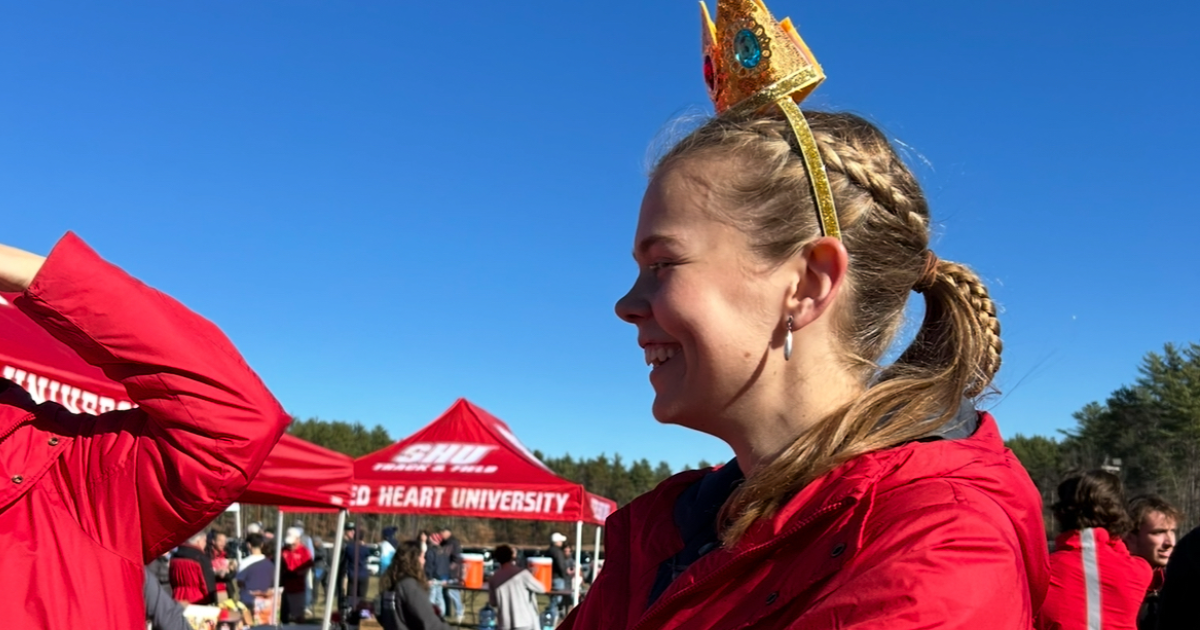
There’s one version of Sjöberg whose desire to maintain relaxation seems to be a direct affront to the idea of a schedule, showing up to planned hangouts thirty minutes late, prompting teammates to tell her meetings and practices are five to ten minutes before they actually begin. The same person who, according to Higgins, is “the absolute slowest biker you can imagine.” The same person who, according to Waddington, locks herself in a room at the slightest signs of sickness or injury (just to be careful). The same person who is described as the epitome of calm and inspiration by her teammates.
How is this person, this portrait of serenity, the same person who placed 11th in the 1500m at the 2025 NCAA championships and was steaming mad? Upset enough that her parents felt she may not show up for the 5000m, a race barely 90 minutes after her first. The same person who’s always been competitive, from cross country to playing cards.
“I hate losing,” said Sjöberg. “And then I need to, like, hide how happy I get when I win.”
For her parents, it’s simple. For Sjöberg, from horse riding to basketball, writing to running: nothing is without meaning. None of this is to imply the portrait of an obsessive, perfectionist athlete. Sjöberg is simply extremely in tune with her needs, in a way that parents, coaches, and teammates alike admire. Someone that listens to themselves, listens to others.
“Everything Vera does is like 100%,” said Stefan. “She never does anything 75% or 50%. It's always 100%, should be quality. Otherwise, she's very disappointed.”
And it’s not just her parents that notice this quality about Sjöberg, either. To excel at one area of life means something else has to be lacking, right? Waddington disagrees, having proofread Sjöberg’s work, deeming her to be an “incredible writer.”
“We always said, like, there had to be something wrong with her, because she just did everything too well,” laughed Waddington. “Like we had to find something she was bad at, and we still haven’t found it.”
This competitive balance is why, despite all of her frustration after the 1500m, Sjöberg doubled back. She rested, recovered, refueled, cooled down and subsequently warmed up—everything in place to be the best version of herself she could be.
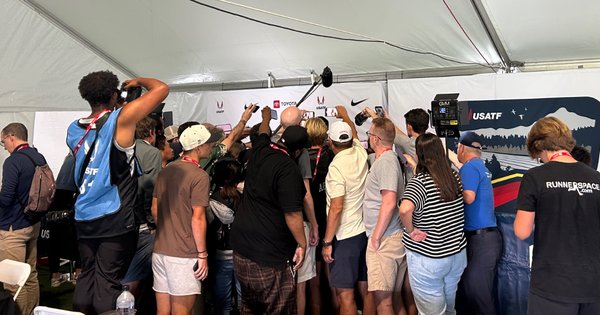
Walking through the mixed zone after her shocking second place in the 5000m, Sjöberg was all smiles. She was nowhere close to being the favorite in that race (she came in ranked 17th in the nation), especially after making the rapid turnaround, but that’s not how she felt. A slow opening pace played to Sjöberg’s strength, and the Swede dispelled all of the frustration and anger felt after the first race by blowing the doors off and running the fastest lap anyone ran in that race. The double she pulled off is described by UNC-Chapel Hill’s director of cross-country and track and field Chris Miltenberg as “one of the quietly most impressive things I've seen.”

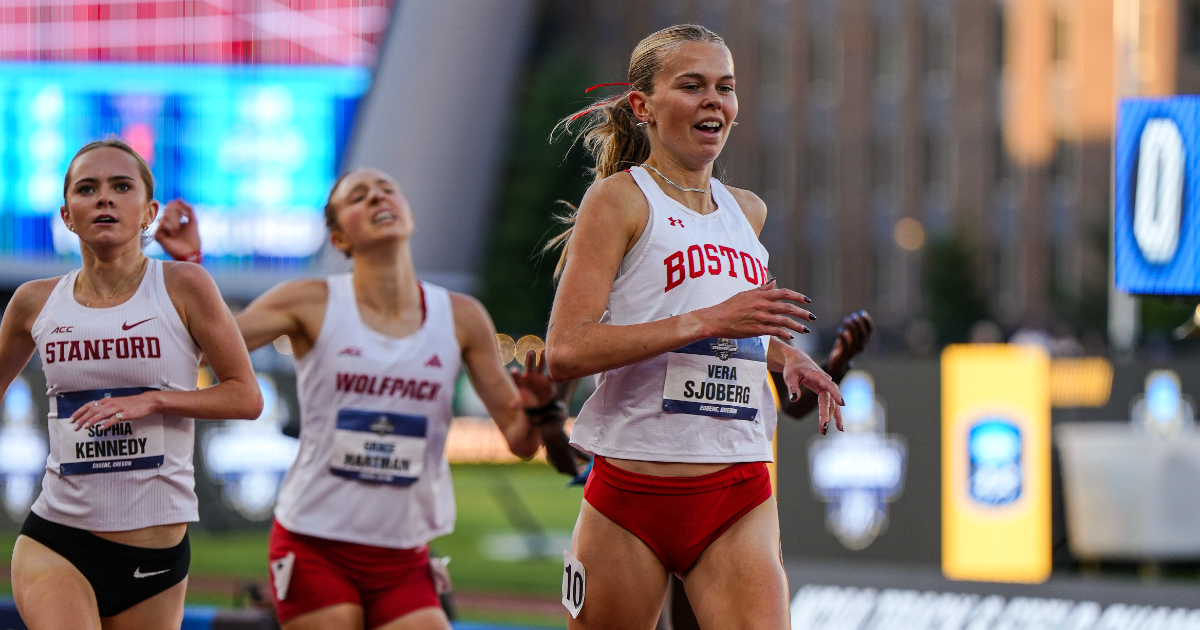
Photo by Audrey Allen / @audreyallen17
After NCAAs, Sjöberg had every right to rest. She’d raced all the way from cross country, to NCAA indoor championships, to World Indoor Championships in China just a week after the collegiate indoor season ended. Barely a month passed after World Indoors, and she was back to racing outdoors, preparing for her fateful double.
Vera graduated from BU as the best track athlete in school history, while maintaining a 3.97 GPA. She committed to UNC-Chapel Hill as a graduate student not long after NCAAs, around the same time she was building up for the World Outdoor Championships. Just over a week after the NCAA Outdoors Championships, Sjöberg raced a 1500m PR in London (4:07.31) that she later lowered to 4:05.09 at the Swedish National Championships.
Between NCAAs and Worlds, she raced nine times—winning two Swedish senior national titles in the 1500m and the 5000m. Sjöberg may not have survived the rounds at the World Championships, but qualifying alone was a win.
“I think it was very motivating to have been there, and now that I've been there, I feel like I've realized that the people I'm competing against, they're just people,” said Sjöberg. “It's so impressive, obviously, but I can also do what they're doing.”
_____________________
Coach Miltenberg is used to seeing his previous athletes compete on the world’s stage (Grant Fisher, Emily Infeld, Elise Cranny, and now Ethan Strand and Parker Wolfe). But, coaching an athlete for cross country after they raced World Championships? Miltenberg says this is a “one of one” situation.
“I wanted to make sure she took a really significant break. Vera is so freaking competitive that she was like, ‘I'm good, I'm good,’” said Miltenberg. “ So she took a good break after Tokyo. We took two weeks really easy, got back into things, and then she raced for the first time at Wisconsin, and I think she had done one workout at that point.”
She placed sixth at the aforementioned Nuttycombe Invite in Wisconsin, first runner through for Chapel Hill.
Two weeks later, sixth at ACC championships.
Two weeks after that, third at the Southeast Region Cross Country Championships.
And just one week later, Vera Sjöberg finished eighth at the NCAA Division 1 Cross Country Championships—almost exactly as planned.
“My main goal was for nationals, and that was to be top 10,” said Sjöberg. “So from that perspective, I did achieve those goals. I feel like there's always, maybe you would talk about, like “A” goal, “B” goal, and maybe I would have wanted to place a bit higher, but that was maybe, the “A” goal, like a perfect day, but I was still, super happy with being top 10.”
That run was the first time a women’s cross country runner at UNC Chapel Hill placed in the top-10 at an NCAA cross country championship since 2008. It wasn’t the placement in each cross country race that made a mark on her teammates and coaches—the way she carried herself in the process mattered just as much.
“She's just so relaxed, and I think that comes from true confidence,” said Higgins. “I think when people (are) trying to give off and be perceived that they're confident, it's just, tense, like ‘I'm so focused, this matters so much.’”
“And she's like, ‘I am focused, and this does matter a lot, and I know I'm going to do it.’”
At the regionals race, Sjöberg made a point to give Higgins a big ol’ hug on her warm-up, not long before it started. Waddington, having raced with Sjöberg countless times, remembers Vera the same way.
“The way that she was so light and energetic and calm right until we got the line, I think really, really helped the culture of the team,” said Waddington.
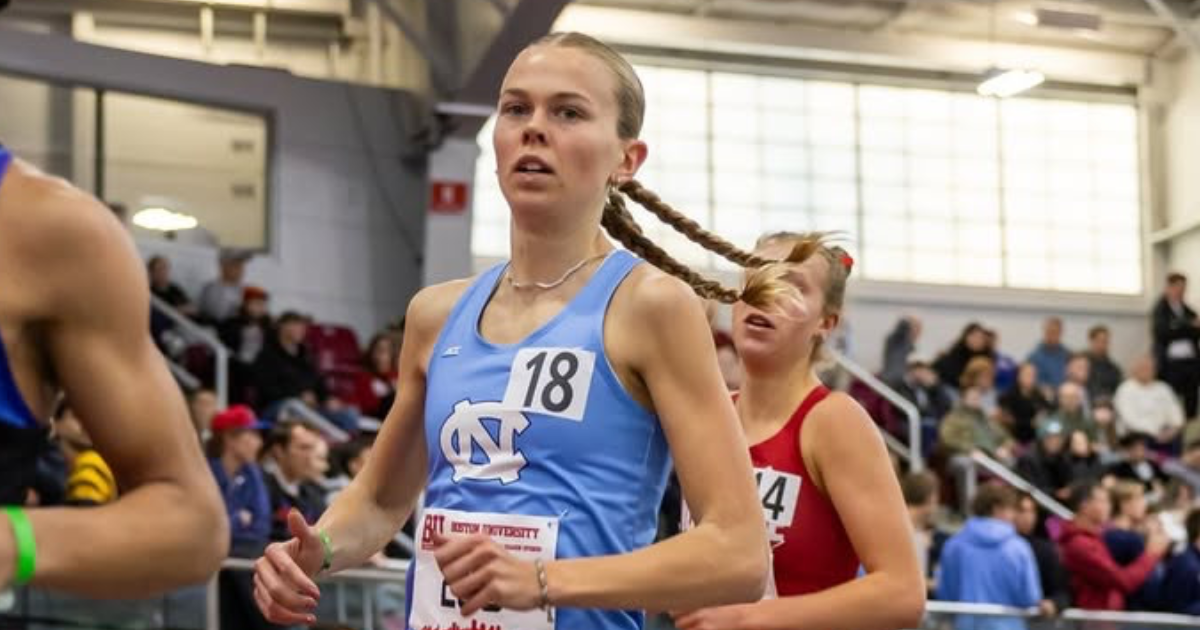
Two weeks after the cross-country season ended, Sjöberg raced one last time in 2025. It was the indoor track and field season opener, back at a familiar track: Boston University. This time, as she lined up for the 3000m, Sjöberg was in a different uniform, one with a larger target on the back. Can’t hide behind a top ten finish in NCAA XC, especially not after being a World Championship athlete.
That’s alright.
She’s there to race.
When watching Sjöberg race, it’s not immediately clear how much she wants to win. Her form, no matter the timing, is cool and calculated. First or last lap. Her face, calm. Posture, upright. A loping, bouncing stride.
The changing of the gears is imperceptible. She runs like a river flows. A placid inevitability, chilling and calming.
As the laps fly by, Sjöberg picks off runners, one by one.
Five laps to go, she’s in third, on the rail, in the lead pack.
Three laps to go, Angelina Napoleon of NC State tries to move past.
Sjöberg doesn’t budge, two World Championship competitors neck and neck.
One lap to go, Salma Elbadra of South Carolina makes a move, Sjöberg follows. Elbadra finished one spot ahead of Sjöberg in last year’s NCAA 1500m. She’d finish ahead again, with a time of 8:41.76. 5th in NCAA History. Sjöberg in second. Race over.
With an over 15-second PR in the 3000m, Sjöberg destroyed Shalane Flanagan’s 22-year-old UNC 3000m record to the tune of 8:43.06. That time makes her the eighth fastest in NCAA history, and less than a second away from the Swedish national record (8:42.246, Meraf Bahta). A historically fast second place is bittersweet. Said Sjöberg: “Well, you always want to win, but I'm so happy with how I competed (and the time, too).”
“She's super competitive. Yes, she PR’ed (at the BU Opener). But like, she wanted to win on Saturday,” said Miltenberg. “It reminds me of when Parker (Wolfe) ran 7:30 last year, and like, he was excited to a point, but he's like, ‘Man, I just got beaten. So I can take it, but I still don't want to lose.’”
“I think that was when you realize: 8:43 in December, great checkpoints. You have to want to win, you know? And you cannot coach that—you have to have that inner competitive drive all the great ones have, too. And she definitely has that.”
_____________________
What’s next for Vera Sjöberg? Where is the ceiling?
When asked of comparisons between Vera and other athletes he’s coached, Miltenberg puts her right in the upper echelon—“I’d say the two people that really stand out to me, that I do see such parallels with, would be Elise Cranny and Emily Infeld.” Or Ethan Strand, whose training was so similar to Sjöberg’s last year (his by Miltenberg, hers under BU coach Jon Molz), that Miltenberg deemed it “mind-blowing.”
This is in line with Sjöberg’s goals, who, like Milt, wants to plan for as many steps ahead as possible.
“I want to have a long career, and I want to make sure I set myself up for that in college,” said Sjöberg. “So I want to run professionally, I don't know exactly where yet.”
“I still had that big goal to run at the biggest stage, like at the World Championships and the Olympics. So, that's kind of my long term goal. And I guess I've done it, but I want to be in the finals and be competing.”
First, NCAA track and field. It’s never been more difficult to win a track and field title than it is right now, with the breadth and depth of talent literally at Olympic levels. After the BU 3000m, it’s clear Sjöberg can race against the best of them.
“I think she can be with any of them on the day, you know, and I think over the next six months, she'll make a lot of progress,” said Miltenberg. “But I also think you look today, there's like seven or eight women, you could say that about that'll even be all there on the day, and super competitive. And I think the great athletes relish that, man, they love it. They're excited about that. And that's definitely how she is.”
Regardless of what happens this year on the track, the future is looking bright for Vera Sjöberg, and those around her. Higgins, through her living with Sjöberg, has no doubt she’ll continue to excel.
“It's like every single thing has a purpose, no going through the motions, like, truly getting the most out of herself that she can have every single drill, every single stretch,” said Higgins. “And I really value that. I think that's really awesome to be around, because it's contagious, like, it's one of the most contagious energies there is: that ruthless passion for what you do, and that's what she has.”
Waddington sees the same for Sjöberg, saying “I could see her being like an Olympic athlete, no problem.”
Sjöberg’s parents, Stefan and Annica, are simply content to follow her on her journey.
“We're not really like a ‘runner family,’” said Stefan. “We haven't been like, you know, camping at all the race tracks in Sweden. I mean, we've been interested to follow her, you know, in her footpaths here and in the States. But we haven't…we are the support. We were not like, what do you say the reason…. She didn't do this because of us. She did this despite us, you know, her family — not despite, but we’re just kind of following what to do.”
Added Annica: “She's still on her journey, yes. But if she decided to, say ‘Well, I'm not going to run anymore. I want to do something else.’ Okay, great, let's see. Although it doesn't sound like that.”
So maybe Sjöberg follows in her countrymen Andreas Almgren’s footsteps. After all, they did go to the same high school and train at the same track (if only a few years removed). European records, Swedish National records, world global medals: Almgren certainly is blazing that path.
Maybe she wins an NCAA title before it’s all said and done. Maybe all of the hard work pays off exactly how it’s planned to be. If anyone can work their way to the top of the podium, Sjöberg seems like the one to do so. Who knows what the future holds for her? That’s the beauty of track and field. There are no guarantees.
But that’s exactly why Sjöberg is an athlete on the brink of stardom.
No such thing as bad weather, only bad clothing—no bad situations, only bad preparation.
Sjöberg won’t be caught unprepared. Whatever comes next, she’ll be sure to take on that adventure, ready for it all.
Keep up with all things track and field by following us across Instagram, X, Threads, and YouTube. Catch the latest episodes of the CITIUS MAG Podcast on Spotify and Apple Podcasts. For more, subscribe to The Lap Count and CITIUS MAG Newsletter for the top running news delivered straight to your inbox.
Keenan Baker
Keenan Baker is a track fan. He’s also a journalism major and writer at UNC-Chapel Hill. Putting both of those passions on the page together is the goal, and he looks forward to covering more track and field with CITIUS MAG this summer!