By David Melly
June 17, 2026
There’s an old saying in running we may or may not have invented: You’re only as good as your second best time.
Rather than listing personal bests on a start list or in meet previews, we might be better served when setting expectations to remove the outlier performances. How many of us really show up as the best version of ourselves on any given day? Now the second- or third-best version of ourselves? Oh yeah, that’s what you’re far more likely to get.
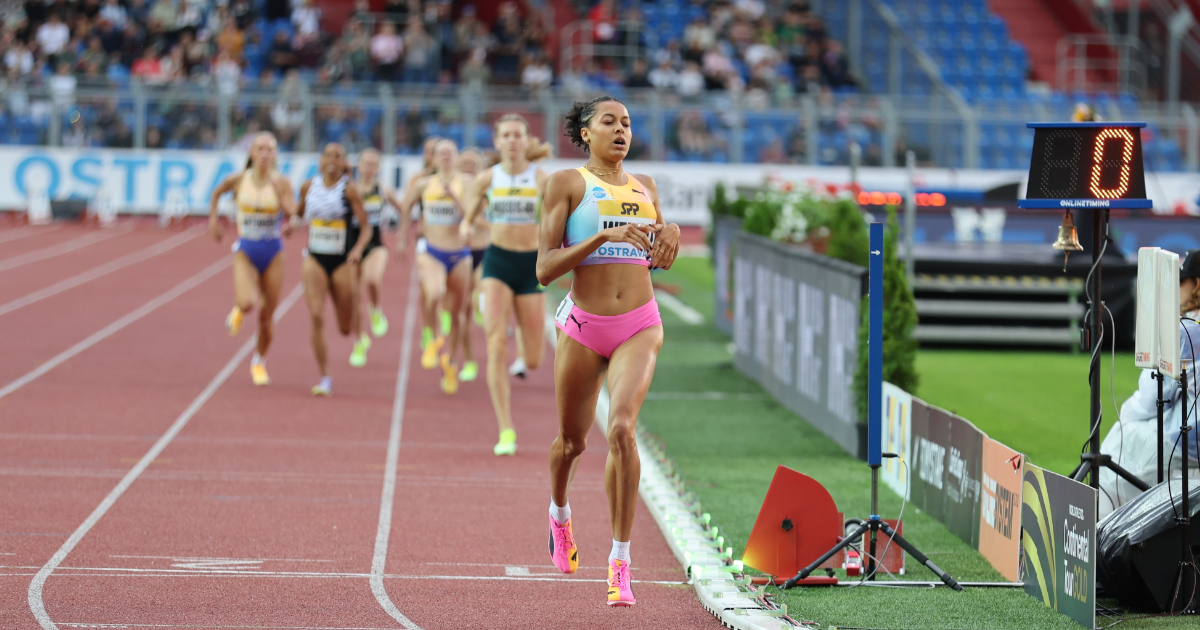
By this rule, it’s now fair to say that Audrey Werro is good enough to be called a 1:54.45 runner. The 22-year-old Swiss star came through the first lap in Ostrava on schedule at 56 seconds and slowly pulled away from the only other person in the field who opted to follow the rabbit, Femke Broeders-Bol. Werro may have surprised Keely Hodgkinson (and all of us) in Stockholm on her path to a 1:53.98 clocking, but now the expectations have risen.
Werro is 22 year old and two years ago she was a 1:57 runner. Now, she’s the fourth fastest woman of all time and has the fastest second-fastest mark ever. For comparison, Caster Semenya’s second-fastest 800m is 1:54.60 and Hodgkinson’s is 1:54.61. Hogkinson is the fastest third-bester at 1:54.74 with Semenya on her tail at 1:54.77.
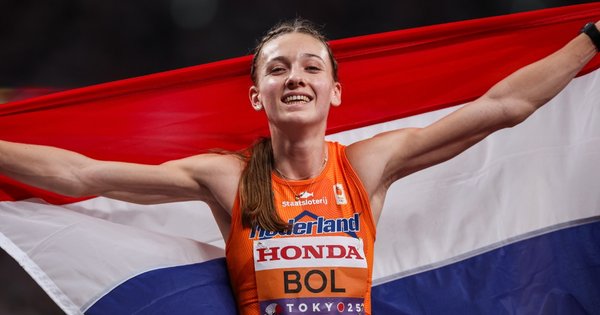
Back to Broeders-Bol for a moment. If it weren’t for Werro, then all eyes and thinkpieces would be focused on the Dutch 400m hurdler-turned-half-miler’s outdoor debut at her new distance. Unlike Werro, there are only two performances to list on Broeders-Bol’s recent resume: 1:59.07 from indoors and 1:57.13 from yesterday. Given this small sample size and trajectory, it feels fair to say maybe she is better than her second best time.
Behind those two headliners, six other women broke two minutes, highlighting the increasingly obscene depth in the event (more on that in a moment). As Spotify is publishing their predictions for Song of the Summer 2026, we are ready to make a prediction of our own—the Event of the Summer 2026 will be the women’s 800m.
It’s a weird summer because every athlete has their own set of priorities. Is the focus on the Commonwealth Games, European Championships, Diamond League Final, or World Ultimate Championships? There is a high possibility that many of the top athletes pass by each other like ships in the night. (Let’s hope that in the women’s 200m, Melissa Jefferson-Wooden, Julien Alfred, Gabby Thomas, and Shericka Jackson all find themselves at the same venue at the same time. Sounds expensive…)
But we know that at least Werro, Hodgkinson, and Bol will all meet at the European Championships. The trio are also regulars on the circuit and so the odds of additional run-ins are quite high. Werro has already raced 12 times in 2026, but that’s nothing in comparison to 2025 when she had 29 races. Last year, Femke raced 32 times.
Maybe it’s a rush to include Femke in this group as she just lost by 2.6 seconds to Werro. Yet her background and trajectory adds a must-watch X factor to an event that is certainly not lacking in established star power.
Missing so far in the conversation is the defending World champion Lilian Odira, who ran 1:57.27 to finish third in Rabat behind Werro, and 2024 Olympic silver medalist Tsige Duguma. That’s the nature of the women’s 800m though—anyone can show up on the day. In the past seven years there have been six different global champions, and the only one to repeat is Athing Mu.
In 2023, 59 athletes broke 2:00. The next year, that jumped to 78. Last year, there were 88. And with three months still to go into 2026, there are already 69 women under that barrier.
The entire event is undergoing a major renaissance and the baseline of what was once considered competitive has now shifted. And nothing would signal the end of the previous era like the takedown of Jarmila Kratochvílová’s 43 year old world record.
So get in losers and buckle up, because being the second best version of oneself won’t be good enough this summer.

David Melly
Since David began contributing to CITIUS in 2018, he's done a little bit of everything, from podcast hosting to newsletter writing to race commentary. Currently, he coordinates the social media team and manages both the CITIUS MAG newsletter and The Lap Count, supplying hot takes and thoughtful analysis in both short- and long-form. Based on Boston, David breaks up his excessive screen time by training for marathons, crewing trail races, baking sweet desserts, and mixing strong cocktails.