By Kyle Merber
May 13, 2026
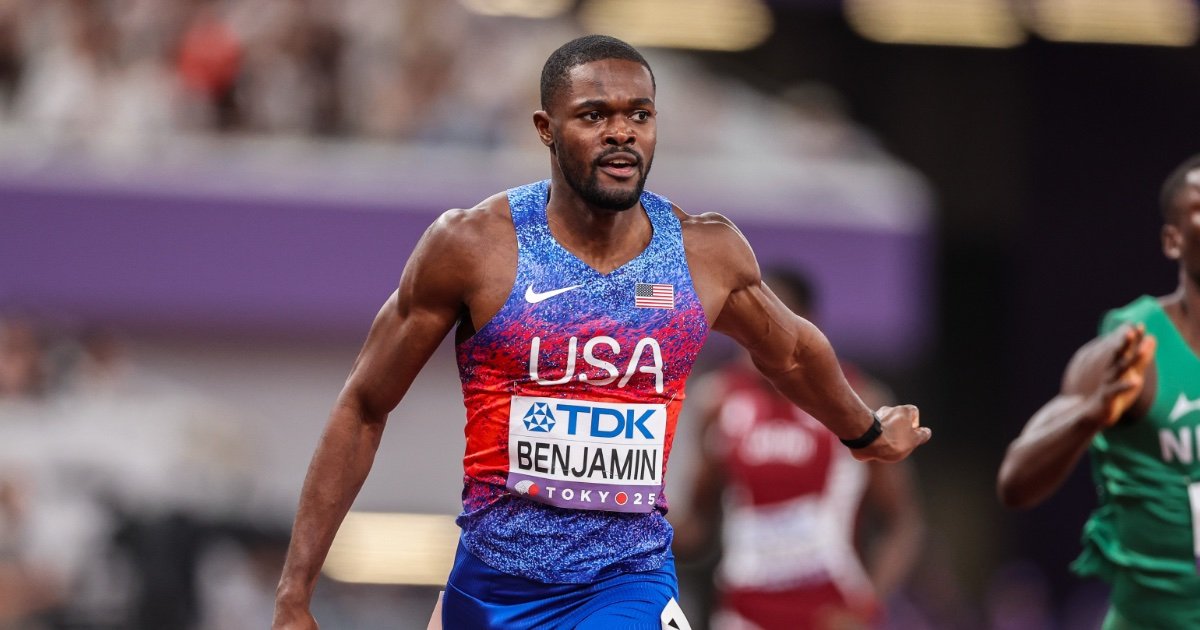
Don’t point fingers at Rai Benjamin… It’s not his fault… but the U.S. men have a 400m hurdles problem.
Okay, maybe it is Rai’s fault, just a little bit. Let’s get into why.
The United States has a storied tradition in the 400m hurdles, dating way back to the Paris Olympics… not that one, the one held 126 years ago. The event was first introduced at the 1900 Olympics, and its inaugural champion was Walter Tewksbury who ran 57.6 seconds over what then became the standardized 10 hurdles. (He also medaled in the 200m, 60m, 100m, and 200m hurdles, which arguably makes it less impressive because it seems like those fields were comprised of chainsmokers suffering from whichever vitamin deficiencies were fashionable at the onset of the previous century.)
A whole lifetime later, the event came to be dominated by American Edwin Moses, who in addition to winning two Olympic gold medals, a bronze, and two World Championships, went on an incredible streak of 122 consecutive wins. Eventually his world record was broken by California’s Kevin Young, whose Barcelona Olympics-winning 46.78 would stand for almost 29 years. In 2008, the American trio of Angelo Taylor, Kerron Clement, and Bershawn Jackson swept the Olympic podium and only deepened the legacy of great 400m hurdlers.
An American man has won 50% of all possible Olympic medals in the event.
But is the world catching up? Like most events in track and field, times are quickly getting faster. For the 400m hurdles, the 30th fastest time in 2025 was 48.45, compared to 49.03 in 2016.
Although depth has improved, it has been an event dominated by a few names for quite a few seasons. Aptly named “The Big Three” there is no question who has run the tables the past seven seasons. Since 2019, there have only been six men to win a medal at a global championship:
- Rai Benjamin (6)
- Karsten Warholm (5)
- Alison dos Santos (4)
- Kyron McMaster (1)
- Abderrahman Samba (1)
- Trevor Bassitt (1)
In addition to winning medals, the trio has established the three fastest times in history and Kevin Young’s once seemingly unbreakable record is now a paltry 26th on the descending order.
This is not to say the event is boring—it’s anything but! These are three wildly entertaining personalities and with an American, European, and South American trading blows year after year, there are global rooting interests.
The concern for Americans, however, is outside of our dominant leader (who at any point is liable to abandon hurdling for road cycling) that the depth—and crucially, investment in the event—is fading. At the 2025 US Championships there were 25 qualified individuals, yet only six of those individuals had a shoe contract. During the 2024 U.S. Olympic Trials, only three of the 27 qualifiers had a shoe sponsor. Are shoe deals the best proxy for the quality of an event at a given time? Hardly… ask just about any thrower. But we’ll come back to the significance of these figures.
Is it the chicken or the egg? On the international stage, the American advantage is deteriorating quickly. While in 2008, eight of the top 12 times in the world were owned by an American, that dwindled to just four of the top 15 in 2025.
The flip happened around 2019 when the 10th fastest American matched up with the 30th fastest man in the world. In 2025, the 10th fastest American was 58th in the world. This is a great sign if you’re Seb Coe as World Athletics continues to invest in popularizing and expanding the sport in all corners of the globe. In contrast, an American hurdles fan may not be feeling quite as idealistic about such stats.
So what’s happening?
Well, at least in the U.S., the 400m hurdles is often introduced to versatile athletes as a way for coaches to score points to win meets. This past weekend, for instance, the best prep quarter miler in American history, Quincy Wilson, ran the 300m hurdles in 38.77 for the first-time ever to help his high school team win their conference meet.
The NCAA has long been the entry point for many 400-meter runners to add some jumping in the middle, but the collegiate system—formerly the U.S.’s developmental secret weapon—is no longer a secret to international talent. In 2016, only six men broke the 50-second barrier and all but one were American. In comparison, there were seven non-Americans who dipped below 50 seconds in 2025.
Now let’s get back to talkin’ turkey, and by turkey, we mean an entry-level shoe deal that might amount to essentially a meager stipend plus gear and some travel. Imagine you are an American quarter-miler considering what event to focus on as a post-collegiate athlete chasing the dream.
In the 400m hurdles there is relatively little interest from shoe companies, and as long as Rai Benjamin lives and breathes and can still get over the hurdles at a respectable clip, there are only two spots up for grabs. Plus, it’s a gamble. What if you invest a year of your prime to hurdle-specific training, only to discover you are godawful at it?
Now look at the open 400m, which has three spots that seem to be doled out via random number generator—15 different men have qualified since 2019. Then consider that there is a 4x400m squad AND, since 2019, a mixed-gender relay. Just making the U.S. final is essentially a lock to earn a World or Olympic medal! Plus, it’s comfortable: it’s the event you’ve specialized in since you were a 10-year-old on the AAU circuit.
Which event are you choosing?
The United States being slightly less deep and dominant at the 400m hurdles is not a huge problem in the grand scheme of things. Having a diversity of countries being competitive on the international stage is ultimately a good thing for the sport. And this “issue” is one without any real blame to assign. Like all of us, athletes chase after opportunities where they can win and get paid.
Ironically, Rai Benjamin himself has never really needed to explore his other options. But this season, in what is one of the most intriguing storylines of 2026, he is opting to. The defending World/Olympic champ is dipping his toes into the 200m in an effort to produce the fastest flat 400m times of his career. The rest of the world may no longer have an American 400m hurdler problem, but the quarter milers are about to find out if they have a Rai Benjamin problem.

Kyle Merber
Kyle Merber is a former professional miler turned media multi-hyphenate. While he’s not above dropping a quick “back in my day,” he’s far more focused on the present. Since 2021, he has brought his signature analysis and commentary to track fans across the CITIUS MAG network. When he’s not writing The Lap Count or hopping on podcasts, Kyle manages partnerships and pitches a relentless stream of ideas for Chris to consider. He might not be running a 3:52 mile anymore, but he keeps himself in just good enough shape to ensure the athletes still respect him.