By David Melly
April 29, 2026
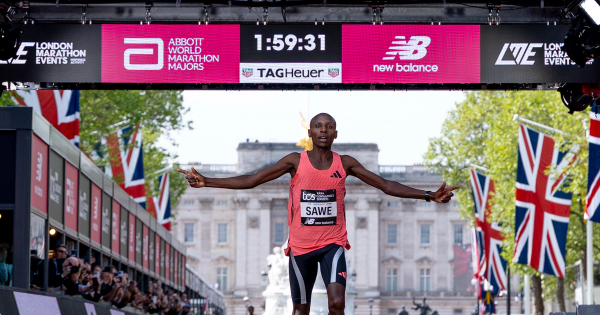
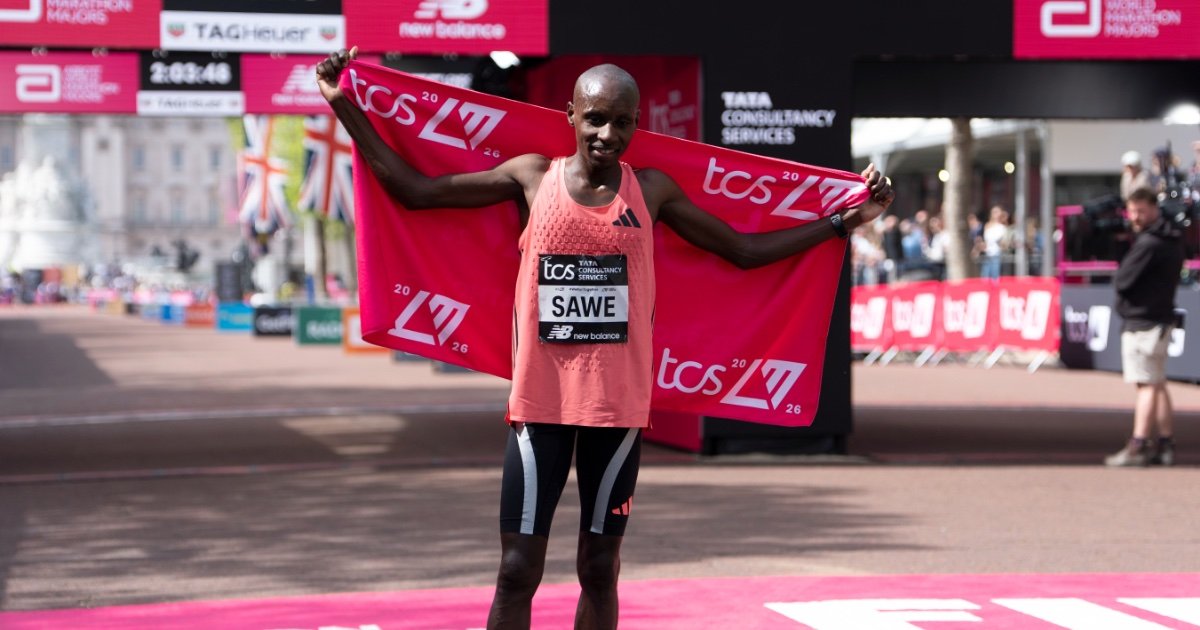
By now, you’ve surely heard the news: the marathon world record starts with a “1” for the first time in history, thanks to Sabastian Sawe’s historic run through London.
1:59:30 is 4:33 mile pace, or 14:09 5k pace. Sawe actually sped up throughout the race, posting a significant negative split (60:29, 59:01), covering 30k to 40k in under 28 minutes, and closing his last 2.2 kilometers at 4:17 mile pace. All of those sound like video game stats, not real paces a human man ran in a legitimate, non-controlled setting, so it’s understandable to look at Sawe’s run and feel your brain start to break a little.
Even in the aftermath of Eliud Kipchoge’s Ineos-funded science experiment from 2019, the prospect of a sub-two marathon felt like a tantalizing hypothetical. After two years of men’s world records in 2022 and 2023, the untimely death of Kelvin Kiptum in 2024 seemed to reinforce that notion. It was further solidified by Kipchoge entering his master’s era.
From December 2023 to April 2026, no one so much as broke 2:02, even as the promising debuts of Sawe and Jacob Kiplimo reignited hope for the future. As recently as last week, Sawe and his team were careful to temper expectations for London, suggesting that the course record of 2:01:25 was the target, not the world record. The requested pace of 60:30 at the halfway point seemed to confirm that intention, although it’s worth noting that when Kiptum ran the course record, he only split 61:40 for his first half.
So that’s part of why Sawe’s 1:59:30 (and Yomif Kejelcha’s 1:59:41 behind him) felt to some like such a surprise. And why so many of us are attempting to attribute the result to some new breakthrough, whether it’s the newest adidas shoes, the “personalized gut training” provided to Sawe by Maurten, or some new performance-enhancing drug designed to evade $50,000 worth of testing. Surely this barrier would not have been so resoundingly shattered without another massive leap forward in the technology that propels runners from start to finish…?
Well, yes and no. The increasing push for optimization in the marathon, for better or worse, has led to faster times. But 1:59:30 is more of a logical next step in the event’s progression than some crazy outlier.
Let’s start with the race itself. Sawe’s run was incredible, yes, but he didn’t exactly go solo. From the halfway point to around 30K, both Kejelcha and Kiplimo were right on his heels, and Kejelcha managed to stay in Sawe’s pocket until the final blistering mile. While Sawe will always be remembered for setting the new world record, three men actually broke the old one, and fourth placer Amos Kipruto ended up sixth on the all time list at 2:01:39, equalling Kipchoge’s old WR mark that stood until 2022. It’s inaccurate to boil down the historic day in London to one man—or one pair of shoes for that matter, as Kiplimo was wearing Nikes.
Sawe’s 59:01 closing half was the fastest ever recorded in a full marathon, but we’ve seen splits of a similar caliber before. Kiptum twice closed marathons under 60 minutes in his short but illustrious career, and Eliud Kipchoge’s 2:01:09 from Berlin in 2022 began with a 59:51 opener. While the London course is record-eligible, it’s still a point-to-point race with the finish line around seven miles west of the start, and from roughly 20 miles to the finish, the course runs east to west in a relatively straight line. So a breeze out of the east, which Sunday had, acts as a net tailwind and is particularly helpful on the back end of the race.
Compared with other barrier-breaking runs like, say, Ruth Chepngetich’s 2:09:56, this looked more like Boston the week prior: a day where the stars aligned and everybody ran fast, not a single superhuman effort defying all logic and straining credulity. Sawe’s margin of victory was 11 seconds, compared with 7:36 for Chepgnetich.
The time itself was unprecedented in its starting number, but statistically it doesn’t stand out nearly as much. The World Athletics scoring tables assign 1:59:30 a 1328-point value, just five points ahead of Jacob Kiplimo’s 56:42 half marathon and 16 ahead of Chepngetich’s. It’s far from the highest-scoring men’s world record, either—Usain Bolt’s 9.58 and Mondo Duplantis’s 6.31m both clear 1350 points. The top four 200m marks all rank higher than Sawe’s WR, at least in World Athletics’s estimation.
Since the supershoe era formally began in 2016, the men’s world record has now been broken four times, twice by Kipchoge, once by Kiptum, and now once by Sawe. The latest 65-second improvement isn’t particularly unusual by those standards, either: the last three jumps were 1:18, 0:30, and 0:34. Carbon and foam technology has undoubtedly increased the margins of improvement—the last minute-plus improvement before Kipchoge’s was in either 1967 or 1969 (depending on whether you count Derek Clayton’s second world record, which is a whole other story)—but in this new era, Sawe’s mark isn’t totally out of line.
All this context isn’t designed to take the shine off Sawe’s special day. Quite the opposite, in fact. If you’re the cynical type that questions every great performance and you feel more inclined to ascribe record-breaking runs to science, cheating, or both, this should help calm your anxieties a little. 1:59 is incredible in the typical sense of “amazing” or “excellent,” but it’s not incredible meaning “impossible to believe.” It could be too good to be true, by all means, but the time does still make sense in the broader arc of the sport’s history.
It’s a brave new world out there, and it’s a near certainty that this pair of sub-twos won’t be the last we see. With Berlin and Valencia coming up in a matter of months, they might not even be the only sub-twos this calendar year. And with Sawe (31), Kejelcha (28), and Kiplimo (25) just barely scratching the surface of what are hopefully long and fruitful marathoning careers, today’s barrier-breaking may look a lot like business as usual before long.
David Melly
Since David began contributing to CITIUS in 2018, he's done a little bit of everything, from podcast hosting to newsletter writing to race commentary. Currently, he coordinates the social media team and manages both the CITIUS MAG newsletter and The Lap Count, supplying hot takes and thoughtful analysis in both short- and long-form. Based on Boston, David breaks up his excessive screen time by training for marathons, crewing trail races, baking sweet desserts, and mixing strong cocktails.