By Chris Chavez
April 26, 2026
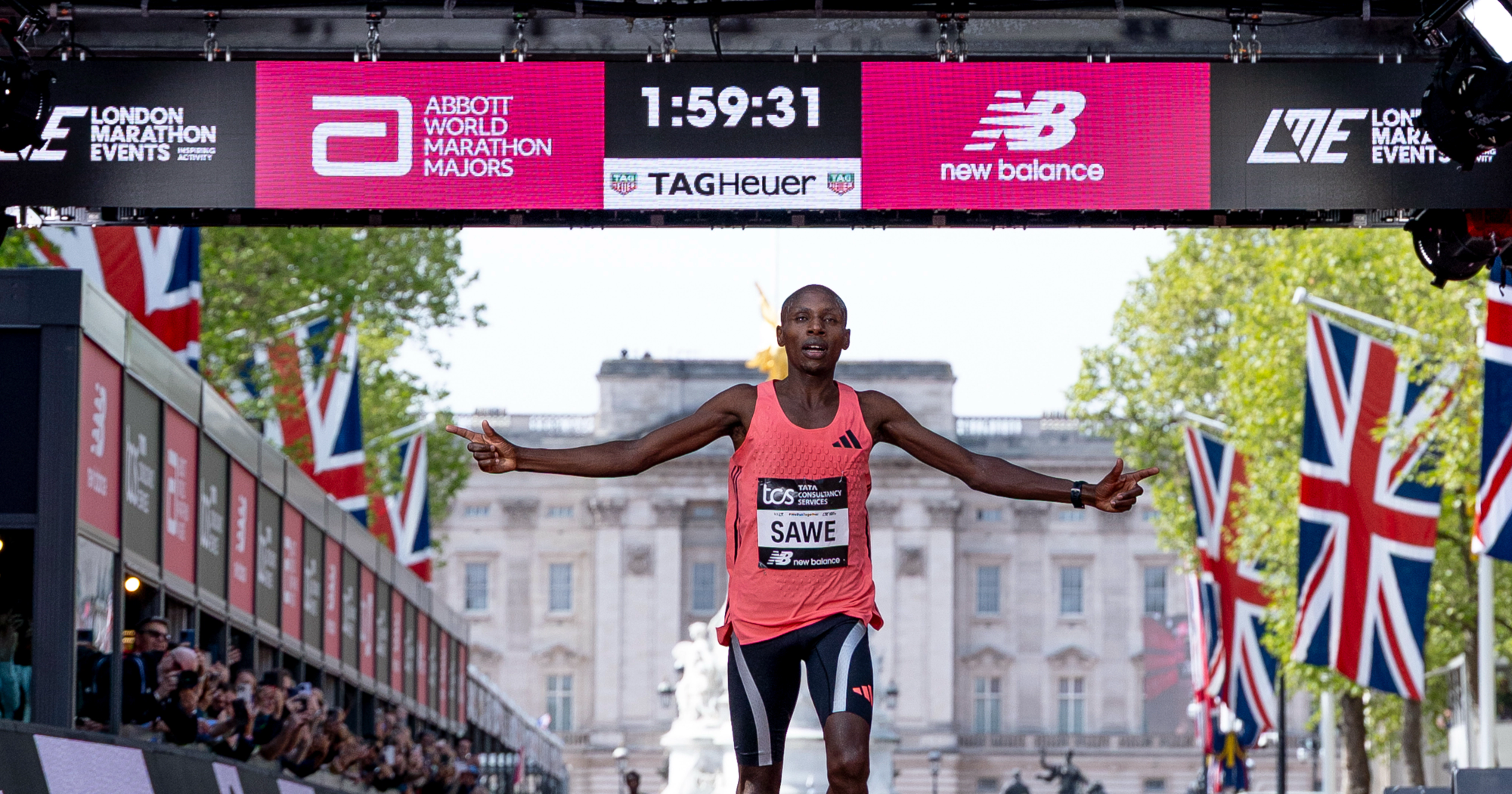
This morning at the 2026 TCS London Marathon, Kenya’s Sabastian Sawe did what no human being had done in an official race: he ran a marathon in under two hours, crossing the finish line in 1:59:30 to shatter the world record by over a minute. It was arguably the most astonishing performance in the history of the sport.
For decades, the two hours has been to the marathon what four minutes was for the mile. That was until Eliud Kipchoge famously shattered it in 2019. But that was in a staged exhibition in Vienna that didn’t count as an official world record due to a rotating cast of pacemakers.
What happened today in London counts. No need to put an asterisk around it. There’s no lingering confusion over whether it was the “fastest ever” or the world record, with an asterisk (like we have with the men’s American marathon record right now). All it took was Sawe, Yomif Kejelcha, and Jacob Kiplimo duking it out over 26.2 miles. That barrier is gone and the marathon as we know it may never be the same again.
We recorded an emergency podcast from the London Marathon media tent with our man on the ground, Preet Majithia, immediately after the race. Below is our attempt to make sense of what we all just witnessed.
How It All Went Down
The plan going in was conservative by the standards of what unfolded. Over the past few days, Sawe and his coach Claudio Berardelli were vocal about publicly targeting Kiptum’s 2:01:25 London course record. Any world record talk was downplayed. Sub-two wasn’t really in anyone’s forethought. At the pre-race press conference, we learned that Sawe had dealt with a stress fracture in his foot and a back injury, which disrupted his training through December and January. His camp didn’t even know if he’d make the start line for London, but he returned to full training in February and peaked at 150 miles in a single week.
Organizers, fans and pundits like us were expecting the women’s-only world record, which did end up happening. Tigst Assefa ran 2:15:41 to beat her own record by about 10 seconds. That wasn’t a wild surprise, and we could see it coming from the jump.
But even from inside the media tent, the realization of what was happening on the men’s side came slowly.
The lead group of six—Sawe, Kejelcha, Kiplimo, Amos Kipruto, Tamirat Tola, and Deresa Geleta–were the only athletes bold enough to attempt the 60:30 first half target. Their halfway split of 60:29 was remarkable on its own. But the real racing started just after 25K when the final pacer stepped off, and Sawe immediately went.
By mile 17, he and Kejelcha had separated from everyone else. By mile 19, Kiplimo was alone in third, two seconds back. Sawe ran his second half in 59:01 for the fastest second half in marathon history. That’s faster than Conner Mantz’s 59:17 U.S. record in the half marathon, and it obliterated Kelvin Kiptum’s 59:45 from his second half at the 2023 Chicago Marathon by 44 seconds.
Sawe’s 5K splits from 30K onward tell the story: 30–35K: 13:54 (1:57:18 marathon pace); 35–40K: 13:42 (1:55:40 marathon pace); and his final 2.2K was in 5:51 (roughly 1:52 marathon pace). His 24th mile—4:12—was the fastest single mile ever run in a marathon. As the finish drew near, Sawe was still accelerating.
Finishing in second, Kejelcha deserves a lot of credit, too. The Ethiopian track star, making his marathon debut, ran 1:59:41, which was also good enough to break the previous world record by nearly a minute. Kejelcha hung with Sawe through 39K. He never led, but he never flinched, either. His presence was very much what made the record possible—Sawe was unable to let up. Kejelcha later told us that he hit the wall at 41K so that 11-second deficit only happened in the final kilometer.
Kejelcha’s range is one of the greatest in history. He previously held the indoor mile world record in 3:47 and now has broken two hours in the marathon. Across his track career, he collected three silver medals at the outdoor World Championships but never gold. Now, he gets the distinction of running sub-two and finishing second.
Jacob Kiplimo, the three-time World Cross Country champion and Chicago Marathon champion, rounded out an unprecedented podium with a 2:00:28.
The Factors To Consider
The Shoes – Adidas had a great day! Four of the top five men’s finishers were wearing the Adidas Adizero Adios Pro Evo 3. It weighs in at 97 grams for a men’s size 9, roughly 30% lighter than its predecessor, with a 39mm stack height. The World Athletics rules call for a 40mm stack height limit. It’s tough without any actual lab data to quantify how much better the shoe benefited Sawe vs. his run in the Pro Evo 2 at last fall’s Berlin Marathon. A press release from the brand that went out moments after the race just noted that the Lightstrike Pro foam used in this shoe is 50% lighter than the previous version. The foam innovation and the weight reduction the next frontier in the super shoe arms race.
The Course – Historically, London isn’t as fast as Berlin. That certainly wasn’t the case today. The London course has more turns and has always historically run about 90 seconds slower on the front end of the men’s race. At the start, it was around 50 degrees Farenheit, only reaching 60–65 by the end. The preceding days had been really warm, so even modest shade felt significantly cooler. There was cloud cover and a tailwind that typically works against runners finishing west of the start line, which was present today and that mattered enormously over the final 10K along the Thames. Just one week after Boston, the wind played a factor in aiding the runners, here too.
The Fueling – Sawe is a Maurten athlete. The Maurten research team was embedded with Sawe’s team in Kenya for 32 days across six trips between last and this April. They were training his gut to absorb that load by mimicking race-day protocol in training and the hydrogel technology they have developed over the past 10 years now allows athletes to absorb 90–120 grams of carbs per hour without GI distress. In addition to that, sodium bicarbonate is also used, essentially a blood buffer since it neutralizes the lactic acid buildup that causes the burning sensation in muscles during high-intensity effort. Sawe used both of Maurten’s products for it on race day. (Taking the bicarb early is deliberate since it peaks in the bloodstream roughly 60–90 minutes after ingestion, so the timing of 2+ hours before the race would put peak buffering capacity right at the start.) Sawe carb-loaded with Maurten’s Drink Mix 320 for two days pre-race.

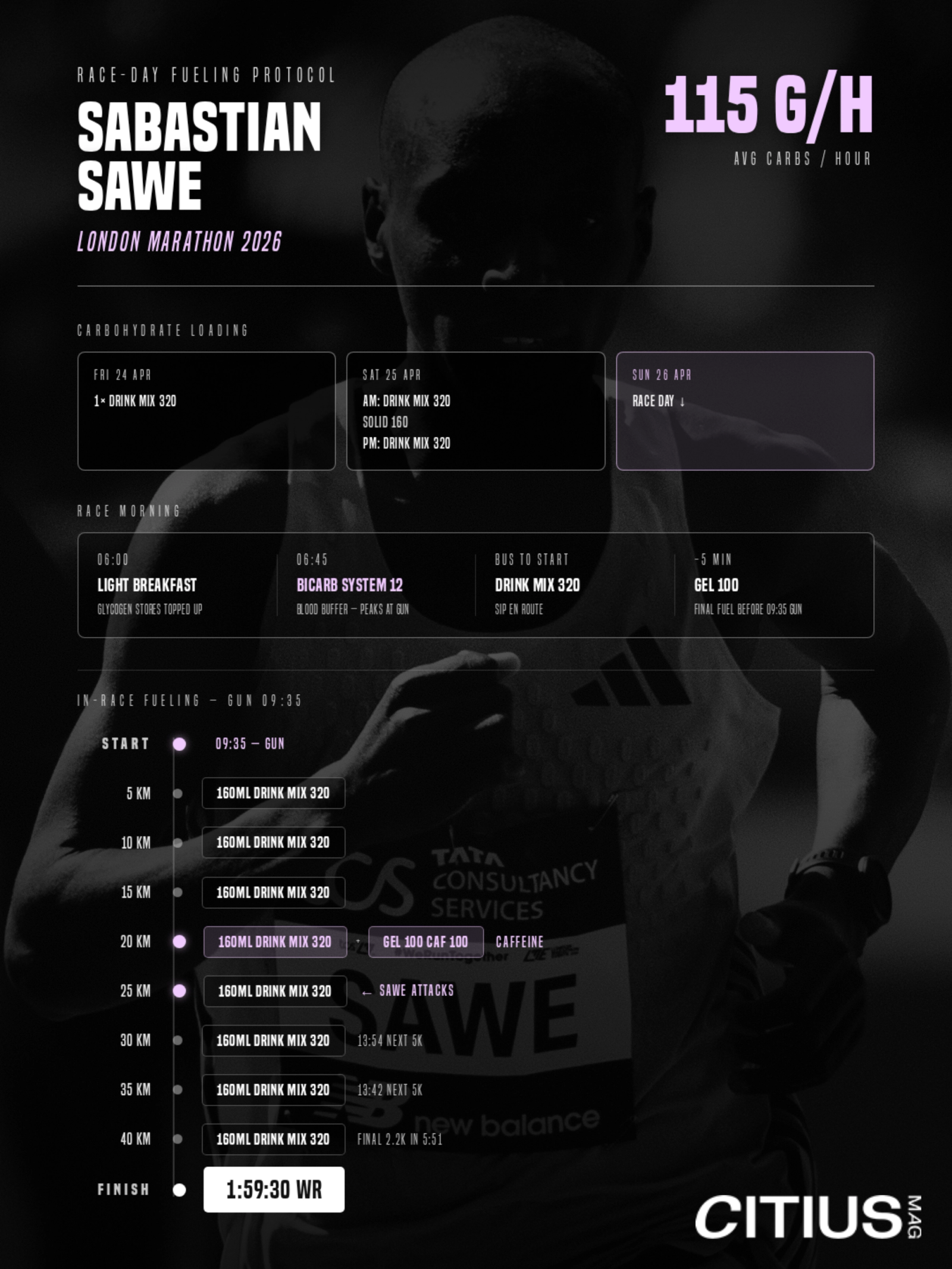
Sawe told the media in the press conference that he had two pieces of bread and tea with honey as his breakfast before the race.
Per Maurten’s Nutritional Scientist Joshua Rowe: “He sipped Drink Mix 320 on the bus to the start line, then a Gel 100 five minutes before the gun. During the race, he drank 160 milliliters of Drink Mix 320 at 5 km, 10 km, and 15 km. At 20 km, he had one Gel 100 Caf 100 and 130 ml of Drink Mix 160. Then at 25 km, 30 km, 35 km, and 40 km, he drank 130 ml of Drink Mix 320. From start to finish line, he averaged 115 grams of carbs per hour.”
If you thought this was the perfect run, it possibly wasn’t. Sawe may have missed a bottle along the course, per the Maurten team (but they were looking to confirm which), which only has us thinking about what a cleaner, perfectly fueled effort might look like next time out.
Kejelcha was the only man in the top five who was not fueling with Maurten during the race.
The Doping Question – For those wondering if we can trust this new 1:59:30 marathon world record by Sawe since there have been so many Kenyan runners caught doping and using performance-enhancing drugs in recent years… it’s always hard to have 100% certainty, but credit to Sawe, his agency and adidas for doing their best to be transparent.
Adidas included a budget in Sawe’s contract to provide funds to the sport’s anti-doping organization (the Athletics Integrity Unit) of about $50,000 for additional testing. Basically, they wanted to prove he was clean, as there was growing confidence that he would break the marathon world record. They also wanted to avoid the doubt of Ruth Chepngetich breaking the women’s marathon world record in 2:09:56… and then having that skepticism validated when she tested positive for a banned substance.
Sawe was reportedly drug-tested 25 times (this included blood and urine) in the space of two months in the lead-up to last fall’s Berlin Marathon and that’s a pretty high number. He was not tested as frequently before this race, but his coach, Claudio Berardelli, confirmed that the Athletics Integrity Unit sets the testing regimen and that he is on a higher frequency of testing than other athletes in 2026 because of the additional funding being provided.
You can never say with absolute certainty that any athlete is 100% clean, because you just never know. The best we can do is take in as much information as possible and allow athletes to demonstrate transparency. And that is what Sawe’s team has done.
What Comes Next
The question isn’t whether we’ll see another sub-two. It’s how soon, and how much faster will it be next time? It feels like a Roger Bannister effect could be upon us. Kipchoge’s 1:59:40 in Monza and Kiptum’s 2:00:35 demolished the psychological ceiling for certain athletes and they get the benefit of that being part of their legacy (after being bumped to No. 5 and No. 4 on the all-time list, respectively). Sawe watched those performances. Everyone did. When you see that a thing is possible, it reframes everything.
Sabastian Sawe is just 30 years old. He has run four marathons and won them all. He has now run faster than any human being in history while participating in the most tested campaign the marathon has ever seen. He also did not opt for a solo time trial. It came in a race, against the best competition the sport has ever assembled. And the result was nothing short of spectacular.
Keep up with all things track and field by following us across Instagram, X, Threads, and YouTube. Catch the latest episodes of the CITIUS MAG Podcast on Spotify and Apple Podcasts. For more, subscribe to The Lap Count and CITIUS MAG Newsletter for the top running news delivered straight to your inbox.

Chris Chavez
Chris Chavez launched CITIUS MAG in 2016 as a passion project while working full-time for Sports Illustrated. He covered the 2016 Olympics in Rio de Janeiro and grew his humble blog into a multi-pronged media company. He completed all six World Marathon Majors and on Feb. 15th, 2025 finally broke five minutes for the mile.