By Citius Mag Staff
May 21, 2026
The Court of Arbitration for Sport has upheld the doping violation against former 10km world record holder Rhonex Kipruto, confirming he committed an anti-doping rule violation through blood manipulation, but then reduced his ban from six years to five. The full 60-page decision reveals the extraordinary scientific and legal battle behind one of the most complex Athlete Biological Passports.
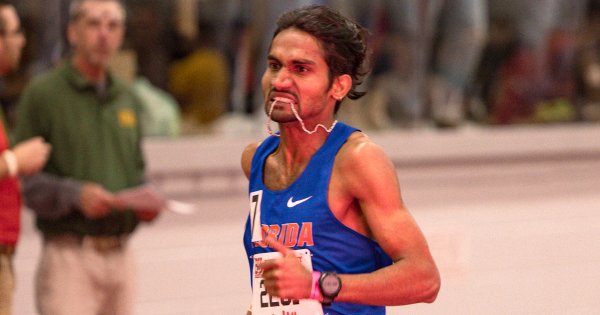
Background on who is Rhonex Kipruto:
– Born 1999, from Metkei, Kimamet Village, Kenya
– 2019 World Championship 10,000m bronze medalist
– Former world 10km road record holder (since stripped)
– Coached by the legendary Brother Colm O'Connell of St Patrick's High School, Iten
– Managed by Davor Savija of Ikaika Sports
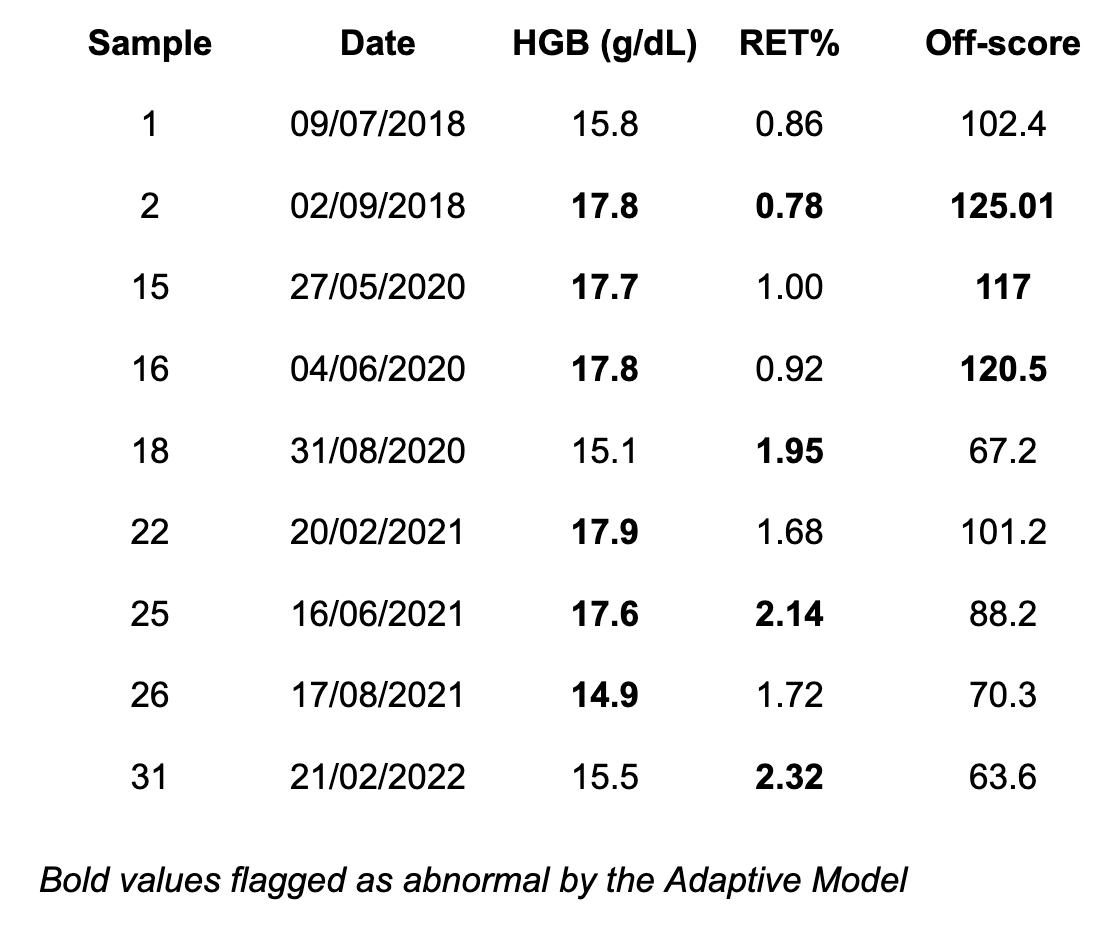
How the case began: Kipruto provided 32 blood samples between July 2018 and March 2022 as part of World Athletics' Athlete Biological Passport program. Four were deemed invalid, leaving 28 in his profile. An independent expert panel flagged the profile in April 2022—and the findings were damning.
The blood data:

What the experts found: Three independent haematologists (Prof. Giuseppe d'Onofrio, Dr Laura Garvican-Lewis, and Dr Jakob Mørkeberg) reviewed the profile anonymously and unanimously concluded that doping was the most likely explanation. They issued five separate expert opinions over four years, each time reaching the same conclusion. Their final verdict, in 2025: "The totality of ABP evidence leads to the unanimous conclusion that the Athlete's blood profile is highly likely the result of blood manipulation and highly unlikely due to any other cause."
The key red flags, explained:
– Sample 2 (Sept 2, 2018): High HGB + suppressed immature reticulocyte fraction (a classic pattern of recently discontinued EPO use.) Collected six days before a Prague 10km race in which Kipruto performed well.
– Samples 15-16 (May-June 2020): Elevated HGB with unusually low reticulocytes, which is the opposite of what would be expected during a low-training period. The panel said this pattern is consistent with EPO use.
– Sample 18 (Aug 31, 2020): Low HGB + elevated reticulocytes, which is consistent with blood withdrawal for later reinfusion.
– Samples 24-25 (June 5-16, 2021): Sharp rise in HGB and reticulocytes in the days immediately before the Kenyan Olympic Trials, consistent with ESA (erythropoiesis-stimulating agent) use.
– Samples 30-31 (Nov 2021 - Feb 2022): Large reticulocyte spike with falling HGB after 44 days at altitude, which is again consistent with blood withdrawal.
The probability of the five threshold-breaching results occurring by chance alone: approximately 1 in 10 billion.
The three defenses Rhonex Kipruto mounted—and why CAS rejected every one:
Explanation 1 – Alcohol abuse: Kipruto acknowledged drinking heavily, particularly during the COVID pandemic, and argued dehydration caused elevated HGB values. CAS rejected this. The Joint Expert Panel found that alcohol actually increases plasma volume—which would lower, not raise, HGB. The EtG (alcohol marker) values in his urine were also largely below meaningful thresholds, and two of the most flagged samples (Samples 2 and 15) showed no alcohol markers at all.
Explanation 2 – Irregular training and COVID disruption: The defense argued erratic training loads caused the blood value swings. CAS rejected this too. Exercise physiologist Dr Garvican-Lewis—whose expertise even Prof. Brandt conceded surpassed his own on this point—explained that the Adaptive Model is specifically designed to accommodate altitude residents and training variation. Normal seasonal fluctuation produces gradual, modest changes — not the abrupt, statistically extreme peaks and valleys seen in Kipruto's profile.
Explanation 3 – Primary Inherited Erythrocytosis (PIE/PFCP): The most sophisticated defense argument, was introduced late in proceedings. Kipruto's expert Prof. Stephen Brandt of Vanderbilt University argued that a combination of genetic variants—JAK2 L393V and HFE H63D—gave Kipruto a rare inherited condition causing hypersensitivity to EPO, which in combination with altitude training and alcohol use could explain the ABP abnormalities.
CAS dismantled this argument piece by piece:
- The key disease-defining EPOR mutation was not found in Kipruto.
- JAK2 L393V is classified as a "variant of uncertain significance" with no established functional data showing EPO hypersensitivity.
- If the condition were genetic, it would produce consistently elevated values across the entire passport—not dramatic peaks and valleys.
- The private blood tests used to establish the diagnosis were conducted in 2024, two years after the last ABP sample, at the request of Kipruto's own expert, and were therefore potentially susceptible to manipulation.
- The family history evidence (father and uncles with JAK2 L393V) established only a shared genetic variant, not an inherited erythrocytosis phenotype.
The competition correlation:
Beyond the statistical abnormalities, the panel found a clear pattern of flagged samples clustering around key competitive moments:
- Sample 2: Six days before Prague 10km, September 8, 2018
- Sample 20: Three days before Valencia Half Marathon, December 6, 2020
- Samples 24-25: Days before Kenyan Olympic Trials, June 17-19, 2021
The Panel concluded this confluence "amply demonstrated" a doping scenario.
The sanction:

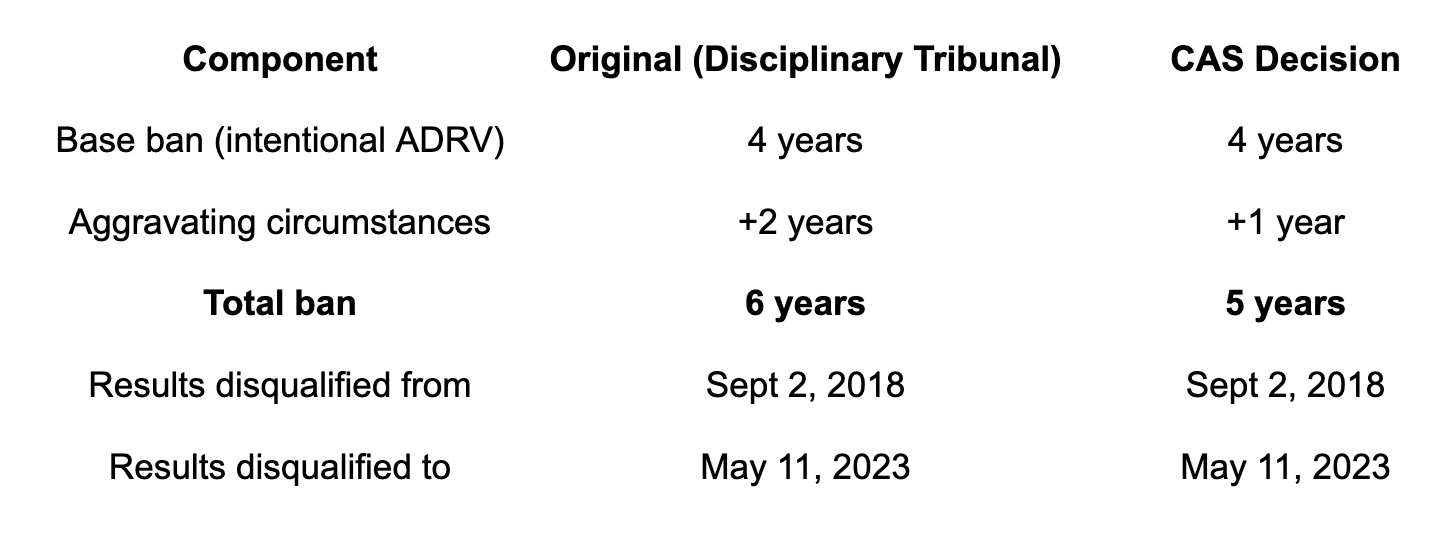
CAS agreed that multiple instances of blood doping across the passport constituted aggravating circumstances—using a prohibited method "on multiple occasions" is explicitly listed as an aggravating factor under the 2023 Anti-Doping Rules. However, the Panel applied the principle of proportionality and reduced the aggravating period from two years to one, finding that the two-year addition went further than the evidence strictly warranted.
Ban timeline:
– Provisional suspension began: May 11, 2023
– Ban commences: May 28, 2024 (date of original Disciplinary Tribunal award)
– Ban expires: May 28, 2029
– Earliest eligible return: May 2029
Keep up with all things track and field by following us across Instagram, X, Threads, and YouTube. Catch the latest episodes of the CITIUS MAG Podcast on Spotify and Apple Podcasts. For more, subscribe to The Lap Count and CITIUS MAG Newsletter for the top running news delivered straight to your inbox.

Citius Mag Staff