By Paul Snyder
July 8, 2026
By nearly any metric, last weekend’s Pre Classic was a barn-burner of a meet, as it basically always is.
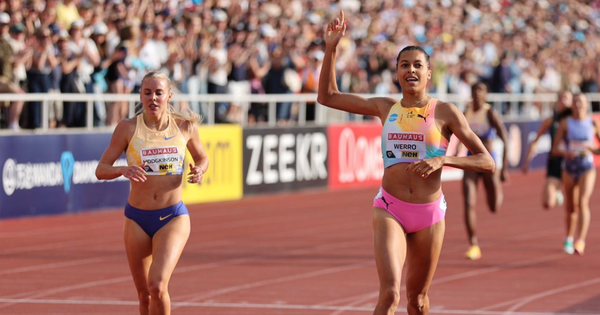
The women’s 100m was so exceptional that we dedicated the entire preceding section to it; Lilian Odira took down Keely Hodgkinson again in the 800m; Nikki Hiltz won their first Diamond League race ever, defeating the entire 2025 World Championship podium in the process; Masai Russell continued her incredible run over the 100m hurdles, tying the meet record at 12.24; Chase Jackson got the better of her Dutch rival in the shot; 19-year-old Tate Taylor upended the men’s 200m global pecking order with his 19.75 victory; Collen Kebinatshipi continued to make the case that he’s the best overall sprinter in the world, as he held off an impressive late charge from Rai Benjamin in the 400m; Cam Myers became the first Australian winner of the Bowerman Mile; Jamal Britt’s late career resurgence gained another data point with his 12.86 110m hurdles PR and meet record; Leonardo Fabbri threw a new world lead in the shot; Mykolas Alekna’s kept up his remarkable return from surgery with a 71.06m—non-Ramona!—toss in the discus.
Even some of the non-Diamond League events were notable! Zhang Jiale, the 19-year-old Chinese hammer phenom, beat Camryn Rogers with a personal-best heave of 77.94m, and Brandon Miller continued to explore his new late-charging strategy to great success in the men’s 800m, edging out Cooper Lutkenhaus and just about every healthy top American 800m man in the process.
However, we wouldn’t be track fans if we didn’t find something to grumble about amidst an otherwise delightful two-day span of athletics. And that thing was pacing in a handful of races.
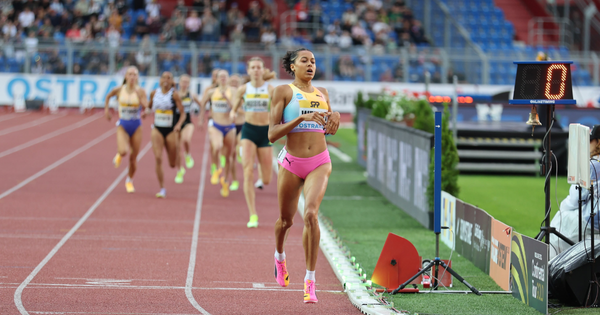
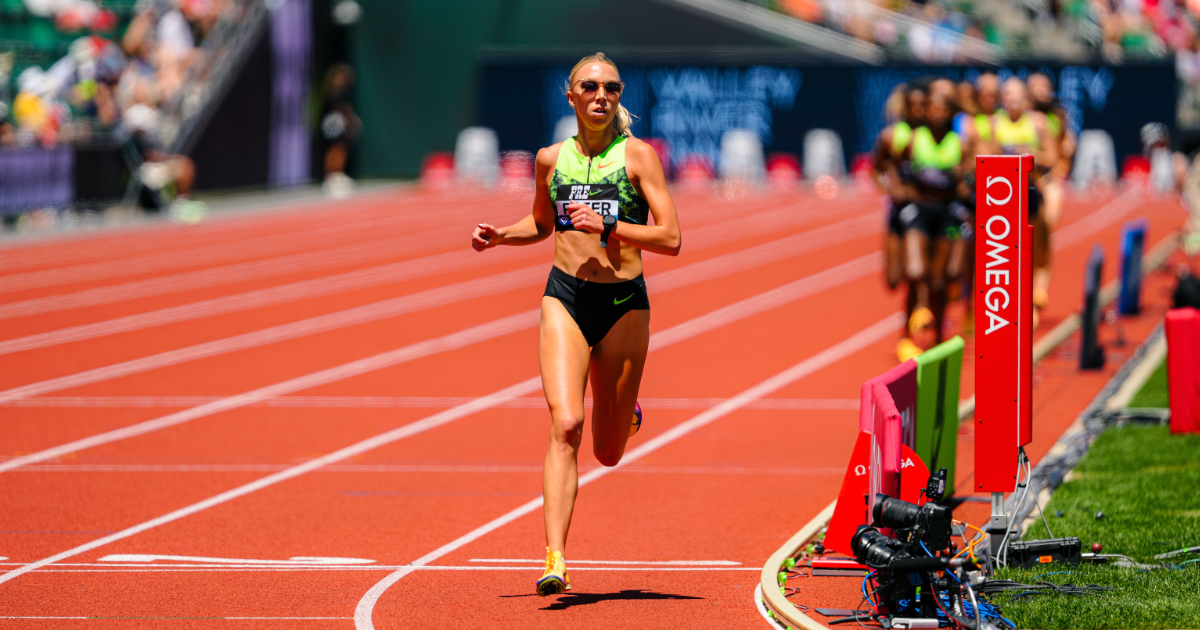
In the women’s 800m, the rabbit split 53.58 at the 400m mark, well ahead of the pacing lights and even further up from any athlete with an intention of finishing the two-lap race. In the men’s 2 mile, the field essentially said “nope” to the rabbit and pace lights from the jump. In the women’s 2 mile, when the pacer stepped off after a 4:33 1600m, the leaders likewise stepped off the gas. And in the women’s mile, the pacer and lights were ignored from the get go.
Rabbit mess-ups led to interesting results: the women’s 800m still turned out to be an excellent race that saw plenty of shuffling of the field throughout the final 200m… the men’s 2 mile was another in a recent stretch of great races from Parker Wolfe… or the women’s 2 mile saw six athletes still in contention with 200m to go… and in the women’s mile, the fact that it wasn’t a 4:13 race as called for likely made Hiltz’s upset possible.
No matter how exhilarating the outcome of a distance or middle-distance race, whenever there’s a visual reminder of the gap between how fast people are running and how fast they at one point claimed to want to go, there’s going to be disappointment. A pacer mishandling the assignment is one thing, and easily dismissible as such. But pace lights blinking along 20+ feet ahead of the field is simply a bad look that screams “a week ago I wanted the world record but now I’ve got cold, spiked feet.”
Diamond League pacesetting is a careful dance between ambition and adaptability. More often than not, the fault lies not with the pacers themselves, but with the athletes refusing to chase them. Understanding and quickly responding to shifting race dynamics is a commendable part of racing savvy, but the visual weirdness of abandoned-pace efforts needs to be addressed.
The range of possible solutions range from Vaudvillian to Ludditistic, and just about all of them are infeasible, but hey… let’s run through them anyway.
Get rid of pacing lights entirely
This one isn’t gonna happen. They’re extremely useful and clearly help athletes keep up with brisk paces once human rabbits step off. We like seeing world records, and really, records of any sort fall. Accordingly, meet directors would probably rather deal with minor blowback from the iffy visual of lights dropping athletes like at Pre, if the tradeoff is a 5% increase in the likelihood of a world record, should everything go perfectly. It does feel like there should be a moment, however, in a comically slow race where someone simply makes the executive decision to kill the power.
Implement an “all-you-can-eat sushi”-inspired penalty system
Most all-you-can-eat sushi establishments have a policy: you pay extra for any sushi you or your party are unable to consume. This keeps people from attempting to abuse the system or doing the very cool but reckless “I’ll have one of everything” move, unless they are extremely hungry or dining with an entire NFL offensive line.
Why not apply something similar on the DL circuit? In most rabbited races, the pace is dictated by one or two athletes. Should those athletes not go with the rabbit, they should be fined a percentage of their appearance fee for every lap they fail to do so. If it was the meet director who got greedy and asked for an unreasonable pace, then they should be required to run an all-out 400m at the conclusion of the race, and if they don’t complete their penalty lap within two seconds of what they predict they will run, they have to go again.
Pull ineffective rabbits off the track with a giant cane
If a rabbit opens up a gap so large on the field that it becomes unseemly, a dedicated prop comic employed by the meet should use a giant cane to yank them off the track. The crowd will love the little taste of slapstick comedy, and once the speeding rabbit gets the hook, all attention goes back to pure, time-agnostic, unfettered racing.
Borrow a concept from cycling
Even a rabbit hitting the prescribed paces perfectly can wind up in no-man’s land. The big dogs sometimes simply forego the slipstream. Yes, unfortunately these pace-setters will still get the hook, but rather than allow the pace to wallow, we can utilize financial incentives to get somebody else in the competitive field to become a de facto rabbit.
In criterium-style bike racing, riders can earn a prime (pronounced “preem”) for leading the race at key intervals. Sure, a dominant rider could theoretically ride from the front the entire time, gobbling up payouts en route to victory. But the typical outcome is that a few athletes without a shot in hell of winning say “screw it,” blast off to the front, quicken the pace for everyone else, battle for their bonus, then die an honorable death.
On the track in any given race, at least half the field will likely recognize within a lap or two that this isn’t going to be their day. Chasing a halfway prime allows these runners to salvage what would otherwise be a bust of a race at best or a DNF at worst. If this system is good enough for the Fifth Avenue Mile every year, it’s good enough for the track.
The Silent Treatment
This one doesn’t help the fans in the stands, but there are several ways a TV broadcast can help address the issue. The cameras themselves can simply choose to ignore the pacer and the lights, which keeps the focus on the actual race dynamics playing out. More importantly, commentators can actually talk about the race in front of them, not the race they wish was happening. There’s nothing more frustrating than watching a thrilling sprint finish and having the first words out of the announcers’ mouths be “So-and-so just misses the meet record!” There’s even an argument to be made to not let announcers see the clock at all to force them to do their darn job: calling the race in front of them.
World records rarely fall, even under the most advantageous conditions with optimal pacing. Great racing can happen at any time, anywhere. And even with some serious real estate between the lights and the action a handful of times at Pre, we got plenty of great racing.

Paul Snyder
Paul Snyder is the 2009 UIL District 26-5A boys 1600m runner-up. You can follow him on Bluesky @snuder.bsky.social.