By Paul Snyder
February 4, 2026
Two of America’s most promising young middle-distance stars took home decisive victories at Millrose, but though Roisin Willis and Cooper Lutkenhaus both factor greatly into the broader track and field conversation at the moment, the distance they competed in sure doesn’t.
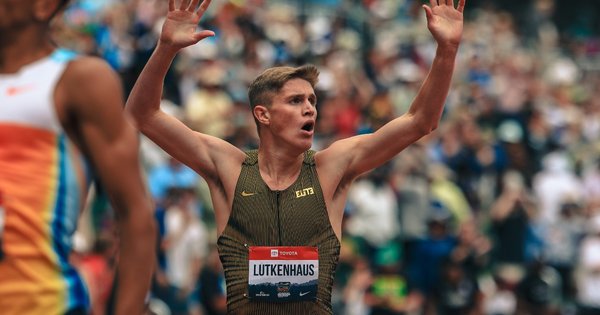
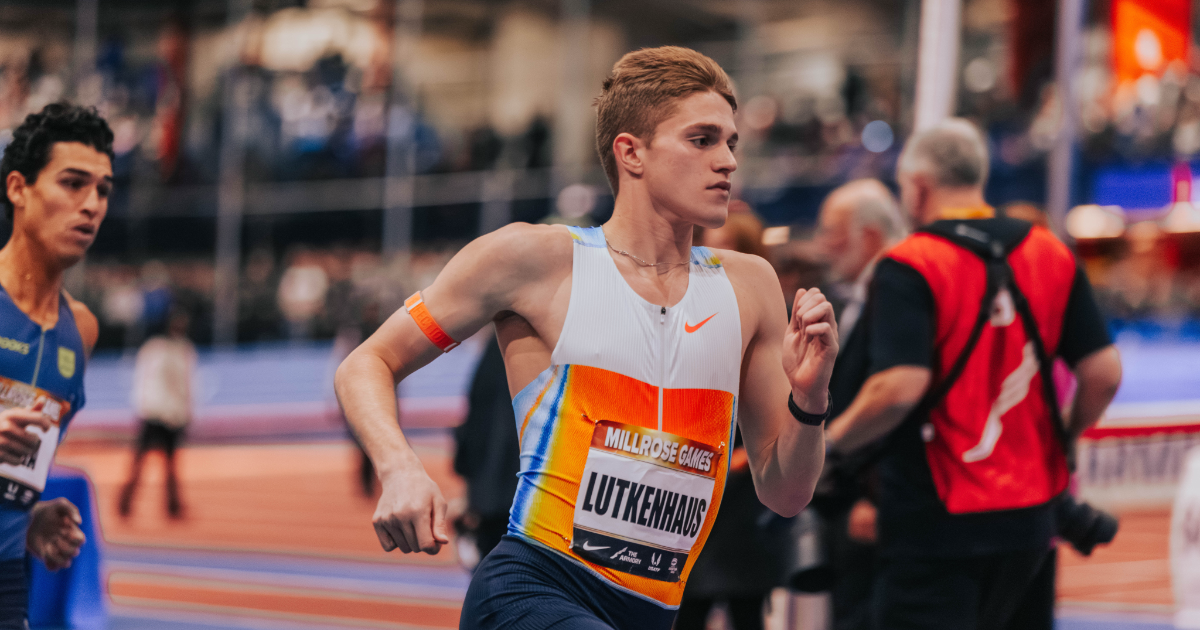
Willis took down a respectable domestic field and posted the seventh-fastest indoor 600m in American history (1:24.87). And in the men’s field, 17-year-old Luthkenhaus took some time off from being a high school junior and posted the fifth fastest time in U.S. history (1:14.15).
Both youthful 800m specialists posted comparatively even splits in their one-lap-shorter-than-usual outings, and in doing so, hawked down the bell lap-leader over the final 75 meters to cruise to victory. Tactically speaking, they both demonstrated poise and patience beyond their years, and both gave us another reason to believe that Team USA just might be bringing home some hardware in the 800m at the next handful of global championships.
But also… like… what else was going to happen? By and large, the fields assembled for the 600m races at Millrose were comprised of 800m specialists. It makes sense they would play out like 800m races, and that the best 800m runners in the field would win. As much of a treat as it is to watch Roisin Willis and Cooper Luthkenhaus compete at any distance as they enter their prime racing years, we wanted something a bit more unpredictable from a scarcely contested event that in theory should serve as a mad science experiment, pitting legitimate mid-D studs against 400m and 400mH stalwarts.
Take a look at the all-time U.S. list for the women and men.
Ranked within both top 10s you see a bunch of names synonymous with the 800m—Mu-Nikolayev, Wilson, and Rogers for the women, Hoey, Brazier, and now Luthkenhaus for the men. But scattered throughout both are a handful of athletes who came at the event like sprinters, and even some whose highest scored career performance was the 600m.
Britton Wilson, Courtney Okolo, Shamier Little: all 400m/400mH stars who managed to hang on for an additional indoor lap. And then there’s the curious case of Alysia Montaño, a global 800m medalist whose best individual career performance—if you believe the WA scoring tables—was actually an indoor 600m.
The men’s list doesn’t include as many pure 400m/400mH types, but is instead heavily skewed toward the sort of tragic athlete whose best event was likely one that is rarely contested: Will Sumner, Erik Sowinski, Cas Loxsom… and in the Montaño spot, Brandon Miller, a globally competitive 800m man who would likely have a larger trophy shelf if the outdoor races stopped a little shorter.
Now envision a world where space and time have collapsed on themselves, in which Millrose’s 600m lineups were simply the U.S. all-time top-ten lists with everyone in their prime. It’s difficult to imagine how those races would go, isn’t it? Does somebody like Little or Sumner dare the rest of the field to enter the Gray Zone, and succeed in running the legs out of the 800m stars who likely were hoping for a slightly more evenly paced affair? Is a Brazier or Mu-Nikolayev simply too good and too speedy for that to work? Does a Montaño or Miller prove that sometimes you need a precise tool to accomplish a specific task?
Who’s to say? Not you, unless you’ve got a time machine. Instead, we get to think more about Sunday’s 600m races which did not play out in any of these ways.
The women’s race owed its early pace to Michaela Rose. Though notoriously a risk-it-all front runner adept at overriding her internal pacing governor, she is ultimately not a 400m runner. She is going to race a 600m like a front-running 800m runner, which she did, resulting in a race that felt more like a condensed half-mile than something wholly unique. We’d seen this before—Rose jumping to an early lead, pushing from the gun, and hoping the pieces stayed in place long enough to hold off late challenges; Willis sitting just far enough back to not cook herself, then striking when Rose began to falter. It was just the sub-90-second edit of the usual two-minute version.
The men’s race benefitted from the presence of eventual second-place finisher Jenoah McKiver, who is carving out a solid professional niche for himself as a 4 x 400m relay depth piece. Him leading most of the race wasn’t shocking, but we hadn’t seen before how he’d react to a field of mid-D guys, nor how they’d respond to McKiver. Because of this, he was a bit of an unknown in terms of how he might handle the last lap, but he acquitted himself nicely, and made Luthkenhaus sweat through the final curve before it became apparent that the kid’s 800m strength would be too much for him.
Hard-closing long sprinters, take note: per World Athletics, McKiver’s top-scoring career mark came at Millrose. He might be a 600m specialist in a world where no such thing exists. That’s something we wouldn’t know about the 2025 mixed relay gold medalist without him being included in this field. And his presence delivered something the women’s race didn’t: two athletes who don’t normally share a starting line going head-to-head.
We need more Jenoahs! Whenever a tweener event like the 600m is given center stage, we really need to make sure the players come from a range of disciplines. It keeps the racing more interesting. Developmentally, it gives star athletes a different tactical look to respond to. And in a world where the indoor season can sometimes feel like a collective hibernation while we wait for the summer to roll around, it gives us an opportunity for the “short track” to deliver something distinct and unique.

Paul Snyder
Paul Snyder is the 2009 UIL District 26-5A boys 1600m runner-up. You can follow him on Bluesky @snuder.bsky.social.