By Citius Mag Staff
July 22, 2026
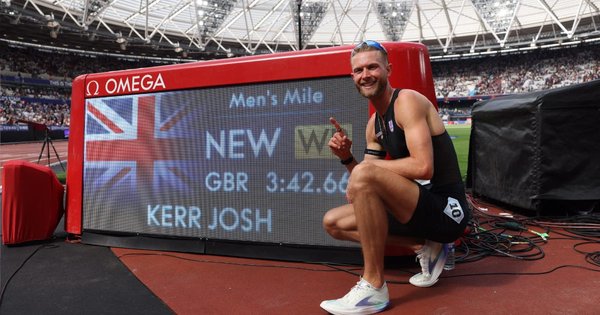
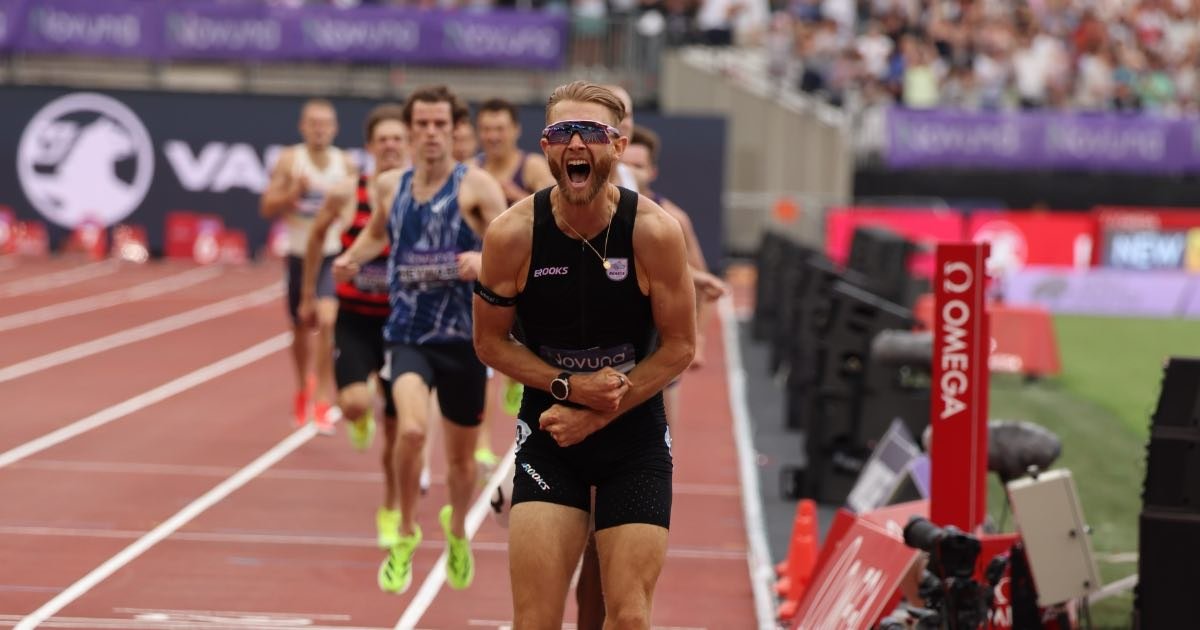
On July 18th at the London Diamond League, in front of 60,000 people, Josh Kerr ran 3:42.66 to break Hicham El Guerrouj’s record that had stood for 27 years. He did it by publicly calling his shot four months in advance, first targeting the specific date and venue before he had even finished rehabbing the calf he tore at the World Championships in Tokyo last September.
Kerr is already one of the most decorated middle-distance runners of his generation as the 2023 World champion, two-time Olympic medalist, and two-time World Indoor champion at 3000 meters. But the world record puts him in a new category entirely. He is now the seventh Brit to hold the mile world record, and the first since 1985, joining a line that runs through Roger Bannister, Seb Coe, and Steve Ovett. The race commentator on the world feed, Tim Hutchings, called it “the ballsiest world record in the history of middle-distance racing.” It’s hard to disagree with that assessment.
We had the chance to chat with Kerr for The CITIUS MAG Podcast to unpack the performance and the full arc of his Project 222 with Brooks. The following interview has been transcribed and edited lightly for clarity. You can listen to the interview on The CITIUS MAG Podcast on Apple Podcasts, Spotify or wherever you get your shows. You can also watch it on The CITIUS MAG Youtube channel.
CHRIS CHAVEZ: I’m sure with the fifty-plus interviews you’ve done in the last couple of days, it’s settled in at this point?
JOSH KERR: Yeah, I think so. Listening to yourself talk about it for a while helps for sure. But it’s been really fun. It’s been great to see people outside of the sport get into this a little bit and understand what our sport is really about—pushing the boundaries of things. So it’s been a good journey.
KYLE MERBER: What has been the outlet or interview that gave you a pinch-me moment—where you thought, wow, people are paying attention to track and field right now?
JK: The media usually breaks in waves. That evening it’s all very quick—Sky News, BBC, live stuff. Then it becomes more chat-show and podcast territory. We’ve got some really good stuff in the pipeline. Even just Elon tweeting about it—that’s cool. Someone showed me and I was like, “Should I tweet back?” I haven’t tweeted in like fifteen years.
CC: Your last tweet is actually a retweet of photo of you and me running in Santa Monica from 2023, which is kind of crazy.
JK: The boys. Just didn’t feel right to change it. Left it as it was.
CC: Let’s unpack the day. Calling your shot four months out is something you’ve done before, but it sounds like it really started to weigh on the team about six weeks out. What exactly made the pressure feel different at that point?
JK: Five to six weeks out was when I ran that last 800m and it didn’t quite go the way we wanted. But for me personally, the pressure never felt that different—because I don’t listen to outside noise. I wake up in the morning, I chat to the people I see in person, and that’s it. But that’s not how my wife works, that’s not how my parents work, that’s not how Danny works. They see the externals a lot more than I do. And you can see it in how I was coached—Danny put some pressure on me in certain workouts, referencing what numbers we were targeting. So I could feel it through the people around me.
But I genuinely don’t care about anyone else’s perception. I was trying to do something no one had done. I was trying to bring a positive moment to this sport. And I was trying my absolute best. If I’d run 3:43.4 or even 3:43-high, that would have been my best. I would have looked around and said: that record was just better than me today, and I’m sorry this wasn’t the moment you expected—but that’s all I had. If that’s your approach, you’re not scared. You go in with a whole heart and a full cup and you just send it. Whatever the result is feels like a Christmas present. That’s always how I’ve felt going into big races.
KM: How much of the fact that this was an off year played into calling the shot? You’ve been running global championships for nearly a decade. Was this the thing you needed to keep yourself honest when the normal motivation of a major championships isn’t there?
JK: Yeah, it was a balance of things. Obviously Tokyo didn’t go the way we wanted—but the prep camp had gone really well. So I was still on crutches when we went in to present to Brooks and just said: July 18th, let’s do it. They laughed at first. I’m going to release the presentation at some point—no NDAs. I asked for a nice big sexy bonus. They laughed initially. Then I said: but I will have run the world record. And they went: yeah, okay. Once World Indoors happened, the ball really started rolling—they were like, “This guy’s still pretty good.” So it was a crazy process, but really fun.
CC: Did you wear a suit to the Brooks presentation?
JK: Something similar, but with a Brooks shirt underneath. You’ve got to keep the main thing the main thing. Brooks shoes on for sure. Their chief marketing officer Melanie Allen is incredible—they brought it to leadership, got the budget approved for marketing and shoe development, and they bought in massively from that point on.
CC: On the spike—they shared that it was designed to give you the feeling of running downhill. Walk me through what the testing and science actually showed about your particular foot strike.
JK: My initial question to them was: a 120-pound female 800m runner and me at six foot two—are those two spikes made with the same foam density? Because I don’t think they should be. And they are. I was like: I need something that doesn’t compress out under my power and just bounce it back up. I need foam that’s actually built for me.
So we got the foam super dense and hard. And then—their claim, in my dumbed-down version—they cut the brakes off the back of the spike. So if I’m not running 55s or faster, the spike doesn’t perform well for me. It also holds me into the plate where I pronate, so they built up the inside of the right spike. And if I heel strike, there’s nowhere for the heel to land—the back half simply isn’t there. It forces me to run the way I need to run to go 3:42.
KM: I’ve heard some people say the reason you broke the record is the spike. When you hear that, do you say “No, I’m just that good”—or is it “Yeah, this is exactly why I pitched the idea to Brooks! Let’s sell some shoes!”?
JK: Both, honestly. They deserve every bit of credit they’re getting. They worked incredibly hard. But if you put most people in that spike, it’s not going to happen. At the same time, if we don’t have those spikes, we might have been on the wrong side of the number. The conditions weren’t ideal: a pacer dropping out five or six days before, a bit of wind. Those spikes made up the margin. It was genuinely a team effort in every sense.
CC: So we’ve got the spike, the custom speed suit, the pacing, the training, the mental performance coach. And bicarb—are you using it?
JK: Yeah, I use it. I don’t promote it because I’m not contracted to anyone on that side, but you can see it in the videos if you look. I started about a year and a half, two years ago—I didn’t use it at the Paris Olympics. But my new PBs have all come with it.
The mental performance coach side is huge. Julian Florez or my wife Larimar recorded part of our big whiteboard meeting in Albuquerque—me, Danny, Drew Windell, who’s joining as an assistant coach for the Brooks Beasts—I probably just released that before they were ready to announce it, but he’s awesome—and Brannon Kidder. We sat down and debated the splits for about an hour. When we’d figured it all out, the job was done. And I was forced to put the whiteboard away. Two weeks before the race, the work is done. Jose, my performance coach, kept saying: ‘You cannot be in analytical mode and in flow state at the same time.’ The cramming stops. You trust what’s already been built.
And I’ll be honest: I felt pretty rough most of the week leading up to it. Travel, caffeine cleanse, all that stuff. But as soon as I started running fast in warmups, I felt great. The worse the pre-race week, the better the race. We’ve all been there.
KM: Coming off a disappointing World Championships—straining your calf, getting eliminated in the semis—you just seemed to take it on the chin without excuses and immediately recalibrate. How key was the performance coach at that moment?
JK: I think the biggest thing was realizing no one cares. Not in a callous way—in a freeing way. I wanted to retain my World title. I didn’t. I put myself in the wrong position, went over on my calf, and that was it. And I thought: I don’t want to be remembered for being that guy who turns his adversity into Instagram edits. I let my team down because of my positioning. That was on me.
The thing Danny always says—he’s a huge UFC guy—is: Before I shut the cage door, let me do everything I can for you. And once everyone has done their job and the cage door closes, it’s entirely on you. I love that feeling. When the team has delivered everything, and now it’s just me—that’s when it’s time to go.
Then I went straight to vacation in Japan on crutches. Like, how bad is life really?
CC: Take me to the night before—when you’re finalizing the last race plan. How did that meeting go?
JK: We’d already done the big decision meeting three to four weeks out in Albuquerque. The job is done with two weeks to go. The night before was really just Jose keeping me out of my analytical brain. The splits were locked. My whiteboard had every possible split imaginable—literally months of math, because the extra nine meters of a mile versus a 1500m makes the math extraordinarily difficult. But once we agreed on the splits in that room, I folded the whiteboard away and didn’t look at it again.
The splits we had planned: 55.1, 55.4, 55.7, 54.9—targeting 3:42.9 flat. (What he actually ran: 55.3, 1:51.1, 2:46.5, 3:41.4 at 1600m, then 3:42.66).
The first lap was fast because of me—I wanted to get out well, and we pushed the first 209-meter segment to a 27.4 rather than the planned 27.7. From 209 to the 800, we had it at 27.7. Then slightly slower, then slightly faster again. I knew those checkpoint splits so well that if I needed to come up for air and glance, I could check one number, know exactly what it meant, and immediately go back to work.
At 300 meters to go, I needed to be at 3:01. Got it at 3:01. Anything under 3:28 [with 100 meters to go] and you’re in the promised land. After that, it’s just straight down the last hundred.
KM: When did you know that you had it?
JK: Honestly, the 1200m time trial was probably the easiest one I’ve ever done. Afterward I went up to Jose and said: I wanted that to feel harder, and I don’t know why. And he said: talk to me about that. And I said: I wanted it to feel real, but it didn’t feel real because it wasn’t that hard. And the question he kept asking me was: what if it was easy? And in the race—it just felt right. The body knew the pace. It was flowing.
KM: For me, those 4x800m workouts were the first signal. Then the 1200m time trial was when I thought: Unless there’s a thunderstorm, it’s happening.
CC: The 1200m time trial is what converted me.
JK: Yeah, it was a great one. And the 1:44 helped a bit too.

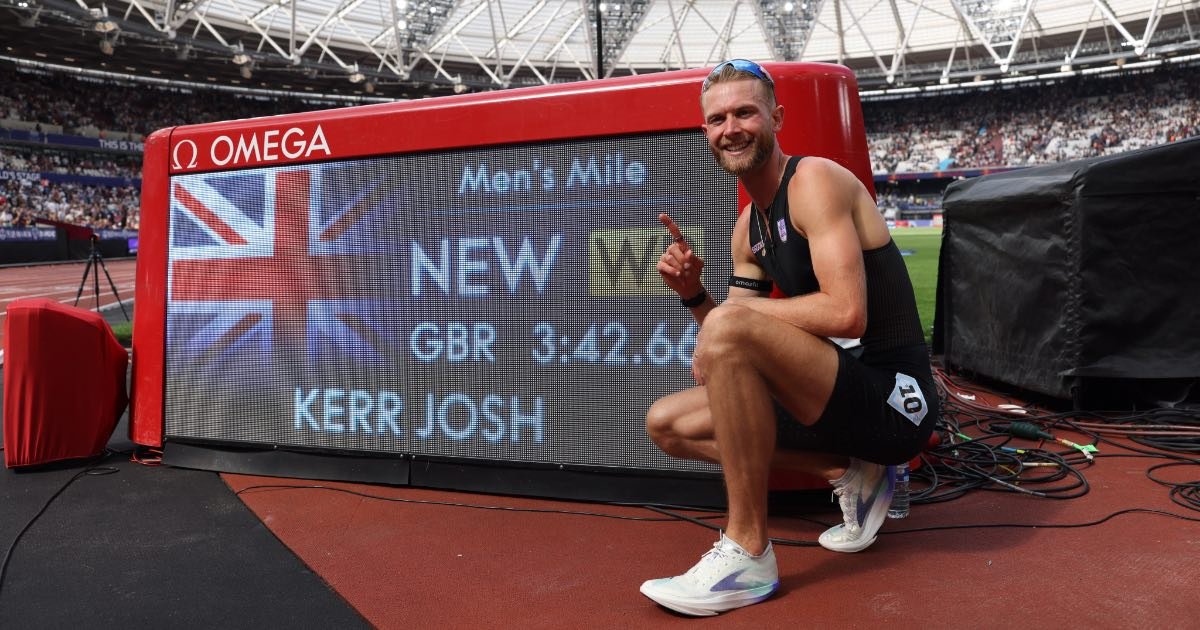
Photo courtesy Diamond League AG
KM: Given this performance, and the fact that your training approach is quite different from Jakob’s threshold-heavy model—what would you hope coaches or athletes would take away from what you do?
JK: The threshold training has a lot of science behind it and I get it. But athletes are sometimes treated as the rule when they should be treated as the exception. I’m not saying this is the right way to train—it works for me. What I would really push back on is young athletes doing lactate testing. You need to internalize effort and pace first. Before you’re chasing specific zones based on blood lactate, you should be able to run a 400 and know within a second or two what split you’re going to run. Learning what pace feels like—truly internalizing it—is critical. Because when you get to a race and you’re front-running, you need to know your splits without a device telling you. That element gets lost when younger athletes are just trying to stay in their lactate bands. I don’t get that. Explore different training modalities—just learn the fundamentals first.
CC: Two moments from the race I want to dive a bit deeper into. One: just before the gun, you crack a smile. Two: With 150 meters to go, you go completely deaf. That last one you’ve talked about before was at the Paris Olympics was the other time it happened. What’s going on internally in both of those moments?
JK: I’m a very present athlete. There aren’t many times in your career where you have 60,000 people expecting you to run a mile world record—that’s never going to happen to me again. And I was told to enjoy it. I had an absolute blast. I was talking to Brandon on the start line, saying things I now realize he couldn’t quite hear—which nearly changed the trajectory of what we were trying to do. Jose kept asking: “What if it was easy?” So I said to Brandon at the start: What if it was easy? And he heard: Take it easy? I was like: no, disaster. But it was fun.
With 150 to go—I wasn’t fighting the body. The big thing we work on is a non-judgmental mind. Whatever emotion comes up, you greet it at the door. If doubt comes in: okay, I understand why you’re here, here’s why we’ve prepared for this moment—and then it flows through. Nothing gets sticky.
The hearing thing is a weird one. In Paris it happened so early in the race. In London it happened so late. I think it has to be mental versus physical—I’m still exploring it. But I was just kind of out of body, watching myself, the body running the splits it knew by heart from thousands of repetitions in training.
CC: Has Hicham El Guerrouj reached out?
JK: He was supposed to be there. I heard he wasn’t allowed into the country. I don’t know what happened. He hasn’t reached out. I’ve never spoken to him. I honestly always thought more about Roger Bannister than El Guerrouj. He’s the greatest of all time. He’s the reason people care about the mile. That was just the guy I kept thinking about. As for Hicham—I was told he removed it from his Instagram bio. So he’s being respectful, I guess.
CC: And finally: When’s the next 1500m?
JK: Commonwealth Games next week—Wednesday and Saturday. After that, I’ll sit down with Julian and Danny and chat about what’s possible. I genuinely feel fresh and I want to keep going. There’s a conversation to be had about wild card access to World Ultimate Championships in September—my world ranking is essentially a No. 1,000,000 right now, no points in the qualifying window. Danny has some concerns about flying too close to the sun, which I understand. But I want to race. As soon as race plans are set, we’ll announce them.
Listen to the full episode with Josh Kerr on Apple Podcasts, Spotify, or watch on YouTube here.

Citius Mag Staff