By Kyle Merber
July 8, 2026
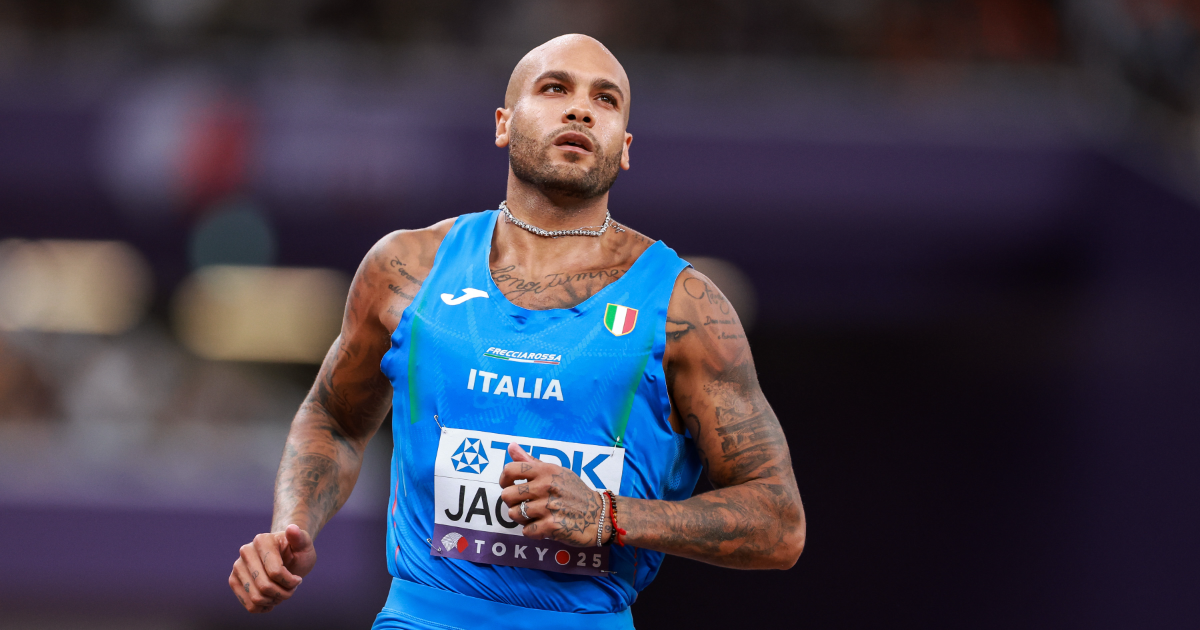
When Marcell Jacobs won the 2020/2021 Olympics, this newsletter’s subtitle for the write-up on the victory was simply titled, “Wait, who?”
Remember, the Italian had been a long jumper until 2018 and it wasn’t until a couple months before shooting to stardom that he first dipped below the 10-second barrier. His then-personal best of 9.95 would be broken in the Olympic prelims, semi-finals, and finals, where Jacobs earned the most prestigious medal in the world.
Naturally, there was speculation. Coming out of lockdown—a quiet spell for the sport—Jacobs’s seemingly sudden ascension raised yellow flags for many fans. How could someone no one had ever heard of would suddenly be the fastest man in the world? His mixed bag of results that followed only added to the confusion. The next year he won the World Indoor Championships 60m. He then DNS’d the semi-finals at the World Championships, before bouncing back and winning the European Championships, albeit in a time of 9.95—a far cry from his still personal best of 9.80.
In 2023, Jacobs didn’t break ten seconds. In 2024, scratching from previously announced meets became common practice. But when it mattered most, he tended to step up, winning the European title and then finishing fifth in the Olympic final in Paris.
Then it was like rewatching the same movie again in 2025: no World final and a season’s best of 10.16. The online ridicule returned, and the once-massive appearance fees almost certainly started to dry up.
The narrative in track and field is that medals are what matter most. And Jacobs has proven time and time again that he can show up in the most pressure-filled moments. Between the Olympics, Worlds, and Europeans he has nine medals. Medals are what matter most, but the regular season is where narratives are shaped. He has only run in eight Diamond League meets through his career, without winning any and often losing by quite a significant margin. And that’s why such a large gap exists between his reputation and his legacy-defining accomplishments.
This past week, however, Marcell Jacobs’s name was back in headlines, thanks to a regular season mark! At a windy meet in Austria—one you likely didn’t know was happening—he ran 9.67 with a significant tailwind of +4.1 m/s. That performance makes him the second fastest man ever (in all-conditions) behind only Usain Bolt. Even without the wind, that’s worth about a 9.84, an objectively strong mark.
It certainly doesn’t prove that he is the second-best sprinter ever, or even the best this year. However it does prove that five years after coming out of nowhere, Marcell Jacobs is still relevant. Does hindsight help explain that 2021 performance? We weren’t ready to digest it then, but maybe we are now with the benefit of additional context. While some athletes win the Olympics to put an exclamation point on their careers, others first announce themselves via Olympic gold.
Critics have long lambasted Marcell Jacobs—at best as a one-hit wonder who got lucky, and at worst as a potential cheater. But the reality appears to be less sensational: he’s proven himself to be an exceptionally talented, yet injury-prone athlete.
At 31, Jacobs does not appear to be done. After a two-year stint in Florida, Jacobs is now back training under his old coach, Paolo Camossi, and it seems to be working. Winning a blustering 100m at a Continental Tour silver meet isn’t exactly enough to make him the presumptive favorite for World Ultimates, but that result does chip away at previous misconceptions. It may be insane to refer to an Olympic champion as an underdog, but if you’re cheering for Jacobs, it certainly feels like you’re rooting for one.

Kyle Merber
Kyle Merber is a former professional miler turned media multi-hyphenate. While he’s not above dropping a quick “back in my day,” he’s far more focused on the present. Since 2021, he has brought his signature analysis and commentary to track fans across the CITIUS MAG network. When he’s not writing The Lap Count or hopping on podcasts, Kyle manages partnerships and pitches a relentless stream of ideas for Chris to consider. He might not be running a 3:52 mile anymore, but he keeps himself in just good enough shape to ensure the athletes still respect him.