By David Melly
July 15, 2026
It’s been a banner year for the one-lapper. While neither world record has gone down (yet), both the NCAA and Diamond League records have fallen over the course of the last month, with no end in sight to fast times.
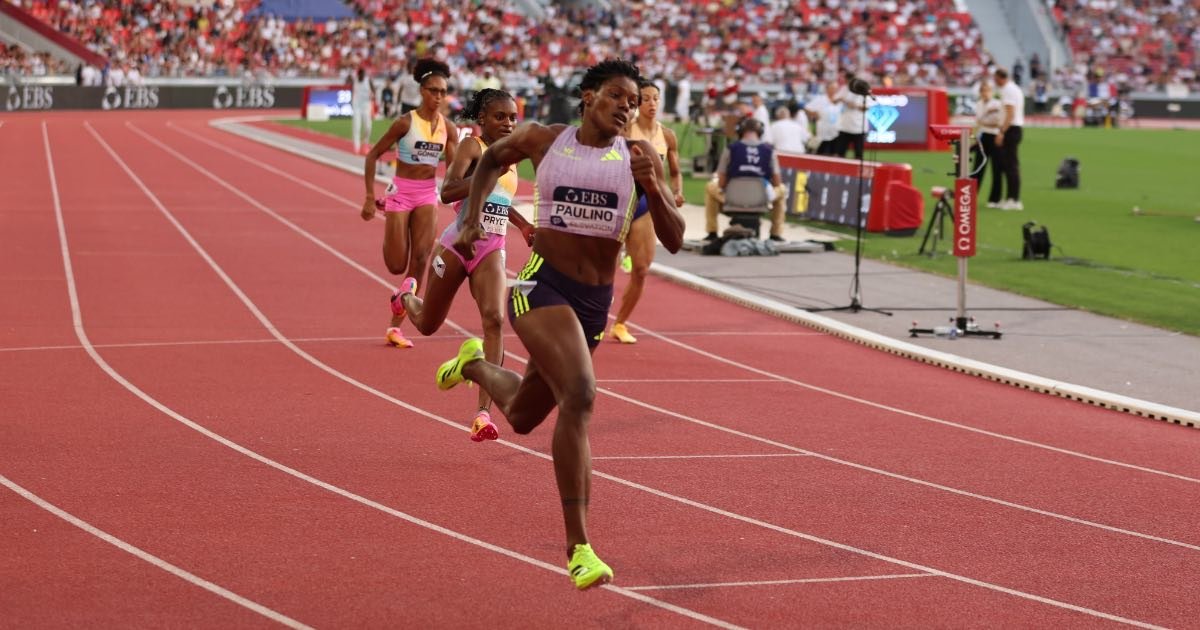
Both 2024 Olympic champ Marileidy Paulino and 2025 World champ Busang Collen Kebinatshipi are riding four-race win streaks and coming off dramatic wins in Monaco. Paulino is running it back in London this weekend, but Kebinatshipi is skipping out—perhaps an intentional decision on the part of meet organizers to give a homer like Matthew Hudson-Smith some time to shine. But it’s not just their winning record that’s turned heads.
Both world leaders are running really, really fast, really consistently, and they’re doing it by running very differently than their competitors. No one on the professional level even-splits a 400m, but both Paulino and Kebinatshipi have become known for their hard-charging closes down the finishing straight. Technically, they’re still slowing down just like everyone else, but compared to their competitors, it looks like they’re finding another gear and kicking it in.
Let’s look at Paulino first. In Monaco, she hit halfway in 23.87, sitting in fifth-place out of eight, and nearly a second behind early leader Lurdes Gloria Manuel. Yet Paulino ended up taking the win in 48.67, with a 0.93-second differential between her first and second 200ms. By comparison, runner-up Aaliyah Butler also broke 49 seconds, but her positive split was more than double Paulino’s—23.23-25.61, for a +2.38 differential.
In Paris, when Paulino set the now-Diamond League record of 48.48, she was in third place at halfway. She ended up winning that race by nearly a full second over Manuel. Poor Lieke Klaver, who led both Paris and Monaco at halfway, ended up fourth and fifth, respectively.
Kebinatshipi’s race splits tell an even more dramatic story. Across four Diamond League victories, Kebinatshipi has not hit halfway in the lead in any of them, and in his two league-record performances this year, he’s positive-split by less than a second. His 43.44 run in Monaco was absolutely ridiculous by professional sprinting standards, not because he ran historically fast but because he did so by going out in seventh place in 21.47, positive splitting by only 0.50 seconds and closing his final 200m under 22 seconds.
It’s hard to put into words how unusual that is, but here’s a quick comparison. Kebinatshipi is now tied with Hudson-Smith at #6 on the all-time list. Hudson-Smith ran his personal best in the 2024 Olympic final, which unfortunately does not have official 100-meter splits like the Diamond League, but a slowed-down rewatch of the race video has him hitting halfway around 20.5 seconds, nearly a full second up on Kebinatshipi two years later, while they crossed the finish line in the same time. As you may recall from that race, Quincy Hall’s dramatic come-from-behind finish for gold stole the show, but even Hall in that race still split roughly 21.3 at 200m.
The one time this strategy didn’t quite work for Paulino was in Tokyo last fall, when both she and World champion Sydney McLaughlin-Levrone closed in 24.8 but Sydney got a 0.14 second advantage at halfway, which ended up being pretty much the margin of victory at the finish (okay, it was 0.20 seconds). They both clocked positive splits in the 1.8-second range, a bit more normal, but still a relatively evenly paced effort.
Weren’t they running such similar races because they were the two top dogs racing each other to the line? Yes and no. Competition is certainly a factor, as the best athletes are pushed by their desire to win. But the 400m/400H, perhaps uniquely as the longest races run entirely in lanes, are so entirely dependent on being able to perfectly gauge your own effort.
The two fastest men in history took two different approaches. When Michael Johnson set his then-world record in 1999, he executed a fairly even effort, splitting 21.22 and hanging on for the coveted sub-22 second half to run 43.18. Current world record holder Wayde van Niekerk set his 43.03 mark running blind – and scared – in lane 9 at the Rio Olympics, and you can tell from the splits: his first half was 20.54, and he unofficially ran a ridiculous 9.78 from 100m to 200m.
So Monaco, and all the history that preceded it, lends itself to two natural conclusions. Either: that pretty much every other long sprinter in the world is going out too hard in the 400m. Or: both Paulino and Kebinatshipi, but especially Kebinatshipi, could run faster in their next races by simply getting out harder. The truth is probably somewhere in the middle, but with their sample sizes growing by the week, there’s a good argument that the pros on the circuit who keep losing to the same runners in the same way may want to change tactics.
While Kebinatshipi’s 21.47 split in Monaco isn’t quite as earth-shattering as Dick Fosbury’s radical decision to jump backwards, it’s notable that four of the last six global titles have been won by runners, male and female, who’ve produced historically fast results with the same race strategy. If you can’t beat ‘em, copy ‘em.

David Melly
Since David began contributing to CITIUS in 2018, he's done a little bit of everything, from podcast hosting to newsletter writing to race commentary. Currently, he coordinates the social media team and manages both the CITIUS MAG newsletter and The Lap Count, supplying hot takes and thoughtful analysis in both short- and long-form. Based on Boston, David breaks up his excessive screen time by training for marathons, crewing trail races, baking sweet desserts, and mixing strong cocktails.