By David Melly
March 19, 2026
Last week’s NCAA Indoor Championship wrapped up in familiar fashion. The fastest 4x400m teams in the country delivered on their top billing, with the South Carolina men and Arkansas women getting the job done despite the targets on their back. For Arkansas, it was their fourth title in the last five years; it’s almost become de rigueur to add ten points to the Razorbacks’ team score before the gun goes off.
Beyond that, however, it was a pretty unusual meet. Many of the most common narratives heading into the weekend took unexpected twists and turns, from upsets to disqualifications to even the highest of expectations getting exceeded.
Sure, there were a good number of favorites getting the job done—Ja’Kobe Tharp and Kayinsola Ajayi brought home two sprint titles for Auburn, and Habtom Samuel completed his set of three NCAA titles with his first indoor victory. Wilma Nielsen picked up two big, but not entirely unexpected, wins in the mile and DMR for the Oregon Ducks, who also swept the multi events. Liisa-Maria Lusti’s pentathlon performance was a bit unexpected, and critical for Oregon’s efforts to fight off the Illinois field event juggernaut, but Payton Bair’s third straight multi title came as a surprise to no one… except, perhaps the Oregonian newspaper, who seems to only know the three-time NCAA champ as a “football player’s brother.”
When the last hip numbers were crumpled up and swept off the track, it almost seemed like there were more lingering questions than answers. In some ways, that’s a bit unsatisfying, but the glass-half-full view is that spending the next few months of the outdoor season grasping for clarity makes the process of fanning all the more fun.
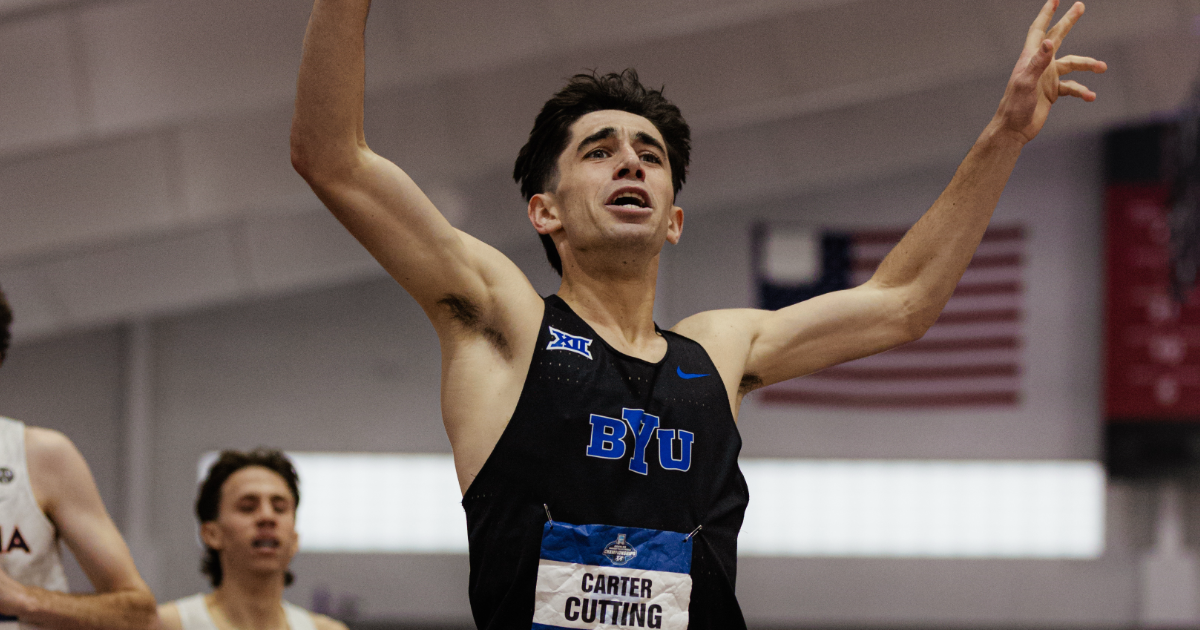
Who the heck is Carter Cutting?
(Editor’s note: out of respect to our BYU friends, we’re sticking with “heck” as the four-letter word of choice.)
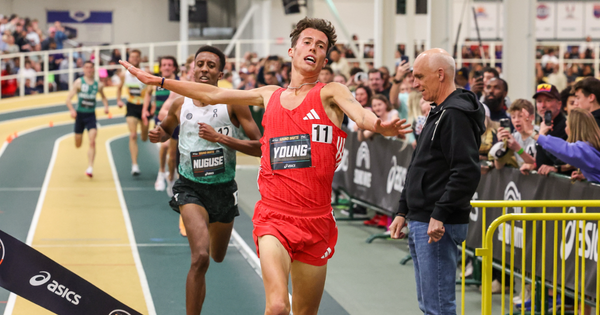
The three biggest favorites in the men’s mile largely delivered on their pre-race expectations: Gary Martin of UVA and George Couttie of Virginia Tech stayed near the front the whole race, and Michigan’s Trent McFarland had the biggest kick, closing in 26.35 for the last 200m. They all finished in the top four… but they all finished behind BYU junior Carter Cutting, the tenth-fastest miler in the NCAA this season. Cutting was the Big 12 champ, but hadn’t finished as the top collegian in any of his other races this season. He’d never run an individual event at NCAAs before, and his mile PB heading into the year was only 3:57.25. That’s not to take anything away from Cutting’s achievements—he’s now a 3:52 guy and the NCAA champion—but it’s safe to say no one outside of Provo saw his breakout performance coming.
Then there’s how the race itself played out. It wasn’t a total crawl, the kind that leads to a chaotic frenzy of unpredictable kicks. And it wasn’t a blistering pace that Cutting managed to outlast. It was somewhere in between, with the field hitting halfway in 2:03 before ratcheting down. Cutting managed to get to the front with 400m to go and masterfully held the inside lane, closing in a respectable but not mind-boggling 55.34 to fend off Martin et al.
McFarland was coming like a freight train in the last lap, but gave himself way too much work to do. Either Cutting found himself in the right place at the right time, or he’s the latest in the Matt Centrowitz lineage of talented runners who punch above their weight with excellent tactics. We’re used to seeing Andy Powell’s stable of middle-distance runners claim that particular mantle, but this time a BYU guy beat both Washington runners in the final at their own game.
What is it about 6.45?
A whopping 15 collegiate sprinters in history have run under 6.50 in the 60-meter dash. But the collegiate record remains stubbornly stopped at 6.45. On Saturday, Kayinsola Ajayi clocked the fifth 6.45 in NCAA history. Not only that, but it’s the second time this year Ajayi has run 6.45.
This particular statistical oddity may never get answered, but barring a rash of pro-contract-signings, it may not last another year. Ajayi and training partner Israel Okon, who finished fifth in the final, are juniors. Arkansas’s Jelani Watkins, a sophomore, ran 6.46 in the prelims and 6.48 in the final. And Malachi Snow of Texas Tech, who finished fourth in the final, ran 6.46 to win Big 12s earlier this season.
What happened to a “wide open team race”?
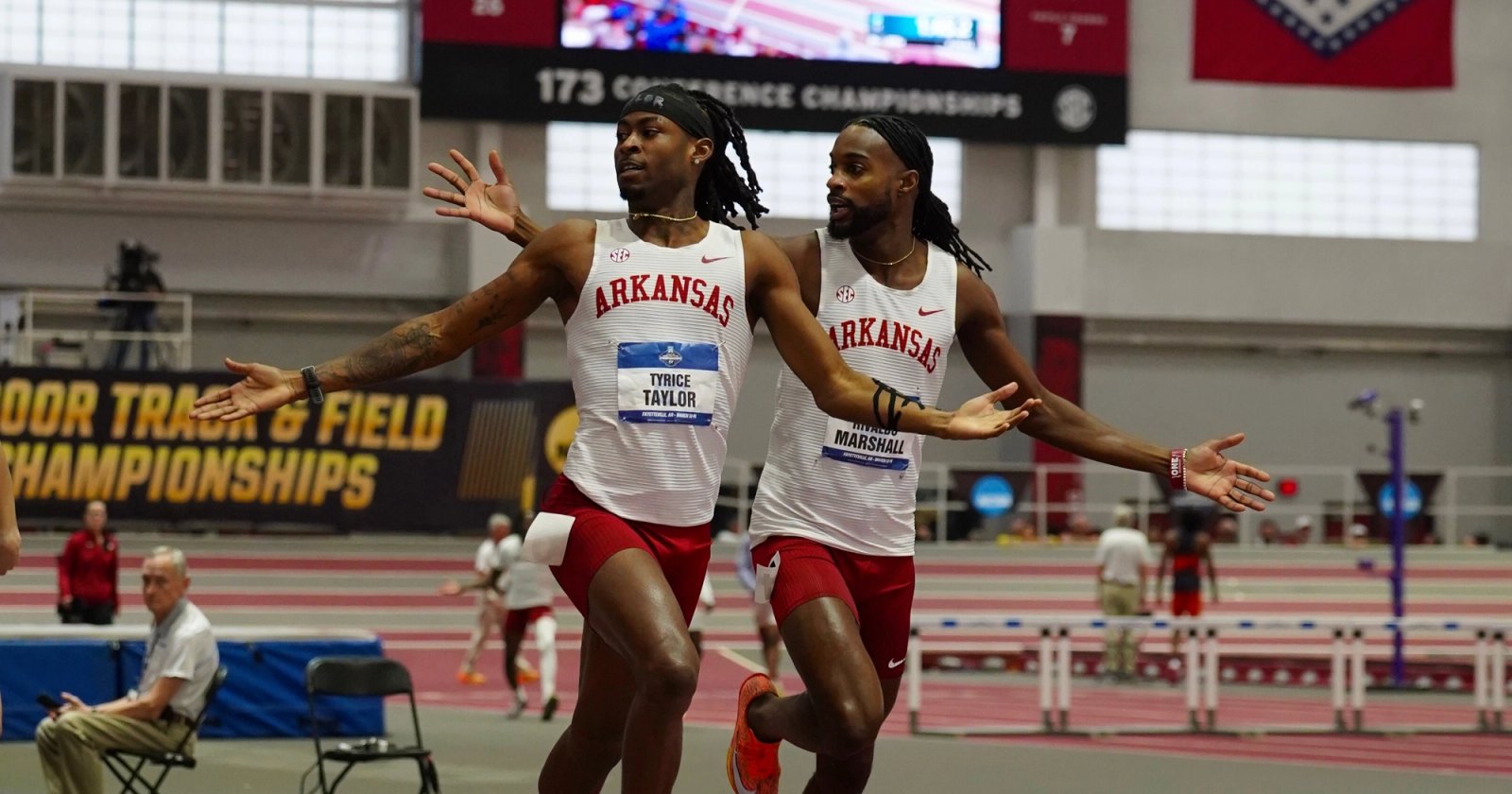
What looked initially like a trophy up for grabs on the men’s side turned into a bit of a dual meet, as Arkansas racked up 73.5 points on its home track to blow the field away. The competition would’ve looked a lot narrower had the Razorback duo of Tyrice Taylor and Rivaldo Marshall not made a mockery of the 800m final, going 1-2 and looking like they were finishing out a medium-easy workout. Arkansas may historically be known as more of a sprint school, but they may very well have won the meet on the backs of their distance runners, as the 800m, plus a runner-up finish in the DMR and Ernest Cheruiyot’s 11 points in the 3000m/5000m, totaled 37 points, just about the margin of victory over runner-up Oregon.

Jasmine Fehr / @jasminefehr
The women’s team pursuit was supposed to be a battle of track vs. field, as the Illinois throwers, jumpers, and multi-eventers set their sights on winning a national title without scoring any points on the oval. But ultimately, balance won the day: Georgia’s winning total of 53 points came from seven different events, compared with second-place Oregon (44 points off four event wins) and third-place Illinois (42 points in four events). The Bulldogs were the only team in the entire women’s competition to score in multiple track and multiple field events. In a star-heavy era of track and field, depth and breadth still wins titles.
Why was Habtom Samuel the one DQed?
One of the most controversial events of the whole meet was the men’s 3000m, where Habtom Samuel initially crossed the finish line first but ended up on the wrong side of a series of protests and got DQed. Colin Sahlman, NAU’s hero of the DMR the night before, is now officially a two-time NCAA champion. Rules are rules, and fair is fair, but if you watch the contact on the final lap, it’s not exactly clear that Samuel was the one at fault. With 120m to go, Villanova’s Marco Langon initiates contact with Samuel, and appears to cut in on the New Mexico runner as they both approached the final turn. This jockeying in turn led Samuel to run into the back of Sahlman, who stumbles a little but is otherwise mostly unaffected.
One could argue that the Samuel-Sahlman contact made the difference in the victory, as initially Samuel was given the win 0.01 seconds ahead of Sahlman, and that’s why Samuel got bounced. But the full chain of events looked more like Samuel was forced into Sahlman in an attempt to defend his space against Langon, but Langon remains in the results as the third-placer (Oregon’s Simeon Birnbaum snuck up to second on the inside in the final strides). These are tough calls for officials to sort out, but it does seem like in the interest of fairness, either both Samuel and Langon should’ve been DQed, or neither—yet only one got the axe.
Was it always going to be so easy for Jane?
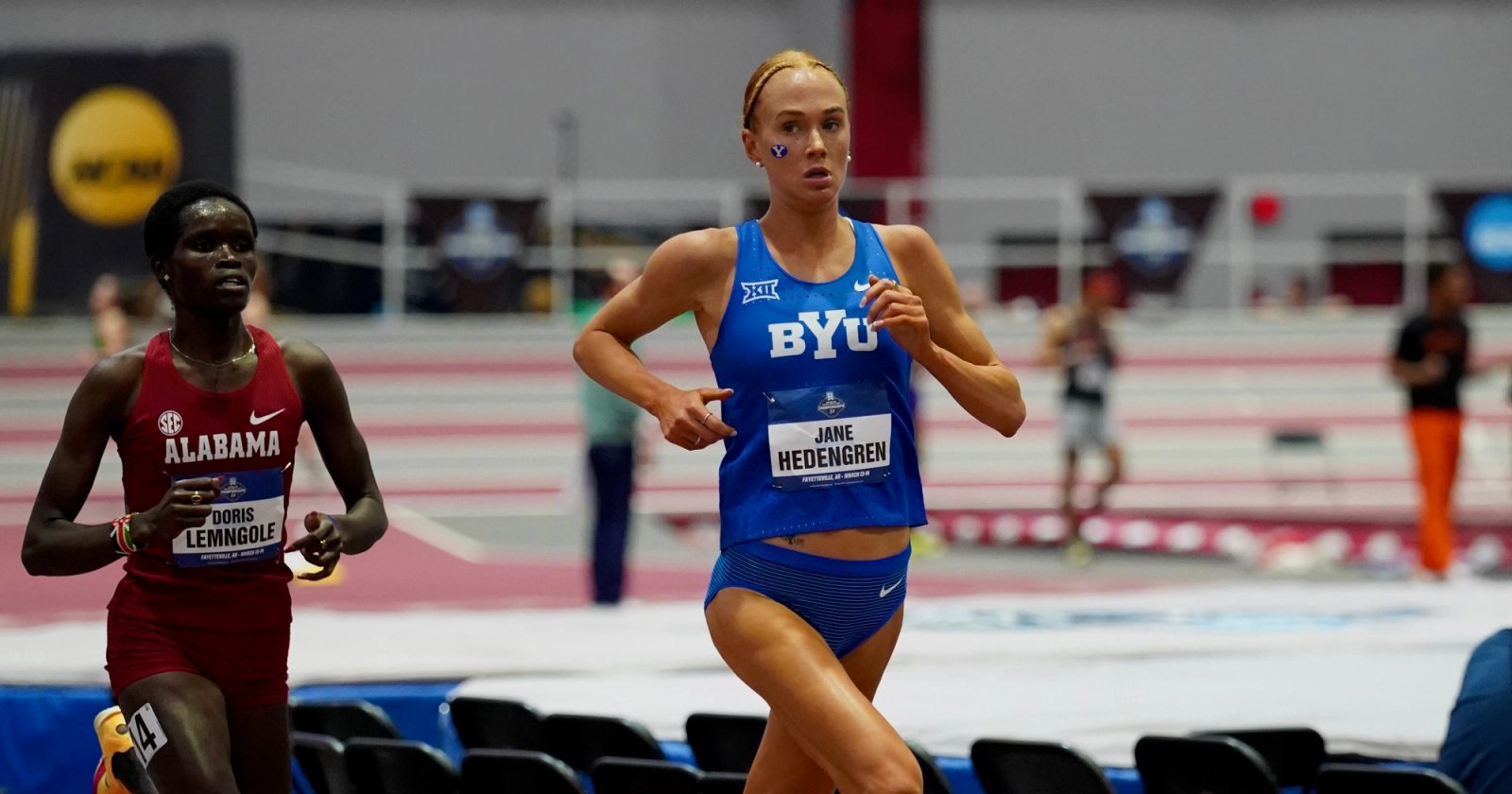
Heading into the weekend, everyone was hyped up for Jane Hedengren vs. Doris Lemngole round 3 (and 4). The BYU freshman and the Alabama junior had met up twice before, at NCAA cross country and in the Millrose Games 3000m, and both times Lemngole’s closing speed proved too much to overcome. Smartly, Hedengren didn’t test her luck a third time, instead opting to tighten the screws from the front each lap, beginning with a mile to go. It was a masterclass in winning from the front, as Hedengren methodically ratcheted the pace down from 35-second laps to 31.81 with two laps remaining. By the time the bell rang, Lemngole was both gapped and cooked.

Jasmine Fehr / @jasminefehr
The next day, Lemngole was an unfortunate DNS in the 3000m—suggesting that, perhaps, health was a contributing factor to her showing the day prior—leading Hedengren to cakewalk her way to the first distance double by a true freshman in collegiate history. Soak it in now, because it feels highly unlikely that Hedengren is going to stick around the NCAA for ten more seasons.
So, uh… how do we feel about the women’s sprints?
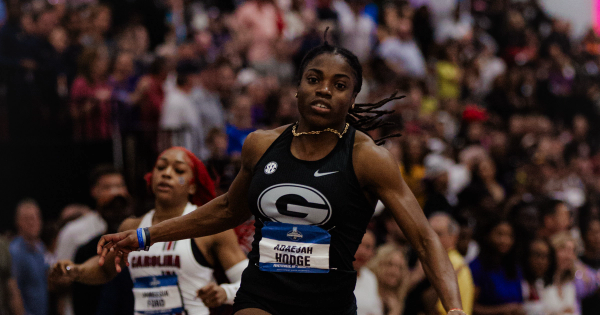
The other big NCAA controversy after DQgate didn’t even hit until two days after NCAAs ended. On Saturday, Georgia’s redshirt freshman Adaejah Hodge made her biggest splash yet as a collegiate athlete, winning the 200m in 22.22 and finishing second in the 60m in 7.15. Hodge is a more familiar face than most NCAA newcomers, because track fans have seen her dominate big stages for years, first as a high school phenom for Montverde Academy, then at Worlds in 2023, then as a World junior champion and Olympian in 2024. Now that she’s beaten more experienced 200m runners like JaMeesia Ford at both SECs and NCAAs, it seemed like we were witnessing the coronation of another great sprint talent.
Except… the celebratory vibes, both for Hodge’s individual performance and Georgia’s team title, were dampened a bit on Monday when the AIU announced that Hodge had previously tested positive for a prohibited substance in 2024 and quietly served a ban that ended in January 2026. On the heels of a similar situation with Hodge’s MVA teammate Issam Assinga, who was issued a four-year ban around the same time as Hodge’s initial violation, some rightfully critical eyes have been cast on the coaching and training setup for the high school sprint powerhouse.
Hodge served her time, and the fact that she cooperated extensively with anti-doping authorities and was only 17 years old at the time of the violation provides some more nuance and context to what otherwise might be a more cut-and-dry villain narrative.
On one hand, it’s easy to combine the timing of the announcement with a hard-core stance on clean sport and cook up any number of rage-fueled conspiracy theories. On the other, you could see this as a situation where a high schooler was led down the wrong path by a bad coaching setup and is trying in good faith to turn the page. It’s entirely up to you.
All in all, the best word to describe this weekend’s NCAA festivities is simply… strange. In the spirit of March Madness, it’s always more fun when the outcomes don’t match the seed lines, and by that metric, NCAAs was quite the success. And whether you’re pulling for Lemngole, Samuel, Martin, or the Fighting Illini, there’s plenty of comeback stories just around the corner as the calendar flips to spring and a wild outdoor season to come.
David Melly
Since David began contributing to CITIUS in 2018, he's done a little bit of everything, from podcast hosting to newsletter writing to race commentary. Currently, he coordinates the social media team and manages both the CITIUS MAG newsletter and The Lap Count, supplying hot takes and thoughtful analysis in both short- and long-form. Based on Boston, David breaks up his excessive screen time by training for marathons, crewing trail races, baking sweet desserts, and mixing strong cocktails.