By David Melly
March 4, 2026
Hope your ferry ride home went smoothly! The 2026 USATF Indoor Championships returned to Staten Island for the second year in a row, and now we have (most of) our Team USA spots selected for this year’s World Indoor Championship in just two short weeks.
There’s two ways to look at U.S. Indoors in a year like 2026. On one hand, the “no global championship” vibe casts a bit of a pall over the whole season, as global stars choose to focus on having babies or launching music careers instead of loading up a full race schedule. But also, the lack of bigger fish to fry makes all the smaller fish appear slightly larger by comparison. If you abide by the theory that track athletes can only really peak two or three times max per year, you may choose to allocate one of those peaks to mid-March as a result.
As for us? We’re taking the glass-half-full view on U.S. Indoors, particularly given how unusually stacked a few events were. The men’s 60m featured Noah Lyles facing off with Trayvon Bromell—and neither took home the win. The 3000m lived up to the hype with Cole Hocker, Yared Nuguse, and Nico Young toeing the line and crossing the finish in basically a blanket. And the women’s 1500m featured yet another clash between Nikki Hiltz and Sinclaire Johnson, the two fastest American milers in history.
But here’s the thing: Hiltz, at 31 years old, was the only athlete in their 30s to take home a national title on the track. In the field events, shot put champ Roger Steen was the oldest U.S. indoor champ overall at 33, but only he and Chase Jackson (31) could join Hiltz in claiming the mantle of “Millennial.”
If there’s been a broader age trend in professional track over the last few years, it’s increased longevity. From Shelly-Ann Fraser-Pryce and Eliud Kipchoge on down, advancements in training and injury prevention have made it easier to view your mid- to late-30s as fruitful medal-winning years, not just a victory-lap addendum where commentators bring up your age constantly with a tinge of pity.
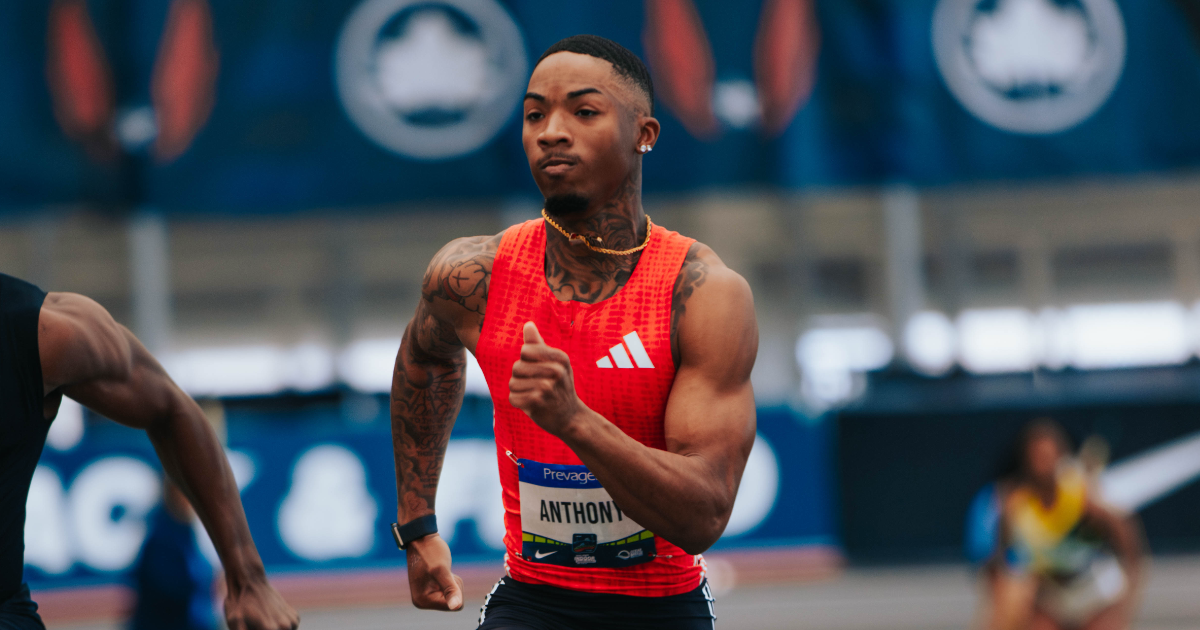
This weekend’s Staten Island antics revealed a very different theme: the next generation of stars isn’t just on their way; they’ve arrived. And assuming everyone accepts their spots, there will be more teenagers than moms on the World team. When Trayvon Bromell won his first World Indoor gold in 2016, this year’s 60m national champ, Jordan Anthony, was 11 years old.
The biggest standard bearer for the rise of young American talent is 17-year-old Cooper Lutkenhaus, who won the 800m title in 1:46.68 while looking like he was barely breaking a sweat. Lutkenhaus is clearly a generational talent, but every other pro in that race is likely hearing footsteps after a high school junior took them to the cleaners.
But he wasn’t the only record-setting wunderkind in Ocean Breeze. The runner-up in the women’s 60m was Mia Maxwell, who equaled the U.S. high school record with her 7.13 run. Her twin sister Mariah was only one spot and 1/100th of a second behind. In the men’s 60m, 16-year-old Dillon Mitchell was only seventh in the final, but earlier that day he ran 6.59 to set the U18 world record in the event. If these kids even make it to college before turning pro, God help their competition.
Speaking of “glad they’re not in college right now,” the sprinters of the SEC must feel pretty proud of their alumni—and pretty relieved they didn’t have to race them in Fayetteville this weekend. Across the men’s and women’s 60m, 400m, and 60H, five of the six champions came from the best sprint conference in the country (the lone exception being Howard University alum and 60H national champ Dylan Beard).
In particular, Anthony and Jacious Sears, the women’s 60m champ, are looking a lot like the Next Big Sprint Sensation. After winning the 60m and 100m at NCAAs last year, Anthony looked well-positioned to make a World team outdoors, but he couldn’t quite sustain the peak into August and ended his season at the semifinals of USAs. Sears has struggled at times to stay healthy, but when she’s able to get uninterrupted training and racing in, her prodigious talent is able to really shine. It’ll be great to see them take on more international competition later this month in Poland and see where they really stack up.
The middle-distance races featured a murderer’s row of 20-something’s in their racing prime, with 22-year-olds Addy Wiley taking the 800m in an indoor PB of 1:59.43 and Nathan Green out-maneuvering the 1500m field to win a tactical race in 3:37.65. The 3000m champs, Hocker (24) and Emily MacKay (27), aren’t exactly retirement age either. What’s all the more impressive is that the “veterans” in the field, like Elle St. Pierre and Yared Nuguse (both second in the 3000m) aren’t exactly fading or aging out; they’re simply being matched by the rising tide they helped start.
All this focus on the young guns isn’t to imply that the best Americans of 2025 are washed. It’s just shown that no one, not even Noah Lyles, can sleepwalk their way to a U.S. title anymore. You better show up sharp and prepared—and you still might get beat. In many, if not most, track and field events, the U.S. team is the hardest in the world to meet, and the swarm of new talent on the senior stage has only made things tougher. That’s a great problem to have, because it makes every race, even the indoor championship in a “down year,” more competitive and thus, more exciting. If you’re a pro reading this, just don’t get complacent, because no one else is.

David Melly
Since David began contributing to CITIUS in 2018, he's done a little bit of everything, from podcast hosting to newsletter writing to race commentary. Currently, he coordinates the social media team and manages both the CITIUS MAG newsletter and The Lap Count, supplying hot takes and thoughtful analysis in both short- and long-form. Based on Boston, David breaks up his excessive screen time by training for marathons, crewing trail races, baking sweet desserts, and mixing strong cocktails.