By Kyle Merber
January 21, 2026
We don’t know whose idea it was to add a 2000m to the schedule at Saturday’s New Balance Indoor Grand Prix, but we do know that person is a genius! Despite it being the first race of the season for everyone in the field, and an “off” a distance, this 2000m is teeming with intriguing storylines. That’s just what happens when we get to witness a clash of athletes from neighboring events.
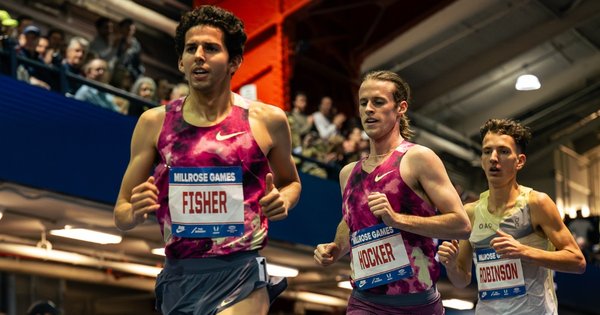
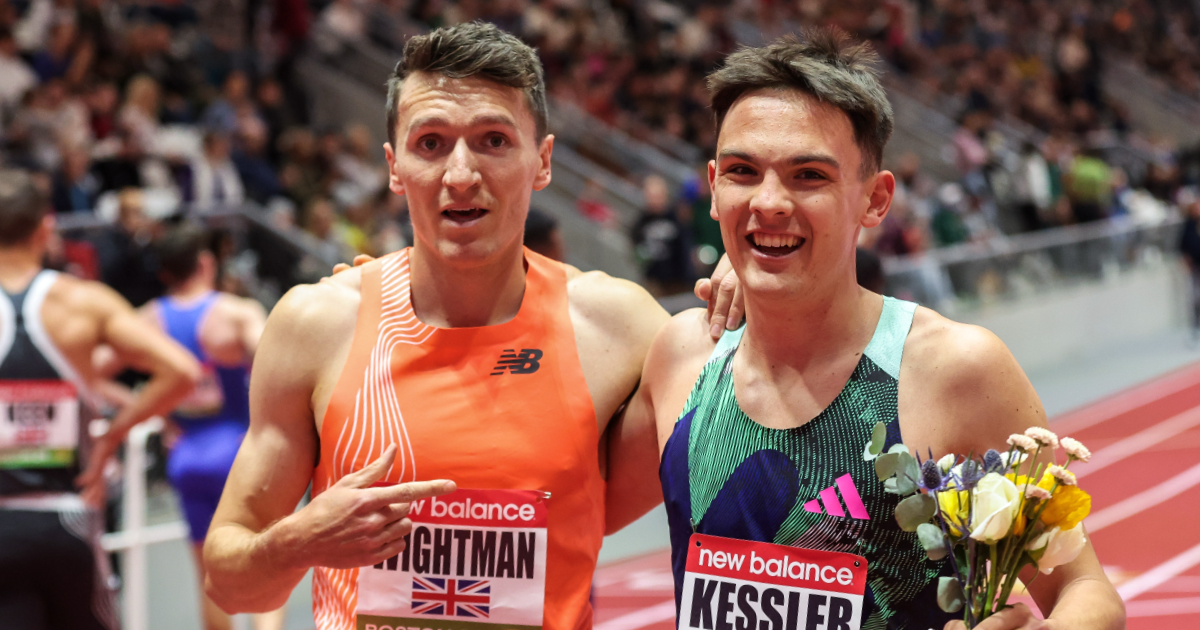
If you had to describe one person in the field as its headliner, that’d be Grant Fisher, the American record holder in… practically everything! But most notably, he has two Olympic bronze medals and the world record in the indoor 5000m. Then there’s Jake Wightman, the 2022 World champion in the 1500m, who proved at the end of last season with a close silver medal that he has returned to his top—and importantly, healthiest—form.
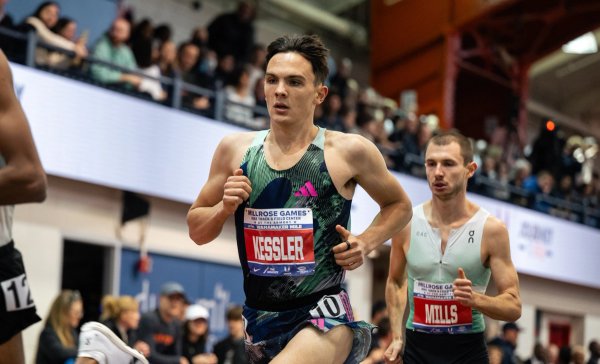
If this was a mile, then we know where the Polymarket obsessives would be placing their bets. If this was a 3000m, then even more so. But it’s not—it’s a 2000m, which also opens the door for someone like Hobbs Kessler, who last year looked one 7+ mile run away from being strong enough to contend in some overdistance. Coming off last week, we’d be remiss not to mention Belgium’s Pieter Sisk, who set a dominant 1500m world lead of 3:34 in Luxembourg. But this isn’t a preview… it’s a love letter to the perfect distance!
For a middle-distance fanatic, the five-lapper (or in this case, ten) is ideal—not because the average human attention span continues to shrink, but because it invites a clash of titans that would normally never be competitive against one another. The aerobic gap between the 1500m specialists and the 5000m runners is significant, at least for those who lack the athleticism to clear barriers.
It’s a chance for the strong 1500m runners who suck at tempo runs to thrive without having to worry about letting a race go so slow that an 800m runner could be waiting in the wings. However, that’s rarely a concern, as the 2000m has never been part of a major championship, despite being an internationally ratifiable distance. This ain’t no World Best!
Considering the “off-year” vibes of 2026, this feels oddly right as a pro opener. The regular season doesn’t naturally build in a crescendo of interest as it would during an Olympic year. Therefore, rather than trying to coerce fans into getting as gassed up about World Ultimates as they would a conventional global championship, it’s in the interest of the public to lean into the unknown—and to embrace the chaos.
For context, the outdoor world records for the event are 4:43.13 by Jakob Ingebrigtsen and 5:19.70 from Jess Hull. On the surface, staging an elite 2000m feels like a great opportunity for meet organizers to chase the photo-op of handing an oversized check to whoever breaks a rarely contested world record. But the record’s no joke! When Jakob got his mark in 2023, he ran the first 1600m in 3:48 and then closed it out in 54.9! According to the World Athletics scoring tables, that is a more impressive performance than both Hicham El Guerrouj’s 1500m and mile records. Take all scoring conversions with a grain of salt… but still.
With the sub-four mile becoming increasingly commonplace with every passing BU meet, the sub-five 2000m should be the new barometer of success to separate the best from the rest, or at least impress dorky potential partners at bars. Since Roger Bannister didn’t run through the line for an extra-speedy victory lap, we had to wait another 12 years before West Germany’s Harald Norpoth dipped under five, going 4:57.8 in 1966.
To date, 185 men have broken five minutes at the distance. That’s fewer than the number of men who’ve run 9.98 or faster in the 100m (193). #185 on the 1500m all-time list is 3:32.13, in case you’re wondering. Since HERE IN AMERICA, we tend to tack on 109m if we want our 1500m runners to push their limits, all of those marks were run in Europe except for a single incredible race at the 2014 Millrose Games, won by a then-39-year-old Bernard Lagat in 4:54.74.
For most of us stateside, we never had the opportunity to run the 2000m. Perhaps you speculated about how good we would have been at it? Or maybe you’ve rowed on an erg at the gym, since that distance became the standardized measurement of rowing greatness during the 19th century. (Before you Google it, the men’s record is 5:35 and the women’s is 6:21.)
As we lead into this weekend’s race in Boston, it is not a fair expectation that this field will crack Kenenisa Bekele’s indoor record of 4:49.99, though it’s certainly possible. (Quick fun aside: technically, Bekele never even broke four minutes in the mile.) But we don’t care so much about the clock—we care about the chess match. Will a 56-second penultimate lap be enough to shake the milers? Will anyone be sharp enough for a sub-26 close? And the most important question of all: Who will make the off year their “on year”? We may find out this weekend.

Kyle Merber
Kyle Merber is a former professional miler turned media multi-hyphenate. While he’s not above dropping a quick “back in my day,” he’s far more focused on the present. Since 2021, he has brought his signature analysis and commentary to track fans across the CITIUS MAG network. When he’s not writing The Lap Count or hopping on podcasts, Kyle manages partnerships and pitches a relentless stream of ideas for Chris to consider. He might not be running a 3:52 mile anymore, but he keeps himself in just good enough shape to ensure the athletes still respect him.