By David Melly
June 24, 2026
To quote the great poet Robert Frost: “Two roads diverged in a wood, and I—I took the one that I hoped would lead to 1500m gold.”
…or something like that. These days, 1500m gold actually feels like a road more traveled. Every year it’s a different guy on the top step of the podium. As a result, we’ve got an ever-increasing sample size of the path to middle-distance success—and a dwindling sample of strategies for sustained, multi-year dominance.
Historically, very few milers are equally skilled at both 800m and 5000m. Only two men in history have broken 1:45, 3:30, and 13:00, and they were two of the all-time greats: Saïd Aouita and Augustine Choge. Conventional wisdom is that there are two kinds of 1500m runners, the speed-based ones and the strength based ones. In our bicarb-fueled current reality where winning championship times in the 3:20s are becoming downright commonplace, the balance seems to have tipped toward the latter, with runners like Jakob Ingebrigtsen, Yared Nuguse, and Cole Hocker finding success in fast-from-the-gun wars of attrition.
Call it the Timothy Cheruiyot Effect. The lesson from the 2019 World Championship was clear: Cheruiyot opened up a huge gap on the entire field by front-running alongside teammate Ronald Kwemoi, and the gap proved insurmountable. Cheruiyot ended up winning by two full seconds in 3:29.26, rendering the kicks of Matthew Centrowitz, Taoufik Makhloufi, and others powerless. In the next four global finals, the winner has changed, but the winning time has been 3:29 or faster every time.
Fast forward to 2025, when the absence of Ingebrigtsen in his de facto pacer role meant that the winning time was 3:34.10, and the top three spots went to speed demons. 2025 champ Isaac Nader has run 1:43.86 in the 800m, but he’s never raced a track 5000m; runner-up Jake Wightman has only run 13:52 on the roads; and bronze medalist Reynold Cheruiyot has a PB of 13:16.40.
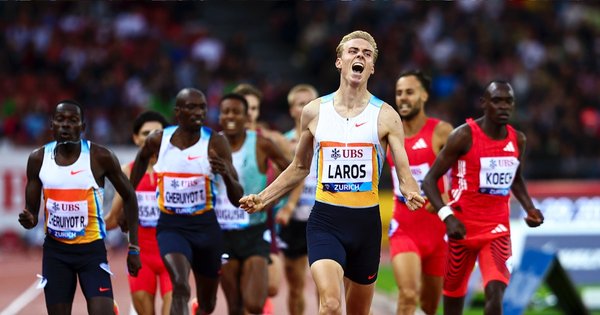
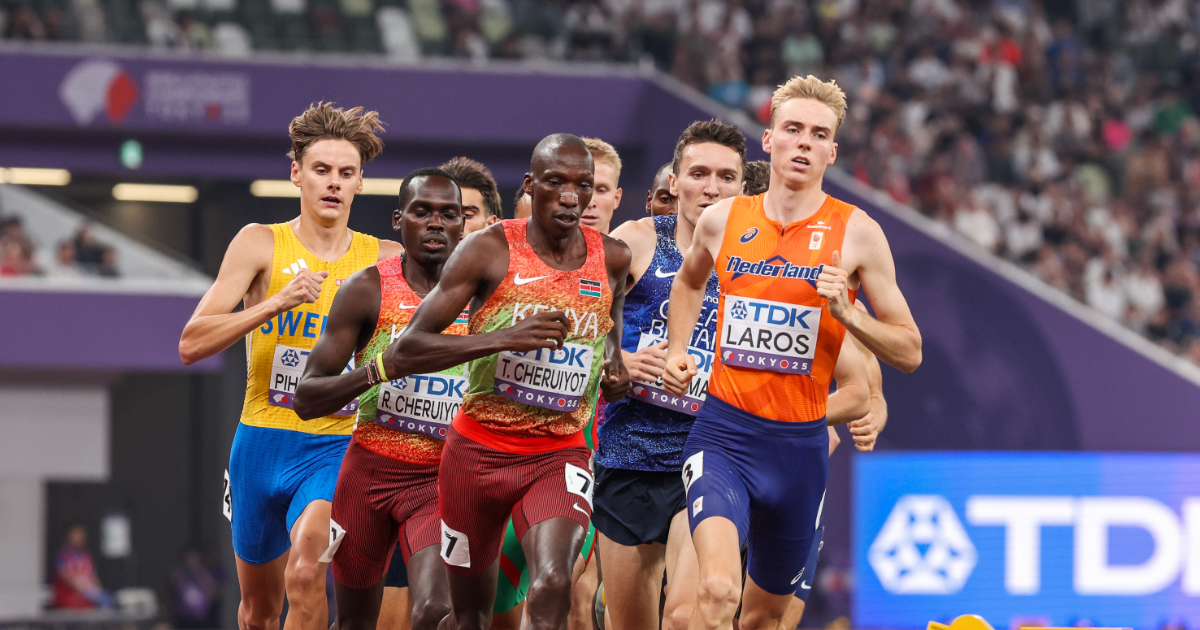
Is razor-sharp footspeed back in style? Niels Laros seems to think so. The 21-year-old Dutchman ran his first race since last year’s World 5000m final this past weekend in Hengelo, clocking a 1:43.83 PB for the win. Laros has “only” run 13:10.86 in his short but illustrious career so far, but he’s also run 7:29.49 in the 3000m and his best results in 2025 came in fast-paced Diamond League races.
Even before his 800m last weekend, it was clear that Laros wasn’t settling for one road or the other. At the European U23 Championships, he skipped the 1500m entirely and instead picked up wins in the 800m and 5000m, using the opportunity of slightly-watered-down age-group competition to hone his chops at both ends of the spectrum. At the Pre Classic, he first burst into the international spotlight with his epic kick to reel in Nuguse from way back, but in the Diamond League final, he took the win in 3:29.20 by sticking in the top three the whole race.
In Tokyo, Laros ended up fifth as the shuffle and chaos of a kicker’s race didn’t quite work out in his favor. After handily dispatching many of the same men in three different DL races, he discovered a racing weakness the hard way. Much like the men in that 2019 final finding themselves unable to reel in Cheruiyot over the last lap, there was a lesson to be learned, and if Laros’s season opener is any indication, he’s taken it to heart.
Generally speaking, the most consistent middle-distance runners of the 2020s have been jacks-of-all-trades, or something close to it. Josh Kerr has yet to run a fast 5000m, but his battles with Cole Hocker over 3000m and two miles make it clear that he isn’t wilfully sacrificing strength for speed in training. Jake Wightman is generally known for his kick, as demonstrated in last year’s final, but it’s worth noting that the 2022 World champ won his gold medal in a 3:29 race, staying close enough to Ingebrigtsen to use his speed to its max effect. With all the advancements in training, fueling, and technology, it’s easy to envision the list of sub-1:45/3:30/13:00 guys ballooning rapidly in the next few seasons.
If Laros is going to keep the streak alive in 2027 of a new World 1500m champion being crowned each year, he’s got to be prepared for either kind of race. And if anyone else wants a chance at beating him to the punch, it’s looking increasingly like they’ve got to reject the notion that the two middle-distance roads must diverge and try to venture down two paths at the same time.

David Melly
Since David began contributing to CITIUS in 2018, he's done a little bit of everything, from podcast hosting to newsletter writing to race commentary. Currently, he coordinates the social media team and manages both the CITIUS MAG newsletter and The Lap Count, supplying hot takes and thoughtful analysis in both short- and long-form. Based on Boston, David breaks up his excessive screen time by training for marathons, crewing trail races, baking sweet desserts, and mixing strong cocktails.