
By Kyle Merber
October 11, 2023
If only the Chicago Marathon was a couple of weeks ago!
Just six weeks after Sifan Hassan competed in three different events at the World Championships in Budapest, she took to the streets and ran 2:13:44 to become the second-fastest woman ever at the distance. Had it not been for Tigist Assefa’s earth-shattering run of 2:11:53 in Berlin, then this would have broken the four-year-old mark of 2:14:04 set by Brigid Kosgei on these same Windy City streets.
In theory, the training required to earn World silver in the 1500m and to win a second World Marathon Major shouldn’t be too similar. But I suppose we should have listened when Hassan said she was doing post-race workouts because she was training through facing off against Faith Kipyegon. To my more impressionable readers, just because it worked for her does not mean it will work for you (maybe good advice when it comes to Kelvin Kiptum’s 180-mile weeks as well, now that I think about it)!
Now that Hassan has proven that she could run five minutes faster than her London debut, it puts her comeback victory there into perspective. Yes, she may have stopped to stretch on occasion, and though she fell off the pace, there was never a mile gap.
It’s quite glorious when the whispers of a world record attempt come to fruition – it creates a lot of anticipation, excitement, and celebration. But there is also risk there, like when it doesn’t happen. I hate myself for feeling even one ounce of disappointment in that moment when it became evident that Hassan was not going to dip below Assefa’s mark. As much as we like to pretend times are completely made up now and that great racing should be the primary focus, it’s still fun as hell to see an increasingly low time on that big clock. Maybe the day will come when I am numb, but that’s a problem for Future Kyle.
While on different courses, Ruth Chepngetich took out Chicago in 65:42 – considerably faster than Assefa, whose first half was 66:20 (Hassan was 65:48). In my preview before the race, I pleaded with Chepngetich to be more conservative. I checked. Unless she’s using a burner email account, she is not a subscriber to this newsletter. Putting time in the bank rarely pays off for amateur athletes, and this is one of those things that’s not too different for the professionals either.

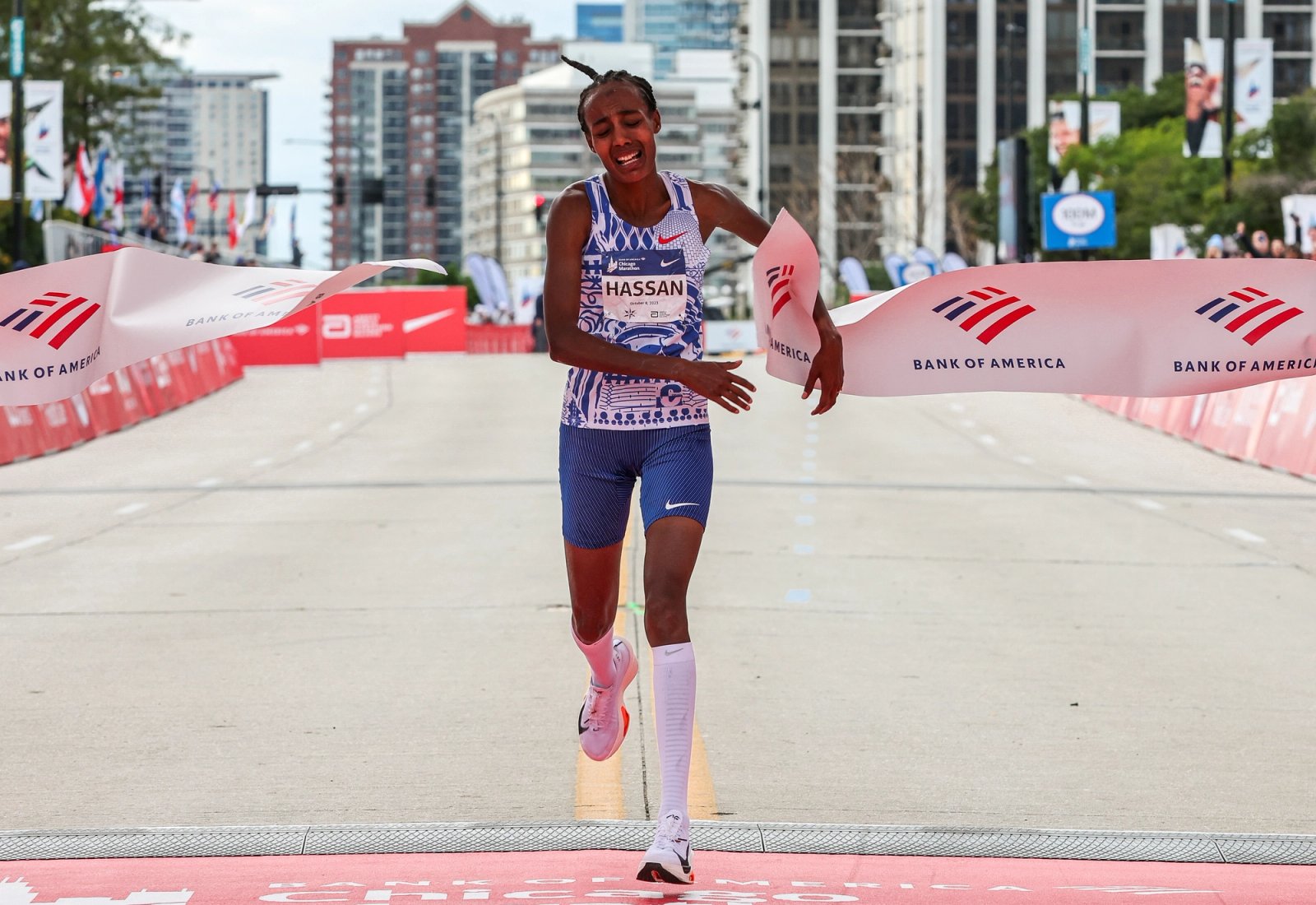
Kevin Morris / @KevMoFoto
Unlike in Assefa’s WR and many of the top female times in the marathon through the years, Hassan did not have a pacer run her to the line and was alone for the last 5-ish miles. Disappointingly but not surprisingly, there was a huge chunk of time in which the stream did not show the women’s race so it’s hard to pinpoint exactly when she embarked on the solo mission.
While 2:11:53 seemed like an incredible outlier just two weeks ago, it is only a matter of time before the gaps are all filled in. At some point, this incredible recalibration of fast times will have to decelerate and there will be a new norm established. Records are not going to be broken annually in perpetuity unless World Athletics loosens its current rulings on shoe limitations. There will eventually be what I assure you I will be repeatedly calling “The Great Stagnation,” and the dots on the scatter plot will fill out between what used to be considered fast and what is now.
Today, 2:13:44 is still fast as hell.

Kyle Merber
Kyle Merber is a former professional miler turned media multi-hyphenate. While he’s not above dropping a quick “back in my day,” he’s far more focused on the present. Since 2021, he has brought his signature analysis and commentary to track fans across the CITIUS MAG network. When he’s not writing The Lap Count or hopping on podcasts, Kyle manages partnerships and pitches a relentless stream of ideas for Chris to consider. He might not be running a 3:52 mile anymore, but he keeps himself in just good enough shape to ensure the athletes still respect him.