By Kyle Merber
November 11, 2026
The off-season for track fans is boring. Now and then an athlete changes coaches or sponsors, or the AIU busts a medalist or two. Mostly, though, there’s little to talk about.
Part of the reason is a lack of statistics. Track and field is a sport built entirely on numbers (on making them smaller if you’re running, and higher if you’re doing something else), yet it has almost no advanced metrics. We get a finishing time, a place and—for the real nerds—a world ranking.
That leaves little to debate beyond “who’s the fastest?” because arguing about who will finish fifth isn’t very interesting. Our attention fixates on the winners, and we overlook qualities that other sports prize in their athletes: consistency, durability, clutch performance, and potential.
Basketball has VORP (Value Over Replacement Player), and baseball has its counterpart, WAR (Wins Above Replacement). Both ask how much better a player is than a freely available replacement, and they carry real weight in debates over each league’s Most Valuable Player, as well as fuel fan chatter about which deep bench addition their favorite team should make in the offseason.
Track’s version might measure how often, and by how much, an athlete finishes in the top half of a field. Noah Lyles rarely finishes off the podium, which suggests he’s far more valuable than a replacement in almost any field.
But saying Noah Lyles is valuable is neither bold nor controversial. We need a predictive statistic that tells us who might be good later, not just who is good now—that’ll give us something new to argue over!
In baseball, projection systems such as ZiPS and Steamer do this. They study a player’s past seasons to flag who might be ready for a breakout, for fantasy players and front offices alike. That’s what track fans need in the off-season: a forecast of who is about to be good. Track statisticians should be measuring trajectory.
Enter PAR, or Performance Against Ranking. For each race, an athlete’s score reflects how far their finish was above or below the place their world ranking predicted, and PAR is the average of those scores:
PAR = average of [(predicted place − actual place) ÷ (N − 1)]
N is the number of ranked athletes in the race. A score of 0 means the athlete finished exactly where the rankings said. A positive score means they beat their ranking, and negative means they fell short. Scores run from −1 to +1.
This first pass considers every 2026 Diamond League race plus the World Athletics Ultimate Championships, taking each athlete’s ranking from the start list for that race. Athletes needed at least three scored races to qualify.
The ten highest PAR scores of 2026:
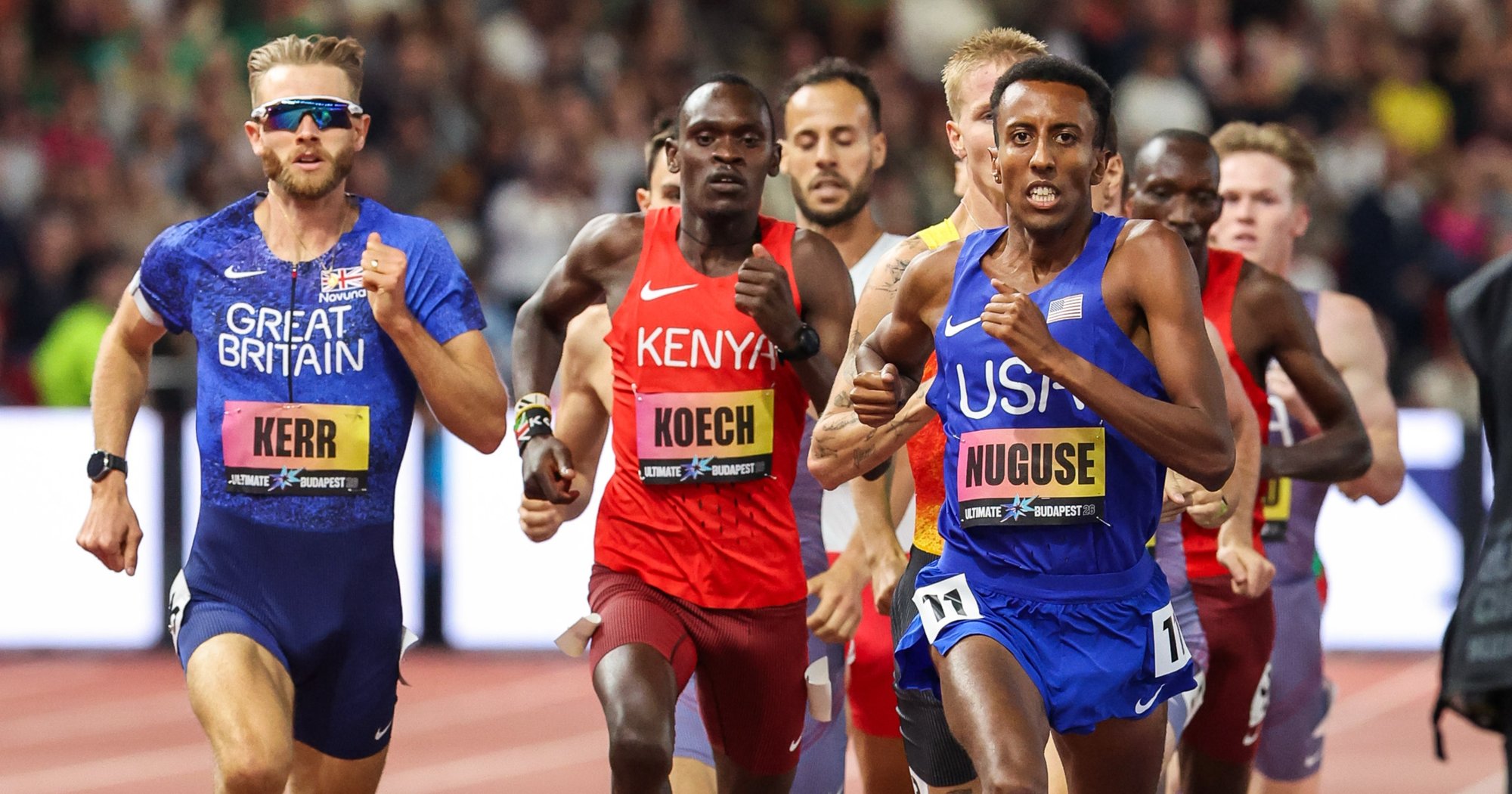
- Phanuel Koech (1500m ): 0.546
- Paulien Couckuyt (400mH ): 0.524
- Jake Heyward (1500m ) : 0.508
- Egide Ntakarutimana (5000m ): 0.419
- Khairi Bejiga (5000m ): 0.391
- Tobias Grønstad (800m ): 0.385
- Stacey Ann Williams (400m ): 0.384
- Klaudia Kazimierska (1500m ): 0.368
- Kayla White (100m, 200m ): 0.341
- Chris Bailey (400m ): 0.328
It isn’t the hottest take to suggest 19-year-old Phanuel Koech is well positioned to become a global superpower given he has run 3:27.72 for 1500m. And Klaudia Kazimierska’s continuous improvement last season eventually landed her at the top spot in her event.
But a guy like Tobias Grønstad would be overlooked in most season recaps. Although he failed to make the World Ultimate Championships as the 22nd-ranked 800m runner, he leveled up in 2026. The goal behind PAR is to quantify Paulien Couckuyt’s trajectory beyond noting her personal best in the 400m hurdles went from 54.45 to 53.20. That’s a precipitous drop, though it doesn’t tell the full story: she one-upped her previous best eight times in one season.
We won’t rub salt in the wounds by listing the bottom ten here… they know 2026 wasn’t their year. So what do you think? Is this a statistic worth tracking? We’ll have to wait for 2027 to find out.

Kyle Merber
Kyle Merber is a former professional miler turned media multi-hyphenate. While he’s not above dropping a quick “back in my day,” he’s far more focused on the present. Since 2021, he has brought his signature analysis and commentary to track fans across the CITIUS MAG network. When he’s not writing The Lap Count or hopping on podcasts, Kyle manages partnerships and pitches a relentless stream of ideas for Chris to consider. He might not be running a 3:52 mile anymore, but he keeps himself in just good enough shape to ensure the athletes still respect him.