By Paul Snyder
July 1, 2026
Coming into this past weekend, the course records at the Western States Endurance Run were held by Jim Walmsley (14:09:28 in 2019) and Courtney Dauwalter (15:29:33 in 2023). It was one of those statistics in sports that felt perfectly intuitive. LeBron James and Diana Taurasi are the all-time leading scorers in the NBA and WNBA… Walmsley and Dauwalter were the fastest ever over the 100.2 mile course at WSER.
But after this past weekend, both course records are considerably faster and held by different athletes. Winner Vincent Bouillard (13:46:15) was one of four men under Walmsley’s old record, and one of three to break the long-coveted 14-hour barrier—Francesco Puppi took second in 13:51:08, Ryan Montgomery came next in 13:53:55, and Thomas Cardin finished in 14:07:58. Jennifer Lichter won the women’s race in 15:28:05, placing 11th overall. Out of the 50 WSERs ever contested, Lichter’s time would have outright won 36 of them.
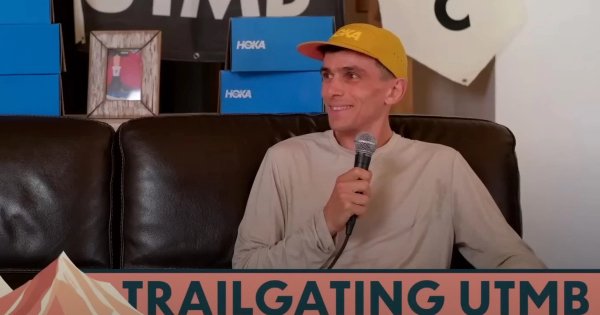
Results such as these surely merit a larger unpacking of the all-time pecking order at the most historic ultra in North America… right? To make sense of what we just witnessed on the switchbacks between Olympic Valley and the Auburn High School track, we checked in with Stephen Kersh, a two-time top-ten finisher at Western States, who was on site photographing and filming parts of the race.
To understand why what just transpired was even possible, let’s start with what Kersh himself was wearing during his long day out along the course: “I was in jeans all day and wasn’t ever very warm.”
This is what most ultra-followers pointed to in the post-race de-briefings—not Kersh’s pants, but the fact that the weather was as close to perfect as you’ll ever get for a race that covers this much varied terrain. “The conditions this year were an anomaly,” says Kersh. “There was no snow along the course due to low snow during the winter, and then the temperatures were some of the coolest in race history, topping out in the high 70s in Auburn (though it certainly was warmer than that in the canyons and along the river).”
Obviously this all contributed to the course records in both men’s and women’s races and the overall historically fast finishing times in the entire top ten. Kersh suggests that the weather provided a psychological boost as well as a physiological one, but he’s quick to wedge a big old caveat in there.
“I think it would be easy to say the weather was what made people really ‘go for it,’ and I’m sure that it played a part in the calculus, but these top athletes are now just complete professionals,” he explains. “They have the ability now to completely focus on this performance and put so many resources into having the perfect day.”
It’s easy to look at a race with as rich a history and surrounded by as much fanfare as Western States and assume that those striving to win it have always been type-A sickos following rigorous training plans, backed up by the latest in sports science. But if you’ve spent any time crewing for a friend at a trail race, you’ve undoubtedly met an old-timer bemoaning the sport’s ongoing transition from fringe activity for recluses, naturalists, and off-the-grid dirtbags, into something that is becoming optimized and that attracts increasingly talented athletes who both love the outdoors and want to kick your ass in terms of exploring it.
Take a look at what Boulliard was doing during his prep for WSER, as outlined by his coach, Mario Fraoli. Lots of aerobic volume, lots of threshold work, lots of heat acclimation, lots of course-specific prep.
The true professionalization of ultrarunning is still fairly new—it might even be fair to say that as a genuine high-end competitive endeavor, it’s a young sport. But given there are some structural similarities between ultrarunning and regularrunning—what we’ll call marathoning for the sake of this piece—we can expect it to reach competitive maturation quickly. And in regularrunning, we are seeing athletes go for it in previously unthinkable ways, and be rewarded. Take the two recent sub-two hour marathon performances, for instance. Kersh thinks that’s what happened to an extent this past weekend.
“The fear of blowing up certainly still exists in the sport, but the chance of lacing one is much higher now,” he unpacks. “The landscape has changed and the caliber of athlete at the pointy end of these races is a more elite, trained, and calculated one. The big swings used to look like someone running recklessly—now it’s just what you need to do.”
There is still an element of caution required in ultras that might now be a thing of the past on the roads. Just ask Hans Troyer, the pre-race favorite who led at a blistering course-record clip before slowing down and ultimately dropping out at mile 78. Other notable DNFs this year included Hayden Hawks, Kilian Jornet, and Walmsley himself. It might be an exaggeration to say anyone on course-record pace was running conservatively, but simply making it through all 100 miles of a 100-mile race remains a significant chunk of the battle.
A lot more can go wrong in a race that takes over half a day to complete than in one that might be completable in about two hours. That’s especially true when your 13+ hour day is spent on undulating and uneven terrain with the potential for tons of sun exposure and often long gaps between aid stations.
Boulliard didn’t hit the lead until he had about two hours of running left, and comfortably ran much of the race several minutes back from whoever was leading at the moment. Lichter likewise took an aggressive yet slightly cautious approach, running hard but still in 20th to 30th position overall for much of the first half of the race, then easing her way up toward the top-10 on the back half. About a third of the way through the race, she overtook early women’s leader Riley Brady and ended up beating Brady by 14 minutes.
So what does this all mean for our collective understanding of ultrarunning greatness? As we enter a new era of performance for the sport, do the legacies of past greats wind up tarnished as their once dominant times are gradually buried? Not quite. Because of the reasons outlined in the preceding paragraph, course records and times probably matter less in ultrarunning than in any other competitive wing of our sport. Its fans and athletes inherently understand that the course and conditions have an outsized impact come raceday, which means placing is the purest measure of greatness.
If anything, ultrarunning is uniquely well-positioned to weather the changes it’s going through for that very reason. Right now, Vincent Boulliard and Jennifer Lichter are the fastest athletes to ever traverse the Western States course. But are they the best champions the race has ever seen? That’s more open to debate, which is the sign of sport that’s navigating its growing pains in a healthy way.

Paul Snyder
Paul Snyder is the 2009 UIL District 26-5A boys 1600m runner-up. You can follow him on Bluesky @snuder.bsky.social.