By David Melly
August 19, 2026
The most exciting and most controversial races of last week’s European Championships, held in Birmingham, UK, happened to be the semis and the final of the same event, held 24 hours apart.
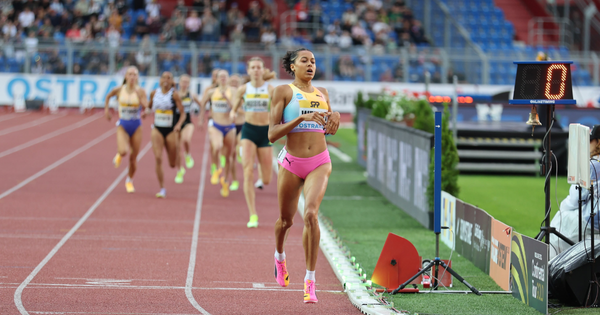
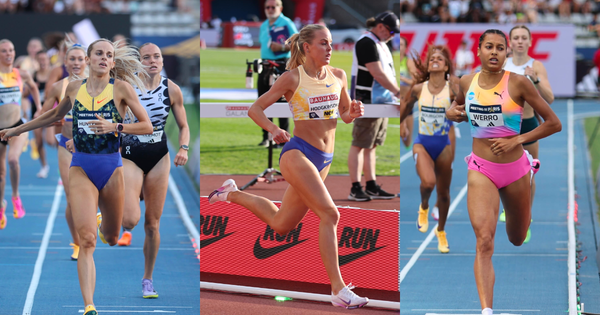
It was clear from the jump that the women’s 800m would be the marquee race of the entire competition—heck, it’s been clear since June 7th, when Audrey Werro beat Keely Hodgkinson and cracked the 1:54 barrier in Stockholm, and even more so since June 16th, when Werro again ran sub-1:55 in Ostrava and Femke Broeders-Bol took second in 1:57.
The trio have been on a much-hyped collision course all summer, as Werro again lowered her Diamond League record to 1:53.80 in Paris and Broeders-Bol made the jump to 1:55.60. After Hodgkinson had to pull out of the 400m final at the UK Championships, some worried that injury woes would deprive us of the head-to-head-to-head matchup we all wanted, but the two-time defending European champ bounced back with a pair of 1:56 victories in Eugene and London. Since finishing second behind Hodgkinson at World Indoors, Werro hasn’t lost a race, but Hodgkinson is a fierce competitor who would be competing in front of a home crowd. Their rematch truly felt like an unstoppable force meeting an immovable object.
From the moment they stepped on the track in the first round of racing, it was clear the two favorites, both bold front-runners, meant business. Hodgkinson set the tone in the first heat of the first round, dropping a ridiculous 1:57.28 prelim, and 10 minutes later, Werro showed she wasn’t messing around either, practically even-splitting a 1:57.83.
But when the semis rolled around on Thursday, the certainty of a two-woman battle for gold was called into question. Disaster struck in the first section, with Werro getting tangled up and tumbling to the ground on the final turn, finishing last in 2:35.35 (more on that below). Then, more positively, Hodgkinson again cruised through in 1:57.38, but this time, she had Broeder-Bol stuck to her shoulder with a smile on her face, looking like she was out for a warm-up jog while running 1:57.46. Perhaps it would be a two-way duel after all—but with the Dutch hurdler taking Werro’s place.
Protests and appeals were filed, and replays flooded both the television and the internet. From one angle, it appeared that Werro had simply stumbled over her own legs, tripping up Gabija Galvydyte as well, who was swiftly advanced. From another, it looked like Anaïs Bourgoin had clipped Werro’s heel with her hand and knocked her just off-balance enough to disrupt her stride. Ultimately, the race officials ruled that Werro had been sufficiently impeded and placed both her and Galvydyte in lane 9, making the final a 10-athlete affair.
The decision made sense on many levels, but of course, a vocal minority (many of whom seemed to be British fans hoping for an unobstructed path to a Keely threepeat) protested that the reinstatement was unfair. There’s an argument to be made that the decision was justified even if the evidence was murky: Werro had done nothing intentionally wrong—certainly nothing to gain an advantage as she ended up with a faceful of track—and fans of the sport, whether buying tickets in Birmingham or tuning in from around the world, benefited from her presence in the final.
Track and field, candidly, could benefit from more discretion at times. The correct decision is not always the right one… although in this case it was both. Had Werro’s untimely fall kept her out of the medal hunt, or worse yet, caused a longer-lasting injury that derailed her summer, we’d all lose. Two of the greatest middle-distance athletes of all time going head-to-head in their primes in meaningful races is a rare thing, and in a year where we’re starving for narratives about why this season matters, the rise of Werro and Broeders-Bol to challenge Hodgkinson’s hegemony has been a welcome thrill.
Friday’s final had all the makings of sporting greatness. Werro was coming in banged up with something to prove. Hodgkinson had the eyes of her home nation all around her. And Broeders-Bol had the benefit of underdog status and an unknown ceiling. More and more, it felt like the sneaky likely outcome was that Femke would steal the whole thing, completing the arc of the Great 800m Experiment that’s been percolating all year.
Hodgkinson held the inside lane all the way around, and by 200m, Werro found herself in the lead. Surely, the reigning champ was remembering how things played out back in June—when Werro got her breakthrough victory by using her rival as a de facto rabbit for 650 meters. Forcing the Swiss 22-year-old to take on the mantle of leading felt like a smart way to turn the tables.
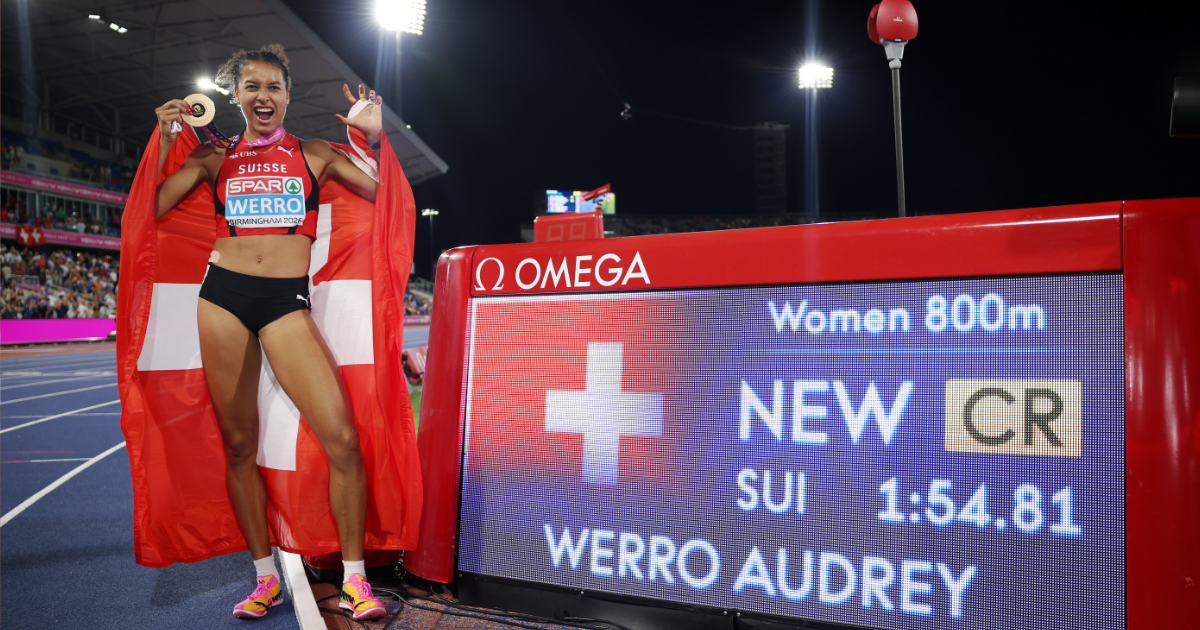
In the end, however, Werro has just gotten too good. Running from the front, she laid down a pace that Hodgkinson simply couldn’t overhaul, even if both women were running pretty much the same speed in the second lap. Werro split 27.4-29.1-29.2-29.1, while Hodgkinson ran 27.4-29.3-29.1-29.2. Those are both incredible runs, decided by a tenth here and a tactical gamble there, and Werro is now the European champ in 1:54.81, with Hodgkinson settling for silver in 1:55.01.
Broeders-Bol didn’t quite have the juice this time to overtake the women she’s been running behind all year, but she did take another meaningful step forward: her bronze-medal run was sewn up in 1:55.54, exactly equalling the 32-year-old Dutch national record. Only a fool would bet that Ellen Van Langen’s mark from 1992 will live to see its 33rd birthday.
Last week proved two things beyond a doubt. Werro is a special, special talent, with the rare combination of front-running speed and back-end strength that makes it nearly impossible to consistently outfox her. Hodgkinson, frankly, did everything right from the first step of the first round, and it still simply wasn’t enough. And the sport benefits greatly when rivalries and racing are paramount—thank goodness track and field didn’t get in its own way this time. When there’s a race that captures our attention, gets people talking, and showcases the best athletes in the world doing their thing, athletics fandom becomes irresistibly exciting. The organizers and overlords of the sport should be very, very grateful Audrey Werro has made herself undeniable this season.

David Melly
Since David began contributing to CITIUS in 2018, he's done a little bit of everything, from podcast hosting to newsletter writing to race commentary. Currently, he coordinates the social media team and manages both the CITIUS MAG newsletter and The Lap Count, supplying hot takes and thoughtful analysis in both short- and long-form. Based on Boston, David breaks up his excessive screen time by training for marathons, crewing trail races, baking sweet desserts, and mixing strong cocktails.