By Citius Mag Staff
August 31, 2026
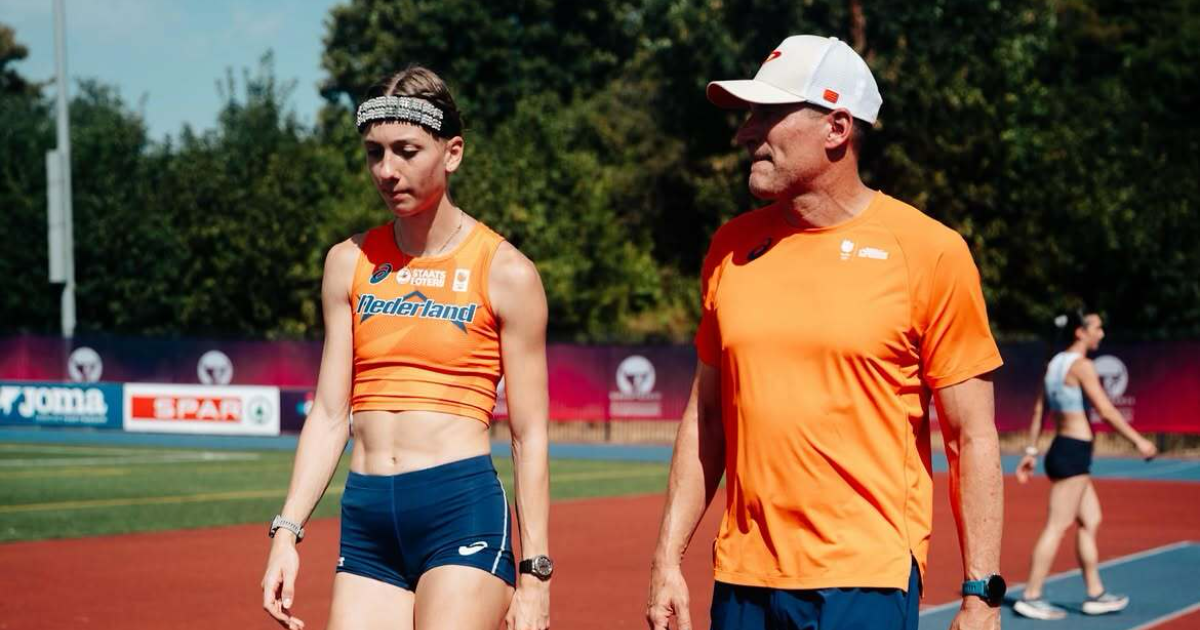
On the latest episode of The CITIUS MAG Podcast, we sit down with Laurent Meuwly, the head coach for sprints, hurdles, and relays at the Dutch Olympic Training Centre in Papendal. He has been with the Dutch program since 2019, and the group he has built includes Femke Broeders-Bol, Lieke Klaver, Nadine Visser, and a rotating cast of international athletes including Australian sprint star Torrie Lewis.
Under his guidance, Dutch relay teams have become a dominant force on the world stage, and his athletes have collected world titles, Olympic medals, and European records across the flat 400, the 400 hurdles, and now — in her first season of competition at the distance — the 800 meters. That last one is the main reason we wanted him on.
When Femke Broeders-Bol made the decision to move up to the 800 this season, it was Laurent who had already been thinking about this moment since he first started working with her. He actually talked her out of making the switch a year earlier than she wanted to — she wanted to go right after the Paris Olympics, he convinced her to stay at 400 hurdles for one more season, win a second world title, and leave that chapter on a high note. Then came the transition.
This interview was done one day after Femke ran 1:54 — putting her within the top ten on the all-time list. Laurent is candid about everything: what he kept from Femke’s 400 hurdles training and what he changed, why her mileage stays around 60 kilometers a week, the mental adjustment of still being only halfway through the race after one full lap, why the world record conversation will eventually shift from who breaks it to conversations about 1:52.
Everyone’s been interested in the Femke Bol 800m transition and we’ve got the inside scoop. The following interview has been edited lightly for clarity. You can listen to the conversation in its entirety on Apple Podcasts, Spotify or wherever you get your shows.
CITIUS MAG: Maybe let's start with your background a little bit, so that people know the context. You've been part of the Dutch training setup since 2019 and before that you started coaching from a very young age.
Laurent Meuwly: Yes, I've been coaching since I was 18 years old. You know how it starts: you're in a club and there's a need for coaches for the younger athletes. I started there once a week, then twice, then three to five times a week. And then I took different steps towards a regional training center, a national training center, national coach in Switzerland. And now, for seven years, I've been the national coach for the events you mentioned — sprints, hurdles and relays — in the Netherlands, but also with an international group of athletes around this, also training in Papendal.
CITIUS MAG: And is that partly supported by the Dutch federation, in the sense that it's great for them to have international athletes who can help bring up the level of the Dutch athletes? How does that dynamic work?
Laurent Meuwly: Yeah, I think it took some convincing, like usual. Everywhere, federations or official training centers are a bit protective and reluctant about having foreign athletes mixed in with their national athletes. But I think I could rapidly prove that we can build something where athletes help each other to grow and make each other better. Of course, on competition day each one looks after himself or herself and runs as fast as possible, but the rest of the year it definitely helps to have athletes on the same level pushing each other to beat the rest of the athletes. I think we have a great atmosphere in the group. Everyone sees the advantage of having this mix and this competition every day in training, because it's almost unique in Europe to have this kind of density of performance, with everyone looking in the same direction with the same high-performance culture.
CITIUS MAG: Maybe we'll start with Femke, because we know that's a big area of interest for a lot of people. So in terms of Femke, you announced very publicly that she was going to transition to the 800 meters in the autumn last year, after the season ended. How long had that been in the works and when did you actually start thinking about the training for it?
Laurent Meuwly: I think when I met Femke for the first time in 2019, I already had the feeling that her qualities would fit the 400 hurdles for sure, which is already a little bit longer than the flat 400, and maybe the 800 meters. Then, working with her, I realized that this was the reality. She's very good in endurance. She has a very efficient way of running. After many successful years in the 400 hurdles, we discussed this transition to the 800 more seriously.
It's quite funny that after the Paris Olympics she was the one who wanted to start this project already, because Paris was not that successful — only a bronze medal, but we expected more. She said, "OK, let's change now to the 800." And I talked her out of it, because I thought it would be better to finish on a high note, with something positive. So we found a new challenge: we mirrored the race on the 400 hurdles. She won another year of the Diamond League, but also became world champion in the 400 hurdles for the second time. And I think that was the perfect end of the 400 hurdles story, to then go to the 800.
About the training, of course I had already been thinking about what it means, and what I want to do to find the right balance between keeping her strengths and her qualities and, of course, improving the weaknesses she has compared to other middle-distance athletes.
CITIUS MAG: You worked with Eveline Saalberg to transition her from a sub-51 400 runner to a 2:02 800 runner and this year a 2:00 800 runner. What did you learn from that that you were then able to apply to Femke as well?
Laurent Meuwly: I think it looks like a similar story, but they are still quite different. With Eveline, we realised that improving her speed even more would be difficult, but that she could probably still improve her 400-meter time by training almost 800-meter-style. That's what we did over two years, and this year she improved her personal best in the 400 to 50.84 in Birmingham, although she trained mainly for the 800. We still need to discuss what that means for the future.
But it's not really the same. It's not like Eveline was the guinea pig for Femke, because they are quite different, and even in 800-meter training we have to adapt and do some sessions differently. Of course I discussed it with colleagues and with physiologists, but I know Femke best, having worked with her since 2019, and I think that's the important part. When you start listening to people about how they think you should train an athlete like her for the 800, you realise very quickly that they don't get exactly what kind of athlete you have in your hands, and maybe they would be too extreme, because they think, "OK, the 800 is physiologically completely different from the 400." For me, it was always important to make this step while keeping what makes her different from all the other 800-meter athletes, and I think now, after 10 races, we can say we were able to do that.
CITIUS MAG: And given what's happened, how have your expectations, your thinking and your goals evolved? You must have had some goals when you started this project, and an idea of what you thought you might be able to do in the first year, and I assume you've far exceeded those. Femke said to me the other day that you'd said to her, "I don't even know what your ceiling is any more, so just go and do what you're doing."
Laurent Meuwly: Yeah, I think the athletes I'm coaching would say I'm a very competitive coach, and what she ran now in Zurich was a bit what I expected for this first season — which is a very fast time, top 10 in the world ever. But from Femke's side, she wanted to take it a little bit easier in terms of how much pressure she would put on herself with goals for the first year, because it's unknown territory. She knows that not only physiologically but also tactically she has to learn a lot for this event. And she has been under pressure for years now, indoors and outdoors, to win gold medals and to beat world records, and she kind of wanted to enjoy this transition, because that gives her — at least for a season — a bit of the outsider role, and not too many expectations on her shoulders.
For myself as a coach, if I guided her towards this new direction, it's because I knew she's able to be one of the best in the world. Therefore I'm not really surprised. Of course, she did a lot of things really well, it was an impressive performance and I would have signed for it at the beginning of the season. But if I reflect on the amazing athlete she is and the qualities she has, I'm not completely surprised.
CITIUS MAG: And the training transition — what has it been? What did you change, and what did you keep the same from what she was doing for the 400 hurdles?
Laurent Meuwly: Very important for me was to keep her strength level. Everyone knows now, with social media and so on, that she's an athlete who can clean 100 kilos (220 lbs), for example, which is quite impressive for a middle-distance athlete. But also her speed qualities: We still have speed during the whole year, from the first day of training. That's the only thing we needed to adapt a bit with the injury she had in February, so that was not really optimal for the preparation towards the summer, but it's something very important in the training. And of course, having a personal best of 49.17 in the flat 400, I also want her to keep the speed reserve she has compared to other athletes with personal bests of 51 or 52 seconds. That's how we plan the training.
Obviously we knew we had to improve her aerobic qualities, and that this would take time, and that it would also be risky to change too drastically, because it can lead to injury or overtraining. We didn't know how her body would respond, so we made some steps in this direction, but that's definitely the part where there is still the most potential to improve.
CITIUS MAG: You've obviously seen the tweet I posted when Femke said, in one of the interviews in the mixed zone yesterday, that her long-run pace is 5:30 per kilometer and her threshold pace is around 4:20 on a good day. There are all these people who are distance runners training for their own marathons saying, "Oh, I can do that" — and obviously they cannot run 1:54 for 800 meters.
It might be good for you to explain how that all works together, because she's a very different athlete to any typical distance runner who might be an 800m/1500m type or a 15:00 5000m type. So how does that all work together in the training?
Laurent Meuwly: Yeah, first of all, those numbers are right. I also read that people were questioning whether it was LT1 or LT2. No, it's LT2. And when she runs 7, 8 — sometimes, very rarely, 10 — kilometers, it's around 5:30, even 5:45 per kilometer. For us it was really important to follow the physiological component. So, we did tests. We trained with zones. Because it was really important that this aerobic part would not lead to overtraining and then get in the way of other qualities.
So yes, she is very different, because runners who run half marathons and marathons could run a lot faster than her in aerobic sessions. But she's a lot faster, of course, than all the 800-meter runners at the moment on the track, and this is what makes her very different. That's mainly, at the moment, how she's performing at the level we see her perform. Obviously for the future this needs to improve, but improve without losing the qualities she has. So it's not going to be huge steps, it's going to be one step at a time.
We also realized that because she's running that slowly, the long runs are not so interesting. So we did a lot of biking instead — first of all because she has a lot more fun on the bike than running that slow, because she really feels strange running so slowly. From threshold up to VO2 it's obviously running, but it's already faster and feels faster. She has to improve this basic part to also increase the ceiling. That's what we know we have to do in the coming season.
CITIUS MAG: So what is her current mileage and where are you looking to get to over this coming winter as she builds for the future?
Laurent Meuwly: I think before her injury in February she was doing a maximum of 60 kilometers a week. From March on it has been less, because we were more on the bike. There were weeks where she could not run at all, so there was a lot of bike. We even did threshold on the bike, VO2 on the bike, until we could progressively introduce those sessions running again.
But I don't see her running up to 80 or 100 kilometers a week, and I also don't see that it's interesting. Again, she needs to be fresh enough for the sessions that help improve or maintain her qualities. Therefore I think she won't run more than 60 kilometers a week, maybe 70. She will keep doing bike for the volume, or cross-trainer. But this direction is not going to change.
CITIUS MAG: We've seen the likes of Keely Hodgkinson and Georgia Hunter Bell, who are obviously some of the top 800m runners in the world, do a lot of bike as well. So I guess it's something that works for 800m training.
Laurent Meuwly: Yeah, it's a good balance. You add some volume in the aerobic work without having more pressure on the lower body — the shins, the tendons, the feet. And especially for Femke, who is running so slowly, it is not really interesting. It's good to improve efficiency at a slower pace too, but I don't think this is the main focus, and I think the bike card that we are playing is quite interesting.
CITIUS MAG: And one other area people have been talking about, and I did ask her about it: she looks so easy when she's running an 800, right? And then you have the other 800-meter runners who look like they're dying, and she's just very calm. But also, when she is in that last 50m, it doesn't look like she's accelerating or that her arms are moving. So have you had to do anything to work on her form, or change her form in any way, transitioning from the hurdles and the flat 400 to the 800?
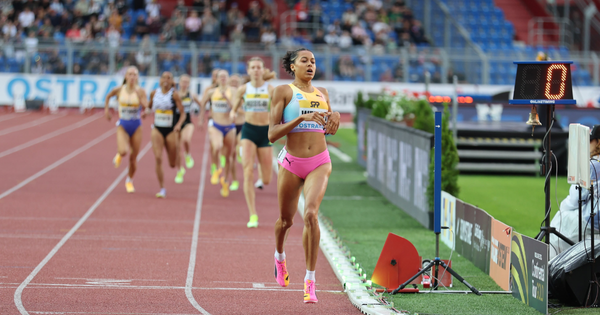
Laurent Meuwly: Yeah. I think if we look from our first outdoor race in Ostrava to Lausanne or Zurich, we can already see some changes. We are working on a higher frequency. We are working on faster arm movements, better arm movements, and this is coming slowly, but it's coming. You have to imagine that when we went from 15 steps to 14 steps in the 400 hurdles, it was the exact opposite: we went from a 2.15-meter stride length to 2.30, and now she has to go back to 2.15 or 2.10. So it's not that easy to change quickly, but she is a fast learner and I already see some improvements since the beginning of the season. And of course that's going to be something we work on in the coming year as well.
CITIUS MAG: Another part, I guess, is nutrition, which becomes relevant in a different way when you're doing a longer distance. Obviously bicarb is a big thing — is she doing bicarb? Are there any other nutrition changes she's had to make in transitioning?
Laurent Meuwly: Actually, in the supplements, there are no changes, because we were doing bicarb already for the 400 meters and the 400 hurdles. But in the nutrition, in the amount of carbs that she's eating, of course there is an increase, because she is training more volume and she needs more carbs. So that was an interesting challenge with our nutritionist and also the physiologist: to test the different zones and how many carbs she's using, to find the right balance and the right fuelling strategy during sessions and after sessions. We took it very seriously and very professionally, and I think this also helped her to improve, and to be healthy and able to afford this new load of training.
CITIUS MAG: That is the big thing, right — staying healthy when you're changing the training this drastically. You obviously did have that little hiccup after indoors. What else do you have to do for injury prevention?
Laurent Meuwly: Yeah, I think we tried to stay in known territory as much as possible, so to keep doing what we were doing before wherever it's possible, and to be very careful about what we are adding with the new kind of sessions we've been doing. I think we will never know how the injury came in February, but the amount of runs she was doing in one session, in the lactic session, is bigger than in the 400 meters.
We all think injuries come from running more mileage, but for her it was not the case. It was not because she ran many kilometers — that would have been a different kind of injury as well. The injury she got was more like a sudden moment. I think she lost control of her way of running during a specific session, and that's how the injury came. And that's also the biggest change in the very specific work: the volume in one session is bigger for the 800 than it is for the 400. So we also know now that those are the sessions where we have to be careful and make sure that she keeps control under fatigue.
CITIUS MAG: She mentioned that they are longer reps and shorter recovery, but I assume a slightly slower pace in many cases.
Laurent Meuwly: Yeah, of course, everything is slow for her compared to what she has been doing before. The challenge at the beginning was to feel the pace and to be a bit more defensive. In the first weeks when we were doing specific work, I always asked her to start quite defensively and to progress, because the speed is not the problem: over one, two, three repetitions she can be a lot faster than what is required. But if I want to have enough volume in this area, then that's the challenge. It took some weeks, but I think now she manages it very well and controls the pace for the specific 800 sessions.
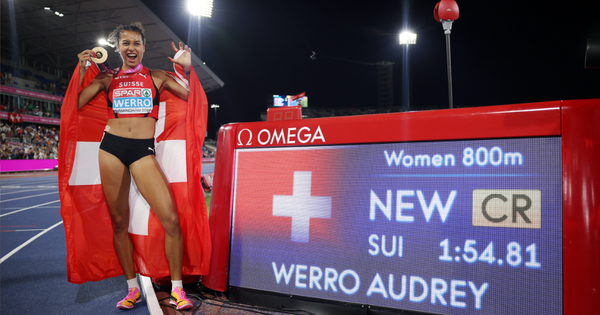
CITIUS MAG: And if we take it now to the races she has done and the progression she has had: initially she started out in a lot of the races just following Audrey or Keely, and she's obviously grown in confidence about what she can do in those races. She's been open about the fact that in that third 200m she was maybe a bit scared to push it, because she was worried about what would happen in the last 200m. So how has that changed, and what work have you had to do?
Laurent Meuwly: Yeah, of course. It's interesting when we look back: I think she has been second in all the Diamond Leagues she took part in. Who would have thought that you start a new event, you go directly onto the biggest stage, and there you are, top two in every race? We could also have chosen another path — go to silver meets or gold meets and find different races.
Obviously the first one was tough. Audrey Werro was already there running for a fast time. And for Femke, at the beginning, what was difficult was to have the right point of view in a race. Because in the 400 it's one lap. But after one lap of the 800 you're only halfway, and it hurts already, and the finish line is quite far. So it was really a mental game, to understand that even if your body and your mind give you a sign — "oh, it's tough" — you need to go through it for a longer time than in the 400. In the 400 you arrive at 300/350, and then you hit the wall. But in the 800 it is not that sudden, it lasts for long. And you need not to be afraid, already at 500 or at 600, to attack, even though you would like to protect yourself and wait even longer. I think this was the thing she had to learn for three, four, five competitions.
Watch Femke Bol and Audrey Werro’s first head-to-head race in Ostrava below:
For the tactical part, I was never really worried, because a lot of people were saying, "Yeah, with her stride, when she's going to be in the pack…", and also about the tactical decisions. But you know, she can open very fast, so she would always be in front somewhere — position one, two, three. I was never thinking about teaching her how to run in the middle of the pack and not be blocked and not be stuck, because even in a heat or in a slow race she can take the lead and manage the race from the front, which she did in Hengelo and which she did in the heat in Birmingham perfectly. And in all the fast races she's just going to take a position in front. For her, to open in 26 for the first 200 meters is no problem, if necessary. So then she's going to sit there and manage the race from the front. So this part was quite easy.
I think another athlete — not with her qualities — would have more trouble adapting to this event. It was really more about going through this painful feeling you have early in the race, and having to go through it for long, and also not always being in reaction, but anticipating a bit the moment where an attack would come, even if it's from far. And I think now, if we look at the last two or three races, she is there from this point of view as well.
CITIUS MAG: Yeah, that's interesting. In Zurich yesterday she tried a slightly different strategy: she took the lead ahead of Audrey. Was that a deliberate change in strategy that you had planned, or was it just how things happened on the day?
Watch Audrey Werro vs. Femke Bol at the Zurich Diamond League below:
Laurent Meuwly: Yeah, there were two reasons for that. First of all, it's a season to learn, so we wanted to try everything. And after, like you said, most of the races following, it was time to take some initiative and see how the race goes when she's taking the initiative. That was one reason.
The second reason: In this race we had Georgia Hunter Bell and we didn't know how fast Audrey wanted to do the first 400 or 500 meters. But what we knew is that if it were not fast enough, Georgia would be very dangerous over the last 150m. Therefore we also wanted to have a tough race, to be sure that if she could not win, she could at least be second and not have to sprint against Georgia over the last 150m. So those were the two reasons why she went in front, or behind the pacemaker.
CITIUS MAG: And I guess the other thing that was interesting in Lausanne — it was really great to see — was that last 100 meters, which was really quick. I think she was faster than Audrey by 0.7 of a second, and quicker than anyone else in the race by one and a half seconds over that last hundred. That shows she still has that speed. Obviously that was a marginally slower race, but that has to be her superpower, really, right? If you're able to produce that kind of close in an 800 meter race, you can compete for the win wherever you are.
Watch Audrey Werro vs. Femke Bol at the Lausanne Diamond League below:
Laurent Meuwly: Yeah, but I think you also mentioned earlier the change of rhythm. We still need to remember that it's the first year and that she's not there aerobically. Because sprinting over the last 100 or 150 meters, or changing rhythm over 200, is not only about speed — and it's usually not really about speed, it's about what you still have in the tank to do it. And for this you need good aerobic qualities.
So I really think that once she has developed this part even more, she is going to be able to use this weapon she has, because she knows how to run fast, even better than she is able to do it now. So for this, we need to be a bit more patient.
CITIUS MAG: And in terms of pacing: in the last couple of races you've had Myrte van der Schoot, who's in your training group as well, doing the pacemaking, and she paced in Paris too. So she's paced a couple of these incredibly fast races. How does the whole dynamic work in terms of setting the pace, and how does it all work together?
Laurent Meuwly: In Paris they were looking for a pacemaker and it was the first time Myrte did it. Everyone was really nervous, because that was the first time we were speaking about 1:53 pace — including the meet director, who told me, "But are you sure she can do it?" And I said, "Yeah, I can guarantee she can do it for 500 meters without problem." He did trust me, and he was very happy after the race. He said, "Yeah, that was an amazing job." She did 530 meters, I think. And then we chose her for Lausanne, where I'm involved in the athlete management, and Audrey chose her for Zurich as well, also because of the good work in Paris.
At the moment, of course, it's the best athlete in the field who is deciding what the pace is. But as you could see in Zurich, then there is a race. So the pacemaker goes in front, usually a bit too fast for the first 200 or 300 meters because everyone is pushing, and she needs to take the lead and then try to manage not to drop the pace too much, but also not to go too fast. And there, this time, Femke decided to go in front, and she was in front until 600, I think. So there are race situations, but for now, of course, the pace is decided by the best athlete in the field. That's usually how it works.
Or, in the case of Marco Arop for example, by the man — you have a guy who likes to run in front. He's not always winning, but he's kind of a guarantee for the others that the race is going to be fast. And then he might decide the pace, even if he's maybe not the best in the race, but the others know he's going to go. Because what you don't want is someone who is asking for a very fast pace and then not following it. That would be stupid.
So for now, if we want to approach the world record, there won't be 10 pacemakers who are able to do this. I think Myrte is one of the ones who can, if needed, even go to 600 meters or close to it. And that's probably what is required for a world record in the coming months or years — and maybe one day even faster than that. So that's definitely going to be a challenge, to find those athletes, because they will need more speed as well. The women's 800 meters is becoming a very long sprint.
CITIUS MAG: Yep, absolutely. And I guess that works in Femke's favour now, because every Diamond League race at the very least is becoming that kind of sprint. We saw at the European Championships as well that it was very much a sprint — each race was incredibly fast, the rounds were crazy. How did you approach the rounds, and managing rounds? Because that's obviously something different as well for Femke, running rounds versus running a one-off 800.
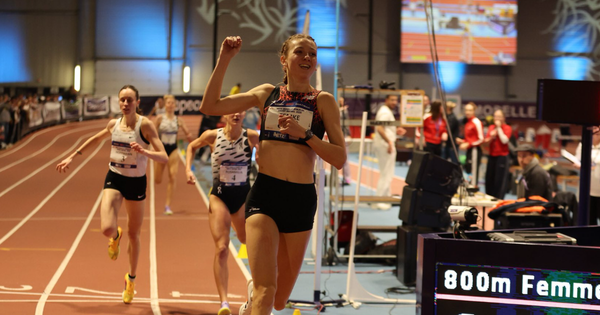
Laurent Meuwly: First of all, it was always our goal during this first season to have different kinds of 800 meters, which is difficult if you go to Diamond Leagues only, because then most of the time it's as fast as possible: it's a fast pace and you follow and you try to survive. But we had the chance in Hengelo to have a race where she had to take control when the pacemaker was out, and that was already after 400 meters. So she led the race from the front, at a not-so-fast tempo but increasing over the last 300 meters and finishing sprinting.
Watch Femke Bol run at the Continental Tour in Hengelo below:
And we had the Birmingham heat, which was a bit the same. She went in front to avoid being pushed or blocked, and then from this position she controlled the race and made sure she would qualify. Actually her heat was the slowest, because no one challenged her. I was a bit surprised: they all stayed with her, even though they knew they needed to run faster to have a chance to qualify by time. But it was good for her, she could save a lot of energy.
Watch Femke Bol run in the heats of the European Championships in Birmingham below:
And then in the semi-final she was with Keely, and there it was clear for us: you take her shoulder and stay there, a little bit on the outside, to be able to make a move if someone wants to attack the two of you. But probably Keely is making sure the pace is fast enough, and if you just stay there then you are going to qualify.
Watch Femke Bol and Keely Hodgkinson in the semifinal of the European Championships in Birmingham:
So yeah, we tried different tactics already, with Zurich now front-running as well, and that gives us a lot of information for the coming years.
CITIUS MAG: We're going to see Femke in Brussels and then in Budapest as well. My final question on the 800 was: what do you think is the best way to break the world record?
You talked about the pacing up to 600m, but obviously between these athletes that are now there — Keely, Audrey, Femke — it looks very much like it's on the table. What do you think is the way for that race to play out? Do you think a competitive race, or do you think it probably needs one athlete to be by themselves? Because in Zurich yesterday, for example, having Femke there meant Audrey closed really well, because she had to close well to get ahead of Femke. But then also, when Femke was at the front on the back straight, maybe it was a little bit slower than Audrey wanted to go on that back straight as well. So there's a little bit of plus and minus when it's really competitive. What do you think is the best way to get that world record?
Laurent Meuwly: I think it depends which athlete's point of view we are looking at it from. It's not the same for Georgia, Keely, Lilian Odira, Femke or Audrey. I think it's slightly different. I think in a year it's going to be different again.
If we look at a competitive race, it needs to be competitive like Stockholm, where the top athletes battling for the fast times are not disturbing each other. If you remember Stockholm, the pacemaker went out and disturbed Audrey a little bit, but Keely used this momentum to attack. Audrey followed, and then at 120 meters she went out and passed Keely. But there were no contacts, there were no moments where one was disturbing the other. In Zurich, we also had two athletes who wanted to run fast, but there was contact at 600 meters. There were moments where maybe one wanted to get the other, but the other is countering, so you cannot really do whatever you want.
Watch Keely Hodgkinson vs. Audrey Werro in the Stockholm Diamond League:
So being competitive is helping, of course, but it needs to be only positively helping — and this is really difficult, because if two athletes want to win the world record in the same race, it's quite difficult, for sure. If you don't have this, you need to have either someone who is very strong over the last 200 meters, or a pacemaker who can do the job to 600 and someone who can finish the job. That's how I see it.
And we've been speaking a lot about the world record. We are now only half a second, a bit less, away from it. But that's still a step. I think now we are speaking a lot about when and who and how, but if I look at the road to LA, I think we are going to be speaking more about 1:52 times than about who broke the world record. So it might be a different tactic also.
CITIUS MAG: That for all of us is going to be incredibly exciting.
Keep up with all things track and field by following us across Instagram, X, Threads, and YouTube. Catch the latest episodes of the CITIUS MAG Podcast on Spotify and Apple Podcasts. For more, subscribe to The Lap Count and CITIUS MAG Newsletter for the top running news delivered straight to your inbox.

Citius Mag Staff