By Paul Snyder
July 29, 2026
At the Greek national championships this past weekend, Miltiádis Tentóglou posted the best jump of his life, launching himself 8.66 meters.
He’s among the greatest long jumpers in history, with a list of accolades that includes two Olympic golds, a World Championship gold and silver medal, the 2022 Diamond League Final crown, a pair of World Indoor titles, 11 wins on the Diamond League circuit, and three wins at the European Championships.
You might expect that an athlete of this caliber posting a PB would put him feet ahead of any of his compatriots. And yet, despite being tied at No. 13 all-time with that mark, Tentóglou only managed to tie the Greek national record.
The man with whom he shares that distinction, Louis Tsatoumas, was by no means a slouch. He jumped 8.66m after all! But he never medaled at the Olympics, never landed on the podium at a World Indoor championship, and the extent of his global medal haul was a single bronze medal, from the 2006 IAAF World Athletics Final.
By really any metric except—except a very notable one: PRs—Tentóglou is the superior jumper. And yet, in theoretical tavernas across Athens right now, long jump aficionados are embroiled in impassioned arguments over who is the Greek G.O.A.T., Tentóglou or Tsatoumas. Sure, one side has more ammunition than the other, but the shared national record at least gives the other side a bit of rhetorical room to operate. (That, and technically, Tsatoumas owns a 2–1 record in their head-to-head matchups.)
Crazily enough, Tentoglou might not even be the best athlete with this particular problem. For a variety of reasons, which could include the size of your country, a poorly-timed career ascension with a great rival, or a record book full of sketchy marks from the 1980s, there are more people than you’d think who’ve never held their country’s national record but have resumes worthy of the Hall of Fame. Such as:
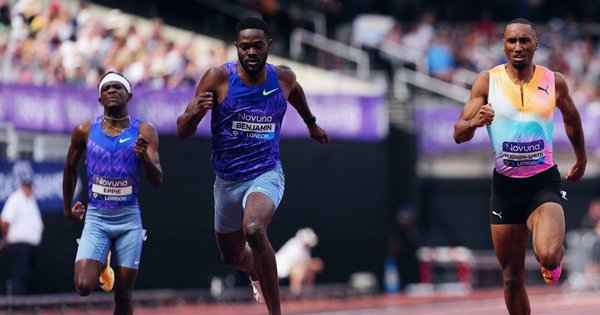
Yohan Blake: We’ll start with one that’s simultaneously obvious but also criminally underappreciated. Blake is the second fastest man ever over 200m. His 19.26 is one of two performances ever under 19.30. In the 100m, he’s tied for second all-time with Tyson Gay at 9.69—that mark is tied for the third best in history. Of course, the only man unequivocally faster than Blake, Usain Bolt, isn’t just his compatriot… he was his contemporary.
That’s how perhaps the second greatest sprinter of all time is also the second greatest sprinter of all time from Jamaica, as well as just a one-time individual global champion. (Blake’s 2011 World title in the 100m happened to come in a race in which Bolt was disqualified for false starting.)
Asbel Kiprop: Kiprop sits at No. 3 on the all-time men’s 1500m rankings, thanks to his 3:26.69 showing at the 2015 Monaco Diamond League. With an Olympic gold medal to his name plus three World titles in his signature event, Kiprop is certainly in the conversation for the Mount Rushmore of men’s metric mile-dom.
And yet… he’s only the second-fastest Kenyan man ever behind Bernard Lagat—a man who is also (depending on who you ask) the fastest American man ever over the same distance, and who still clings onto the second spot on the all-time list. Though their competitive primes didn’t perfectly align, they still squared up in seven 1500m finals, with Kiprop beating Lagat in four of their battles.
Joe Kovacs: The 11 farthest shot put marks in history belong to Americans: The world record, along with the second, third, and fourth best throws all belong to Ryan Crouser. Then at number five is Joe Kovacs’s 2022 23.23m heave. The two next best heaves came courtesy of Crouser and Kovacs, respectively.
Much like the case of Blake and Bolt, Kovacs is more or less the unambiguous historical number two in his event. Totally great, yet totally unlucky to constantly trade blows with the unambiguous historical number one. Crouser won the last three Olympic games. Kovacs claimed silver every time. Unlike Bolt and Blake, both Kovacs and Crouser are still competing. Should Kovacs capture lightning in a bottle and throw one past Crouser’s current 23.56 WR, the G.O.A.T. conversation becomes a bit more interesting.
José Luíz Barbosa: When Joaquim Cruz ran 1:41.77 back in 1984, he was the second fastest man ever over 800m and along with Seb Coe, one of two men ever under 1:42. Cruz went on to win the 1984 Olympic gold medal after having finished third at Worlds the year before. He nabbed a silver medal in 1988 in Seoul, for good measure, rounding out his resume and claim to all-time legend status. Though Brazil isn’t necessarily known as an all-encompassing track and field powerhouse, Cruz isn’t the only 800m superstar it’s produced.
All of this is to say that had Barbosa been born anywhere except Brazil (and Kenya, and probably Switzerland), he’d have been the best 800m runner ever from his country. In the late 1980s and early 1990s, he nabbed silver and bronze at Worlds, won a World Indoor title, and finished just one spot off the podium in 1996 in Atlanta.
Soufiane El Bakkali: Younger steeplechase fans have only known a world in which El Bakkali is a dominant force. Since 2019, he’s placed no worse than third at a global championship—a streak that includes two Olympic victories, a pair of World titles, two World silver finishes, and a lone World bronze medal. He’s the ninth-fastest steeplechaser in history, and one of just 15 men to ever run under 8:00 in the event.
And yet… the Moroccan national record belongs to Brahim Boulami, who is credited with a 7:55.28 PB. Boulami ran even faster—7:53.17 in 2001—but that result was vacated the following year as the result of a positive doping test for EPO. His 7:55 was kept on the books.
If there’s any takeaway from this trip down memory lane, it’s that the adage that “records get broken, but medals stay golden” should probably have an addendum: sometimes, records don’t get broken even if the performances that follow are equally legendary. Time (and distance, in the case of Kovacs or other field eventers) is a weird thing in this sport; it feels like a universal and unbiased measure of accomplishments, and yet… it’s not. Athletes’ careers can be greater than the sum of their parts, and Tentoglou’s is a great reminder that personal bests are just one part of the whole story.

Paul Snyder
Paul Snyder is the 2009 UIL District 26-5A boys 1600m runner-up. You can follow him on Bluesky @snuder.bsky.social.