By Preet Majithia
November 16, 2026
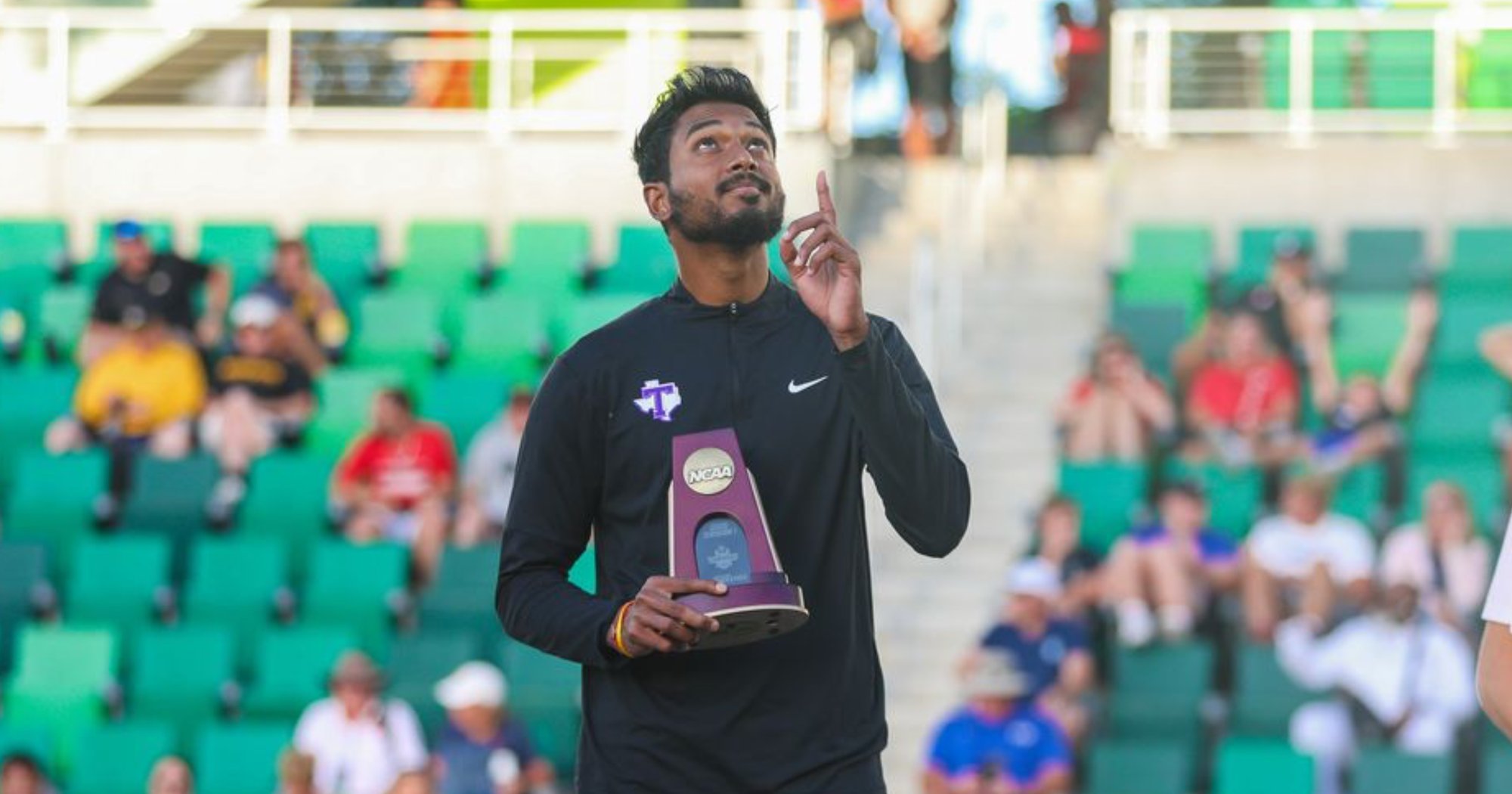
In March, Lokesh Sathyanathan notched the biggest win of his career to date, winning the NCAA Indoor long jump title by a single centimeter. His 8.21m performance made him the first Tarleton State Texan and the fourth Indian athlete to win a D1 collegiate title, setting the table for an outdoor season that saw him replicate his PB effort and eventually finish fifth at the Commonwealth Games.
As Sathyanathan now sits on the precipice of his final season of NCAA eligibility, he sat down with CITIUS MAG’s Preet Majithia to talk through his journey in the sport, how last year’s title fulfilled a promise to his late mother, and what he’s doing to manage staying in the moment while also keeping an eye towards the 2028 Los Angeles Olympic Games in what has become his second home.
The following interview has been edited lightly for length and clarity.
CITIUS MAG: There's quite a lot of your story to share, but let's start with the NCAA part of it. This year, you're competing for Tarleton State, and you had a bit of a breakthrough year, with your 8.21-meter personal best to win NCAA indoors. Talk us through this season: What has been the breakthrough, and how was it to win that title earlier in the year?
LOKESH SATHYANATHAN: This season has basically been a trial season for me, to see where exactly I stand right now in terms of my technique, my speed, my power and everything. It's also been a really good experience to see what I need to be working on and what I'm lacking, especially going into the indoor season. We always do a preseason starting in December. We opened up with 7.75-something, and then we noticed a few minor mistakes that needed to be worked on. Ever since then, we've been working on the tiny details.
The first time I jumped over 8 meters this season was in Fayetteville, Arkansas, at the World Indoor Tour Silver meet, and that gave us a good idea of where exactly we are. It also gave me confidence that we're moving in the right direction. That's what set me up to win the national title in the same place as the World Indoor Tour meet, in Arkansas.
So it's been a really, really good year. I'm grateful and thankful to God for making it happen at the right time, and for giving me the confidence that I can do it not just once, but keep doing it again and again, if I just execute the way I prepare to on the biggest stages.

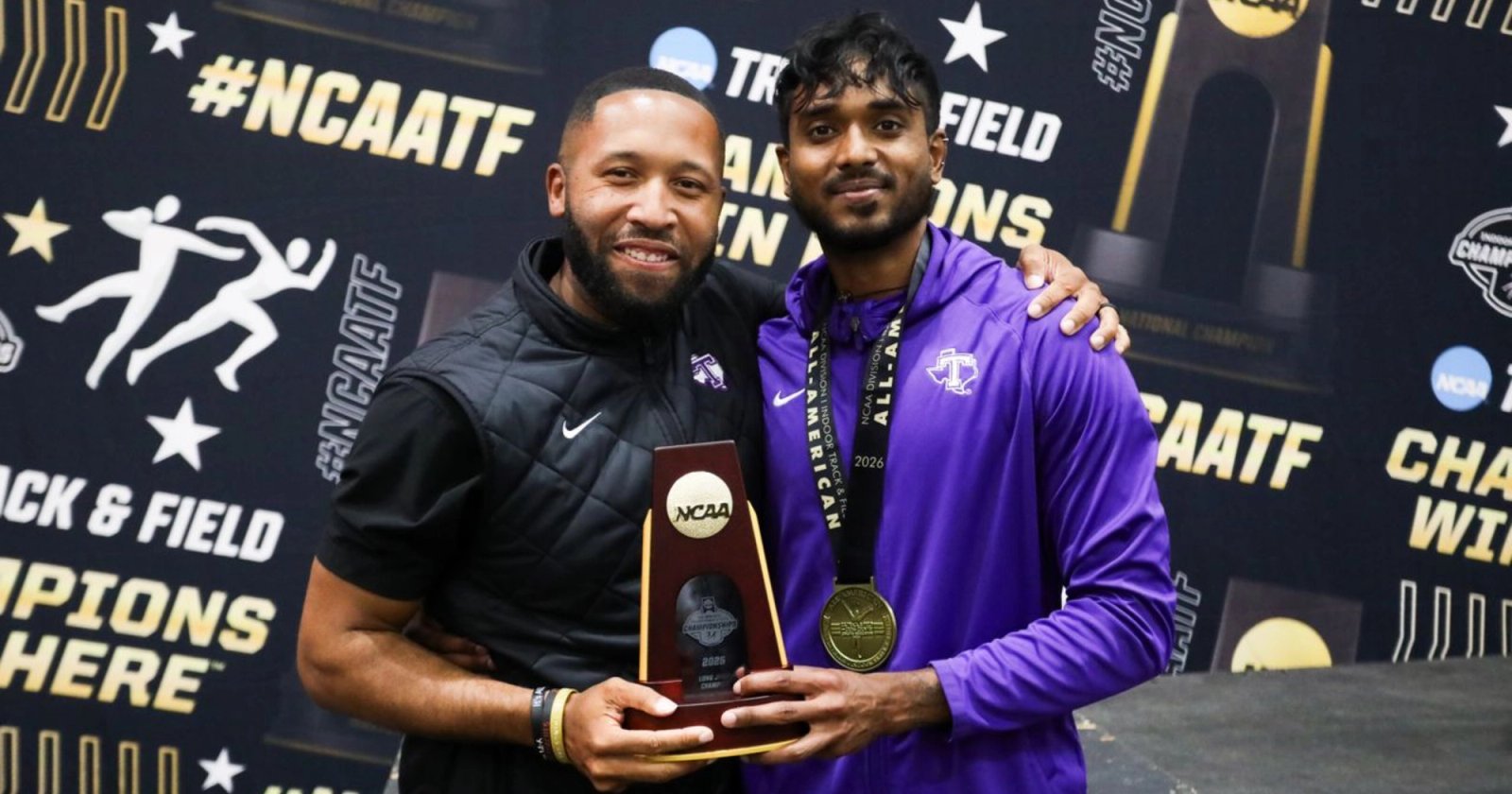
You're only the fourth Indian to win an NCAA title, and it's something that's very hard to do given the level of competition in the NCAA. What did it mean to you to win that title? What were the feelings, and do you feel like it opens more doors for you after that achievement?
It's a priceless moment for me, because I'm not just out there competing; I'm also carrying a huge promise that I made to my mom and my whole family when I was coming to the U.S. I don't want to be just one of the Indian athletes who came to the NCAA to be a student-athlete. I want to be remembered as an athlete who came to the United States, competed in the NCAA, finished at the top and made history. We have very few Indian athletes in track and field who've finished on the podium, so I wanted to be one of them.
It's an emotional moment too, because it would have been even greater if my mom had been there to watch it in person. But I know she's still watching out for me every time I'm out there.
I know that's such a big part of your story. You got the scholarship to go to the U.S., and it was your mom who told you to go and follow your dreams, but sadly she also passed away. Tell us a little more about her role in getting you to where you are now.
As I always say, God and my family have always been the main reason for my success story. They made me into the person I am today, and no matter what, they're always by my side. Whether I win or lose, they're the same; they show the same love. And it's my parents' sacrifice, not just my mom's. My dad deserves an equal amount of appreciation and credit, because he took us to training every morning and evening, and to school. My mom, as a housewife, took care of things and made sure we were taken care of in every aspect, so that we could just go out there, work hard and be the best in whatever we do.
So for me, I'm just doing my part. All the credit goes to God and my whole family. Whoever I am and whatever I'm doing today, it's for them — and also for my coach, Coach [Bobby] Carter, who's part of my journey. Amazing people come together when you want to do something great in your life, and I believe these are my people, guiding me to where I want to be.
In India, obviously, most people play cricket. What got you into track and field? How did you find the sport, and how did you progress to the level where you could apply for an NCAA scholarship?
That's a great question. I started out playing soccer, because my dad is a soccer player. I grew up watching him play, and I always wanted to be a soccer player just like him. He used to take me to his soccer training sessions and friendly matches, and all I would do was chase the ball — run as fast as I could, take the ball and kick it. After seeing me a few times, he said, “You know what? You don't belong here. You belong somewhere else.” He took me to a track facility a few minutes from my home and introduced me to the coach my cousin trained with. That's when the journey started.
My first coach, Ramesh, said, “I'm going to make you do sprints and jumps.” I had no idea what the 100 meters and the long jump were, because I was nine years old at the time. Then I went out for my first-ever championship, in the under-11 category, and I won two golds. That's when it all started. Obviously there have been ups and downs and setbacks since then, but that's part of the journey, and I'm grateful and thankful for every obstacle, every hardship and every victory.
How did you come to focus on the long jump as your main event?
Ever since I started track, it was the first event I actually competed in, and all my coach said was, “I feel like you'll be really good at it.” I'm also a very explosive person — my body type is really bouncy and explosive — and he said, “I know you're going to be a great jumper.” I also fell in love with the process. When I was pretty young, I looked up to great jumpers like Carl Lewis and Iván Pedroso, and I was fascinated watching them jump so far. I think this is the only event where you can run as fast as you can, use all your power in the right way and jump as far as you can. That process made me fall in love with the long jump, and it's been a great pleasure to be a long jumper.
You took that energy and passion and made your first mark on the international stage in 2018 at the South Asian U20 Championships, where you won gold, and then you represented India at the World U20 Championships in Finland that year. How was that experience?
For athletes in India, you grow up watching Bhaag Milkha Bhaag, and for every athlete it's a dream to put on the Indian blazer and the Indian uniform. That was simply a goosebumps moment for me, with chills all over my body: getting my first Indian gear for a major championship, winning gold for India, going up onto the podium, listening to one of the best national anthems in the world and carrying the flag. It's emotional, and at the same time it gives you chills and memories for life. I knew my parents were watching back home, so that was the biggest joy, because it's their hard work. When you see the smile on their faces, it tells you, “OK, he's doing the right thing, and he's making the country proud” — not just the country, but the family too.
That put you in a position to apply for scholarships in the U.S., because you'd made a mark on the international stage. How does that process work, and how did it work for you?
The process is not easy, as we all know, especially the visa process and the paperwork. It's pretty hard, and it takes a lot of time, knowledge and experience to get everything right and make things happen at the right time. I had a really great mentor, Coach Trey Bracall. Anytime I had any doubts, I'd text or email him and ask for help: “How can I get through this application? What's the next thing I should be doing?” I think reaching out to coaches, communicating well and asking for help is the only easy way to get the process done.
Even after that, he kept guiding me. He's the reason I'm with Coach Bobby Carter, because he led me to him — he and my coach were old teammates.
The NCAA is one of those systems that works right away for some people and takes time for others. Sometimes you find the perfect environment the first time, and sometimes you have to explore to find the one that suits you. In your case, you started at the University of New Mexico, then moved on, and you also had some injuries in between. Tell us about that journey and finding the right place for you, which you've now found at Tarleton State.
It's something I always want to talk about, especially with youngsters, who most of the time ask me, “Which university should I go to? Which coaches should I reach out to? Where can I apply?” My personal preference: You have to choose a coach who chooses you not for what you do, but for who you are. That's the first step to creating a bond between athlete and coach, and to making the journey successful.
New Mexico was actually my last option. I was about to go to Arizona, where Coach Carter, my current coach, was an assistant coach, but unfortunately they didn't have the funds to give me a scholarship that year. So I took the scholarship at New Mexico, and it went well for me, because that's where I jumped 8.02m for the first time in my life. It was my first year in the U.S. — a whole new environment, culture, training sessions and everything — and as things settled down, it was pretty good.
But unfortunately, after a year, the coach moved to Louisville, Kentucky, so I followed him there, and things didn't work out for me. Two or three days before my first indoor championship, there was a crazy accident in the weight room: weights were dropped on my left foot and broke a toe. They had to do surgery and put some screws in. A month later I started my rehab, and the surgery turned out to be a failure. I had nobody paying attention or taking care of me, so I had to leave for that semester, go back to India, get my second surgery done, then come back and join Coach Carter for the next semester. I restarted everything from scratch.
That's quite a journey. I heard you mention that you tried to get support from funding sources in India and get some coaching there, and that was also quite challenging while you were injured, right?
Yeah. I stayed in India for almost six months, and I had no help — no place to train and no place to do my rehab. That's when Coach Carter came into my life again. My mentor, Coach Trey, was the one who said, “Coach Carter is going to take a job as a head coach. Would you like to join him?” So I just dropped him a text saying, “Hey, Coach, I'd like to come train under you and continue my collegiate career.” All he said was yes. Ever since then, it's been really great. There were obviously a few hardships along the way, but that's part of the journey, I've been learning through it, and I'm really grateful and thankful for them.
You've had so much success at Tarleton State, including that really successful indoor season. Talk us through the outdoor season this year, because you competed at the Commonwealth Games but didn't compete much in the NCAA outdoors.
That's a huge thing, not just for me but for any athlete. Once you finish your collegiate eligibility, you have to take care of things yourself. Since I'm a student-athlete here, I haven't had any job offers, so it's hard for me to save up money and travel around the U.S. to compete, because I'm not allowed to travel with the team when I don't have outdoor eligibility.
Still, I did compete twice. Unfortunately, at the first jumps competition, it was pretty windy and the weather was bad; it started raining, and it was pretty much a storm. Then a week or two later, I opened up at Baylor. That's my favorite track; I love the environment there. That's where I jumped 8.21m again, with a legal wind, and set a facility record.
Right after that, I didn't have many options to travel around the U.S. to compete, because the meets were far from Texas. I also had my graduation coming up, so I finished my graduation ceremony and then left for India just three days later to compete at the Federation Cup, which is a qualifying criterion for the Commonwealth Games. That was a pretty challenging moment for me: an 11-and-a-half-hour time difference, arriving a week before and then jumping in pretty humid, hot weather. But I still did a decent job, jumping almost 8 meters — 7.94m — and I did qualify.
I think with proper planning and a lot more funding to travel to championships, I would have done better at the Commonwealth Games, because I had to come back to the U.S. right after two weeks, train here for two weeks and then leave for the Games. It's been pretty challenging, but I'm happy I had the opportunity to finish in the top five in the final at my first-ever major senior championship, representing my country. I would have been happier finishing on the podium — that was the plan — but unfortunately it didn't happen. There are greater things ahead.
You’ve got one more year of indoor eligibility, and do you know what the plans are after that? As a long jumper, it's also tricky to get sponsorship and things like that. How is the future looking for you once you've finished your academic career?
I would love to stay here, but at the same time, I believe in God's plan. My plan is to finish my master's here, and I'll be graduating again in the spring. Once I graduate, I'm going to try to work as an assistant coach — a jumps coach, or maybe a jumps and sprints coach — and find a way to stay around my coach, so I can train and work at the same time and focus on future major championships. LA is just two years away, and the United States is my other home, so I have to make sure I'm well prepared for my home Games.
It's a bit of a golden era for India in the long jump right now. You're number five on the all-time list, and the top five Indians in history are all currently competing, so it's a crowded field. What do you think has led to this explosion in athletics, and in the long jump in particular, in India? And how do you see yourself in that picture, making sure you're on that team in a couple of years' time?
I think the major key factor is that in India we have private foundations like JSW and Reliance Foundation. I'm supported by Reliance Foundation, which was started and is funded by Nita Ambani. It's a great initiative for every athlete, because they also invest a lot at the grassroots level. Facilities and support systems like this are helping athletes get better in every event, not just the long jump but across track and field.
India is also getting more exposure now, especially Indian jumpers — as we all see, they've been doing well. I think they have good mentors and coaches around them right now. Some people train at smaller facilities and some at the bigger foundation facilities, but it's the coaches behind them who've been doing a really great job. They're getting more knowledgeable, and they're going in the right direction. And it's the spirit. Especially in India, the spirit is, “We can, and we will.” Every athlete has that attitude, and I love to see Indians evolving, especially in the jumps, which was not expected.
Two weeks ago I ran into a random stranger, and he asked, “What do you do?” I said, “I do long jump.” He said, “How far do you jump?” I said, “8.21 meters.” He said, “Wow, that's really good. Where are you from?” “I'm from India.” And he said, “I didn't know Indians could jump this far.” That says a lot.
Absolutely. Thank you very much for taking the time to join me, it's been really fascinating to learn about your story, and we’re very excited to see what you do next!
Keep up with all things track and field by following us across Instagram, X, Threads, and YouTube. Catch the latest episodes of the CITIUS MAG Podcast on Spotify and Apple Podcasts. For more, subscribe to The Lap Count and CITIUS MAG Newsletter for the top running news delivered straight to your inbox.
Preet Majithia
Preet is a London based accountant by day and now a track fan the rest of the time. Having never run a step in his life he’s in awe of all these amazing athletes and excited to help bring some attention to the sport.