By David Melly
October 20, 2026
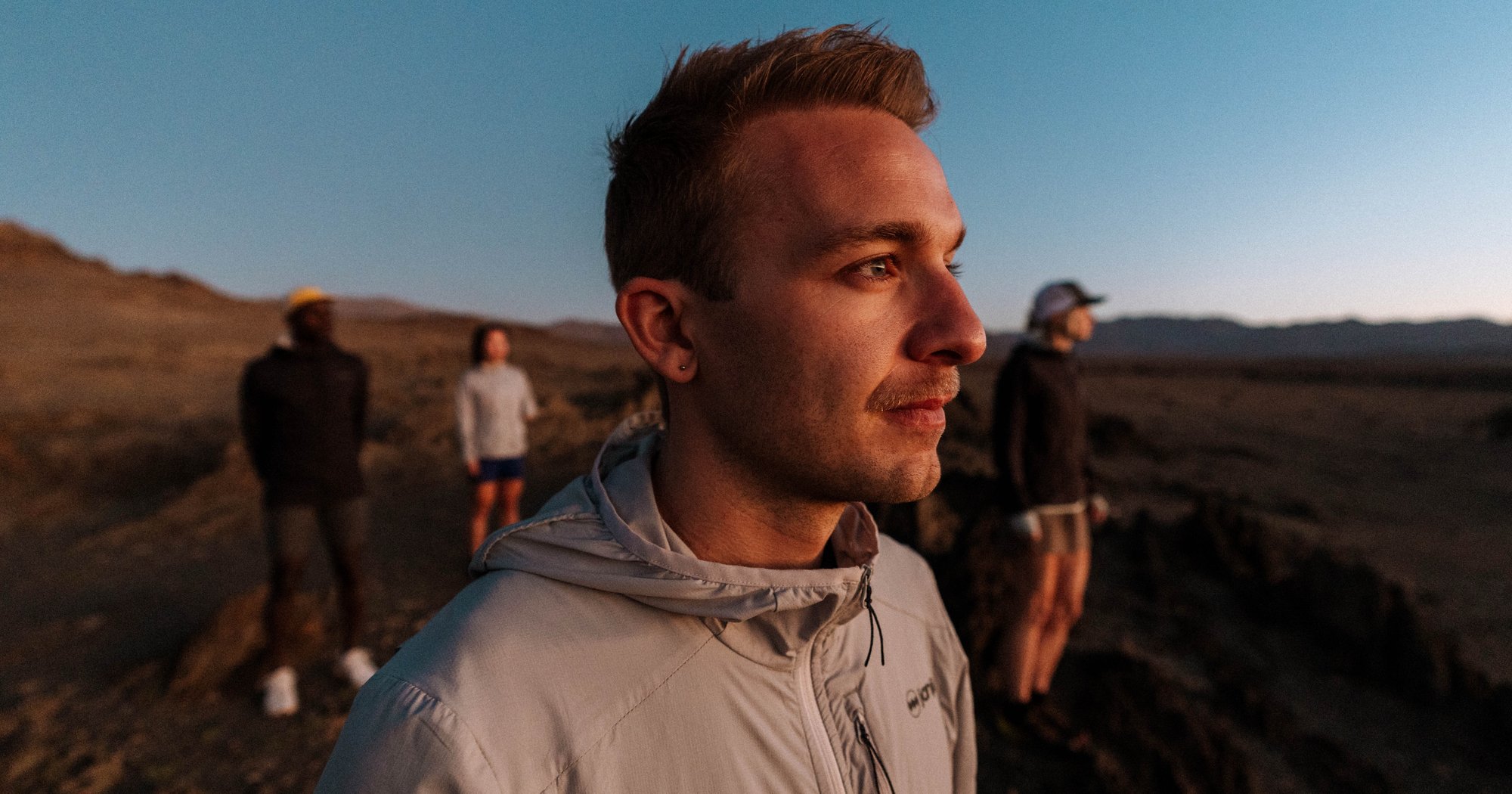
Ultramarathoner Ryan Montgomery is planning to tackle the world record for the 24-hour race at the 2026 Desert Solstice Track Invitational on December 19. The current world record is held by Lithuanian Aleksandr Sorokin, who ran 198.6 miles in 24 hours – continuous 7:15 mile pace – in 2022. Montgomery (who identifies as non-binary and uses he/they pronouns) ran 154.7 miles in his debut at the distance in 2020, and has since gone on to become one of the nation’s top trail runners, most recently finishing third overall at the Western States 100-mile in 13:53:55, 15 minutes under the previous course record.
Montgomery sat down with The Lap Count to share more information about his world-record ambitions, preparation, and approach to the race. The following interview has been lightly edited for clarity.
THE LAP COUNT: Great to sit down with you, Ryan. Tell us what you’ve got planned and why you’re announcing it today!
RYAN MONTGOMERY: I'm feeling so inspired seeing so many “called-shot” world records and people backing it up with results. The sport, generally speaking, is on a rocket ship in terms of performance. So I've been very inspired watching that, combined with my recent third place at Western States this summer. I'm excited to put a really bold goal for myself out there.
I plan to go after the 24-hour world record at the Desert Solstice Track Invitational on December 19 in Phoenix, Arizona. The race is held on a 400-meter track to see how far you can go in 24 hours. Right now, the record is 198 miles and some change, which is an average pace of about 7:15 per mile. So the goal would be to do over 200 miles — two back-to-back 100-milers in 12 hours each.
TLC: They're both ultras, but this is so different from Western States. Why do you want to take on such a different kind of goal?
RM: I think it speaks to the type of athlete I am. I'm obviously a 100-mile specialist in ultrarunning, but I still do marathons, because I think it's fun to change it up, and there are a lot of benefits from marathon training. Earlier this year I ran London as part of my Western States build. Two years ago I ran Boston. And as part of this specific build for the 24-hour world record, I'm doing New York and I'm also doing CIM.
It's fun to change things up. The fun thing about ultrarunning, unlike marathoning, is that with a marathon it's very clear what you're doing. It's a marathon on a road. There might be some hills here and there, or it might be flat. But in ultrarunning, there are 100-mile races in the mountains, 100-mile races on the road, track ultras, multi-day ultras. There's so much variety, and I think it's fun to try on all those different hats.
TLC: For casual track fans, anything longer than a marathon seems the same, but they're really different. In a way, it’s your “Femke-Bol-going-to-the-800” moment. The potential is there, but it's also a huge change. Can you get into how you've trained and prepared differently compared with a trail ultra?
RM: I'm going to warn you: it's not very exciting. Over the past month, I've started to get more into the specificity of the training, which has included a lot of track running. Two to three times a week I'm doing my runs on the track. I think last week I did over 80 miles on the track. Two of those were workouts: one where I did 20 miles on the track at sub-six-minute pace with intervals sprinkled in, and another where I ran a marathon on the track at sub-goal pace. So it's a lot of laps, a lot of loops, a lot of Spotify.
Part of the construct of the race is that every four hours you change directions, so I'm getting used to changing directions every hour, every couple of hours. And then I'm combining a hard workout with a really, really long run. As much as I want to be trail running right now, I'm running pretty flat, on rail trails and dirt roads. This last Sunday I ran four hours on a dirt road.
TLC: The craziest thing about this whole effort is doing it all on a track. How do you mentally prepare for that level of monotony?
RM: For better or worse, I actually do have context on this race. In 2020, during the pandemic, I did my first 24-hour race, and I realized a couple of things. One is that you're seeing your crew and your people every 400 meters. And not only that, there are going to be other people on the track. I think the race has about 20 people total. It's a small group, but 20 people on a 400-meter track is still big enough that you're talking and passing people the whole time. And I believe there are other people going for different world records, whether it's the 100-mile or something else. So it's actually quite social, at least when I reflect on it from six years ago.
I'd say the hardest part is going to be the nighttime, when it's kind of mind-numbing and you're over 12 hours in. The other thing is, if I'm going for this record, I'm going to have to optimize every single minute and second. There are porta-potties on the track, but I'm almost wondering if I'm going to have to pee in a bottle on the backside of the track or something.
TLC: Speaking of optimizing, the other big piece is fueling — 24 hours, 200 miles — and having to balance that with stopping to eat. What's your plan for fueling?
RM: I've been on a bit of a journey with my nutrition the past couple of years. The past two Western States, I've had stomach issues. It's always been around mile 60: my stomach cramps, and I'm on the side of the trail with my stomach killing me from the inside out. I've realized that I really can't take in real food or anything that's really complex. I used to drink a protein drink halfway through my races, and I think it was just too much for my body to break down while also working at a high effort level. So I'm on a fully liquid diet when I'm running now.
At this last Western States, I was pretty much using a prototype from my sponsor, GU Energy, called Roctane. Each bottle is 500 milliliters and has 500 milligrams of sodium and 60 grams of carbs, and I've trained myself to consume that in all my training and racing recently. So I'm going to use liquid calories for the most part. The effort level won't be high enough for me to shoot for over 100 grams per hour, but I think my sweet spot right now is 80 to 90 for this type of effort.
TLC: In recent years you've been training while going through grad school up in New Hampshire, and now you're in Utah. What's your training setup now, and how does it compare to what you were doing before?
RM: I live on a mountain about 20 minutes outside of Park City. My house sits at about 6,600 feet of elevation, and I have access to dirt, trails and tons of roads, so it's really quite ideal for training. I'm at elevation, and I have a nice running community here as well. But the thing I benefit from most is the rail trail in Park City. It's about two miles down the road from my house, and it goes all the way up into Park City and all the way down to a reservoir, 13 miles in that direction. So that's my training setup right now.
My coach actually lives in France. It's super random, but he used to live in Colorado. His name is Jason Koop, and I've been coached by him for almost three years now. We have a really good working relationship.
When you move to a new place, you have to build your team around you. I've always waffled about whether that team needs to be local or can be virtual, and I think it depends on what I'm working on. My current team: I have a local strength coach in Salt Lake City, so it's nice that we can do in-person sessions. But my nutritionist and my running coach both live in France, so that's virtual.
TLC: You have a huge queer fan base, and a lot of them are going to be following along with this attempt. How do you bring that storytelling component — and your identity as a queer athlete — into what you're trying to accomplish athletically here?
RM: This is a big part of how I've been showing up as an athlete recently: bringing elements of “queer flair,” I guess you could say, into my training and my races. So that's my plan. I'm also planning to do a lot more storytelling leading up to this, almost building momentum around my training and what's going on in my life as I build up to it.
Over the past few weeks I've been sharing my training a lot, and people have been saying, “What are you doing? What's going on? Why are you running three hours on a track?” There's this element of people wanting to know what's going on and wanting to be along for the ride, especially when it's something very specific. So my intention is to bring people along for that story as I build for this — all the good and the bad. And there’s definitely going to be some “here's me being fabulous today.” Who knows, maybe some special nails will make an appearance on race day. In the meantime, I'm just going to be myself.
TLC: Good luck! Keep us updated on the training along the way. We can't wait to see how it goes!
RM: Thank you – I’m excited!
David Melly
Since David began contributing to CITIUS in 2018, he's done a little bit of everything, from podcast hosting to newsletter writing to race commentary. Currently, he coordinates the social media team and manages both the CITIUS MAG newsletter and The Lap Count, supplying hot takes and thoughtful analysis in both short- and long-form. Based on Boston, David breaks up his excessive screen time by training for marathons, crewing trail races, baking sweet desserts, and mixing strong cocktails.