By Preet Majithia
September 4, 2026
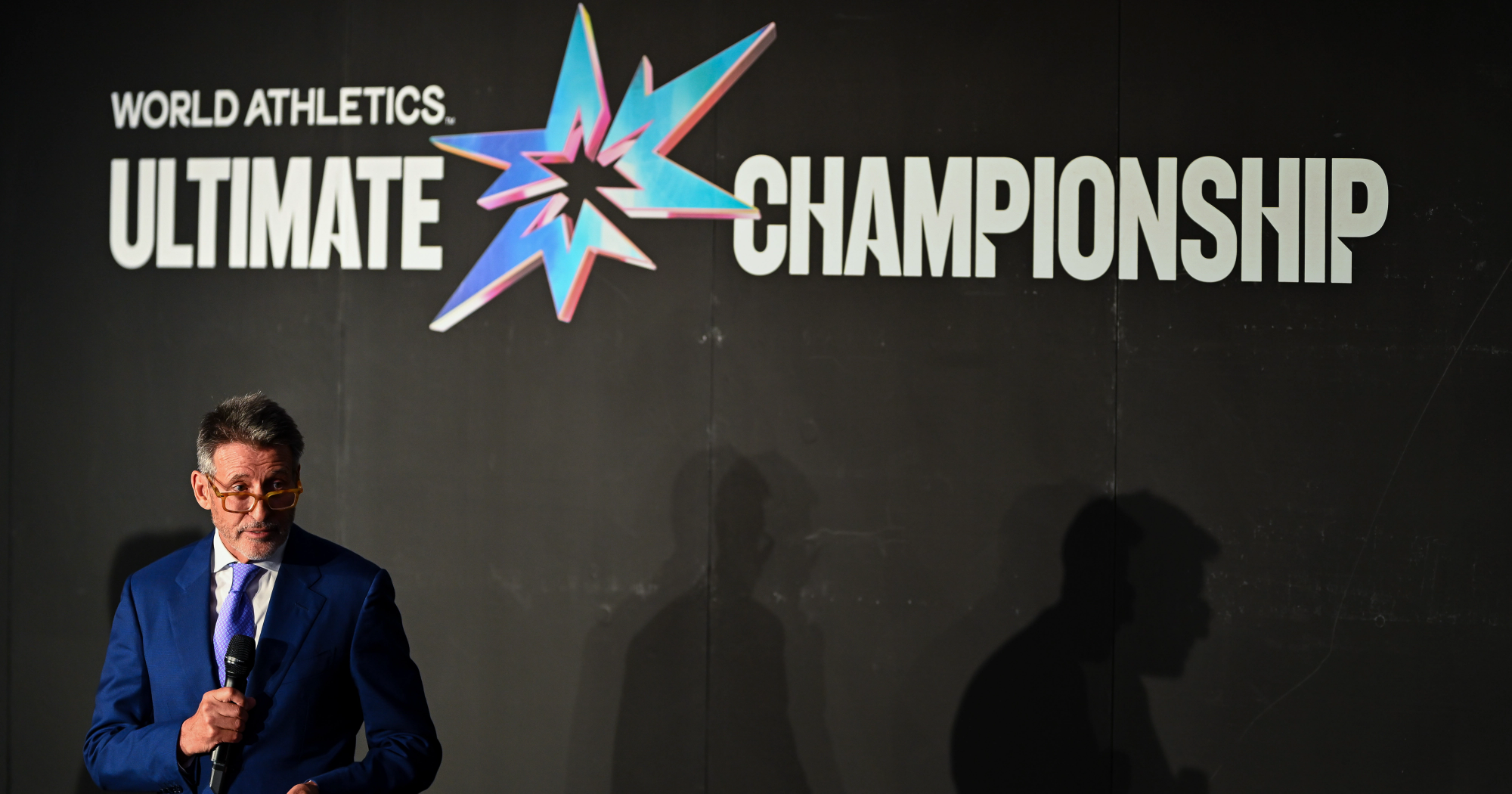
World Athletics President Sebastian Coe spoke with reporters ahead of the Diamond League Final in Brussels (Sept. 4-5) and the inaugural World Athletics Ultimate Championship in Budapest (Sept. 11-13). In a wide-ranging conversation, he defended the new three-day, best-of-the-best format as a deliberate departure from the nine-day World Championships model.
He emphasized many of the points from the World Ultimate Championships initial announcement in December 2024. The event aims to fill the one "empty" year in the sport's four-year cycle. Its event selection, since it only features 16 track events, 10 field events and 2 mixed relays, was grounded in three years of fan research. The format is designed with television entertainment value in mind while preserving the championship format, with a $10 million prize purse in which every competitor is paid.
Questions were asked by a number of different reporters. The following transcript has been edited lightly for clarity.
Q: What do you say generally about the Ultimate Championships?
WORLD ATHLETICS PRESIDENT SEBASTIAN COE: Well, it's different. Totally different. The ambition was never to have an event that simply replicated a World Championships, where you have every discipline, 2,000 athletes and nine days. This is three days, the best of the best, and it would be impossible to put every discipline in there. That's not to say that the disciplines we've chosen will be exactly the same disciplines we go with in 2028 and 2030. We wanted to do things differently, and not everything is going to work. There will be elements of it that we'll want to refine and review, in the way that we do with every event…
We work in four-year cycles. One of those years is not entirely empty — we have European Championships and we have Commonwealth Games — but it doesn't give the sport that global moment the other three years do, with two World Championships and an Olympic Games. We looked at this and decided: let's get that audience, which is vital. No serious sport can go one year in four without that big moment. But let's do it differently. Let's be brave. Let's look at how we present….
One of the legacies I want from this, other than a sustainable championship for years to come, is that there are things I hope we learn from and can take into a World Championships: the rhythm, the pace, the way we've scripted it, the way we've worked alongside broadcasters. I want this to excite new audiences that may not be instinctively athletics fans, nor do I want to offend the traditional fans, people like me. Somewhere in that mix, I think we've struck the right balance. We've spent three years now working on this, and a lot of the work that is unseen — and that we haven't really spoken about, which we probably should — is the research behind it. Those disciplines are not arbitrarily chosen. We know this through our market research: speaking to fans both digitally and face-to-face, looking at their responses to our championships, even wiring them up so we get pulse rates and all sorts of physiological responses as they're watching our events. That work alone will help us develop a greater understanding of who our fans are and what they want, and the Ultimate is the beginning of that journey.
Q: So how should we rank the athletes who will be crowned Ultimate champions compared to World champions?
COE: It's a slightly different concept, but this is a championship. If you speak to the athletes, they're not in any doubt about what it means to walk out of Budapest as the Ultimate winner. And I think their accountants will be in no doubt about the difference in walking out of Budapest. Everybody will receive some financial reward simply for being there. So that will be one down to 16 on the track, and one down to eight in the field.
Q: Even the last one?
COE: Even the last one in the 100 meters gets $2,000. I'm sorry to say this, but everybody talks a really good game about putting athletes at the center. "We're an athlete-centered organization" — I'm going to yawn if I even say that again. We have to make decisions where the athletes are a partner. There are actually three pillars to welfare, and we only ever talk about two. Most organizations only ever talk about two. There is mental welfare, there's physical welfare, and there's financial security. You really are suboptimal in mental and physical welfare if you're not doing everything you possibly can to secure some financial comfort for the athletes. It keeps them in the sport longer, it allows them to train smarter, it gives them medical support as and when they need it. It might even help them make sensible decisions towards the end of their careers rather than having to snatch at things. I also wanted to take some pressure off families. So putting up prize money, for me, is not a gimmick. It is absolutely central to what I believe. The people that complain about prize money, the people that complained about athletes being paid, tend not to be worrying about where the next meal is coming from.
Q: We see it also in two other Olympic sports, swimming and gymnastics, where the prize money is not great. Which steps do you think they can take to make it better, like athletics has?
COE: Nice try. No, no, no — nice try! I'm talking exclusively about our approach in athletics.
Q: But athletics is one of the three traditional Olympic sports. What do you think of the steps that can be taken in those sports to elevate them?
COE: That's for their leadership to decide.
Q: Just for athletics, which steps can be taken to get better financial reward?
COE: Well, let's look at Los Angeles. In Paris, we rewarded our winners. In Los Angeles, we will reward silver and bronze medals too. We have consistently increased our prize money. In the last four-year cycle we worked in, we paid about $51 million in prize money. And let's put this into perspective, because the counter-voice is always, "Oh yes, it's for the few, not the many" — Thomas Bach used to talk to me about that, another socialist lecture. Actually, our focus is overwhelmingly on development and integrity. We spend far more on that than we do on prize money. The prize money we spent in Paris was the equivalent, over a four-year cycle, of $600,000 a year. Compare that to the $80 million in a four-year cycle that we put into development and integrity. It was an accounting error.
Q: Jumping in on the prize money — the $10 million. Where does it come from exactly? Is it a new model?
COE: It's a new model for hosting an event. We, at World Athletics, receive a host fee, but the budget — the cost of putting on the championships, the prize money, all the stuff that you need for a championships — is picked up by the host city. In return, we give them more skin in the game around tickets, broadcast, and sponsorship. So all the ticket revenue goes to the local organizing committee.
Q: You talk about welfare for athletes. Do you think high prize money can become a tool for anti-doping, if athletes can make a better living and reduce the temptation to cheat?
COE: It's an interesting philosophical discussion, and I'm not sure I have an easy or simple answer. In all walks of life there are people, whether there are financial rewards or not, who will probably choose to step beyond the normal parameters that most of us sitting around this table would accept as norms. I've tended not to think that way. Look, I'm sure commercial realities have an influence, but the landscape of anti-doping — and I know this, having created the Athletics Integrity Unit and spent many years trying to understand this — is multifaceted. The U.K. was the first country to have independent out-of-competition testing, which I authored when I was chair of the U.K. Sports Council. So my understanding about doping and those challenges is that they are multifaceted. Yes, in some countries we've been very familiar with, it has been state-supported, and if you go back pre-1989, we also know that was the case. But even in liberal democracies, you've had athletes who chose to do that without government or state coercion — universities, colleges. It's not that straightforward…
I'm happy to concede there may be elements of that in it. I think the biggest determinant is risk and reward: is the reward worth taking the risk for? And I think the Athletics Integrity Unit has helped close that gap dramatically. Are we in 10 years going to be sitting here saying we have a completely clean landscape? Human nature tells me probably not. But we are in much, much better shape than we were even 10 years ago.
Q: One of the questions that has been asked of the meet directors this week, a couple of times, is whether the Diamond League Final has maybe lost a bit of its sporting value because of the Ultimate Championship. How do you see it?
COE: No, I don't think so — and I chair the Diamond League, so I have a degree of responsibility as chair of the Diamond League. World Athletics is a very big investor in the Diamond League, and we believe very strongly in it. Actually, my instinct, having spoken to a lot of the athletes and the meet directors, is that the Diamond League has in many respects had slightly more relevance, given that the Ultimate is the final competition of the year. We agreed in Council two or three years ago that in an Olympic year it's slightly more complicated, because of course we don't choose the dates of the Olympic Games. But in a World Championships year, or a year where we have control over the diary, we've made it clear that we want a World Championships to complete the season. I think there is now a natural pathway through the Diamond League into the Ultimate. And remember, one of the wild cards — one of the places — is the winner of the Diamond League. So it does matter to people.
Q: So the plan in 2028 is the Games, then Diamond League, Diamond League Final, and then the Ultimate again at the end of the season?
COE: At the end of the season, yeah.
Q: With that interaction between all of these different events in the calendar, there are some athletes who have skipped the Diamond League Final in order to prioritize preparing for the Ultimate. Obviously, every year there's some element of that. But you've also got the fact that, taking last year as an example, if the World Championships is at the end of the season, you get newly crowned world champions who aren't necessarily able to take advantage of their new financial status — where they can get better appearance fees immediately afterwards — which they used to be able to do when the World Championships were earlier in the season and they could come in on good appearance fees at the next few meets. So is there a bit of a give and take there, and how do you deal with that?
COE: Look, when you're designing a complicated calendar, you're also taking into consideration what the global calendar looks like in other sports. We all have our own domestic challenges. Obviously, the U.K. is a very strong football market, but in the U.S. you're colliding with baseball and the early months of the NFL. There's never an easy answer. We brought the World Championships forward in 2022 — it was scheduled for 2021, but obviously Tokyo delayed everything — and we brought it forward because American television didn't want it to clash with the British Open golf. So there are always those challenges…
My gut instinct, having spoken to the athletes — and I've spoken to Mondo [Duplantis], Karsten [Warholm], and Faith [Kipyegon], and people like that — is that they like finishing a season and then having a bit of breathing space: to get home, or maybe get back into some fine-tuning training, or just have a pause before going into the championships. It's pretty clear to me, if you look at how we've been doing that — and actually before we did it, by force majeure, we had to go later in 2019 because of Doha and the heat — that the better performances from the athletes are coming when they've got that gap. I've spoken to many of them about it. I've asked exactly the question you've asked me, and I wasn't sure at first…
The only thing I would say is that athletes may have decided to skip a Diamond League race because of the Ultimate, but that's not unusual in the totality of competition. You've had athletes that chose between the European Championships or the Commonwealth Games. I chose between a Commonwealth Games and a European Championships back in 1978. So I think it's for the athletes to make those decisions. Athletes do have to triage. That's why they work closely with their coaches. So I don't think it's a major issue. I really, genuinely don't.
Q: Following on from what you just said: in all sports there have been complaints about schedules that are getting full. Do you fear that might happen at some point in athletics, that athletes say there are too many competitions?
COE: Well, then the market will determine. The market determines the number of people coming into the stadium, the broadcast revenues, the sponsors. That is pretty indicative of how they see the sport. In the last four years, we have improved our revenue stream by some 25%. We're getting bigger audiences than we've ever had before. The Diamond League this year has been a league for the ages. Zurich was extraordinary. And we've got to be really clear here: if we are a professional sport, we need to be seen…
One of the challenges going forward is how you extend the season. If we're being open here, athletics for most people is May through to September. Of course we have cross-country, we have road, we have indoors, but we accept that most people's attention — they'll come in and watch a marathon major, that's a big part of our sport, and they'll watch an indoor championships — but the reality is that we are a May-through-September sport. I wouldn't have wanted it this way, but climate change probably means we're going to have to change that anyway. That may mean extending the season, and some of our events, into a climate that is more benign to the athletes, if you genuinely believe in athlete welfare.
Q: Is there a plan for the Diamond League to increase the number of meetings in the southern parts of the planet, below the equator, like Brazil or Australia or other countries?
COE: Yeah. It's important that the sport develops globally. You can't keep going back to the same 10 places, with everybody getting excited every now and again and then complaining on TripAdvisor that they don't like the restaurants or it's a bit hot during the day. It can't work like that. We've started that journey within the Diamond League, and the next couple of days are going to be in large part about what the future of the Diamond League looks like. I think everybody recognizes that, where possible, if you have really good, attractive meets, we have to make sure they have the opportunity to do that. And yes, that also means south of the equator.
Q: There was this other initiative, Grand Slam Track, which had issues —
COE: Please do not compare anything I've said.
Q: But maybe you took lessons from it, or normalized it, because —
COE: No. The lessons that should have been learned were the other way around: simple meet management, execution, and delivery. And if you can't do that, you shouldn't be doing an event.
Q: So we have a lot of innovation next week. Is it sometimes perhaps more for TV than for us as spectators in the stadium?
COE: It's a balance, but no, I'm not going to pretend. This is designed in large part for television, because that's where our biggest audience will be. But of course it's a battle. If you think about it, at European level we've tried different things in the past. We tried, in the 5K and the 10K, cutting off athletes at a particular point, and we have tried all sorts of things that sometimes work and sometimes don't. The only thing I would say is that we sometimes give up quite quickly on something that doesn't work straight away — and few things in life actually work straight away. Some of the innovations, I think, are pretty sensible ones, and they're largely about what we've learned from our audiences on television and in the stadium. On television, focusing on one discipline is great. In a stadium, that can be a struggle, because audiences are used to seeing the pole vault and the high jump and the long jump going on in the background.
Q: So, as far as I understand the timetable, it's just one discipline going on at a time?
COE: That's correct. It gives us a better chance to showcase the athletes. And the sequence of jumping that you asked me about was again predicated on the fact that —
Q: The timetable.
COE: Well, not only the timetable. We also know that in the jumps you get a lot of fouls, so we're trying to make sure that you're not spending a large amount of time focusing on somebody raking a sand pit and putting cones down on a runway.
Q: Do you believe this sort of timetable is the future? If you look at, for example, the football World Cup, it's five weeks; the Tour de France is three weeks. Do you think three days is enough to attract global attention?
COE: I do. And remember, we still have the World Championships, which is over nine days, and in Tokyo we sold over 630,000 tickets. So we're not going to dispense with that format. It's just that we didn't want to stage another World Championships in a four-year cycle. We wanted to stage something that reached out to new audiences. So we'll see.
Preet Majithia
Preet is a London based accountant by day and now a track fan the rest of the time. Having never run a step in his life he’s in awe of all these amazing athletes and excited to help bring some attention to the sport.