By David Melly
September 2, 2026
Predicting what will happen at track meets is a finicky business.
If you time-traveled back to newsletter time last week and told your past self that two world records would fall at the Weltklasse Zurich meet, it’s a fair guess that you’d have tuned in Thursday expecting to see a double-WR in the men’s and women’s 800m. Audrey Werro was once again toeing the line in front of a home crowd in historically great shape; and this time with Commonwealth Games champ-slash-World-medalist Georgia Hunter Bell to push her to the line. Emmanuel Wanyonyi was running a non-DL 800m placed smack in the middle of the television broadcast with two pacers set to come through 600 meters in 1:14 and change. So it’s understandable to think that either, or both, would make history.
They both ended up running fast—Werro breaking the Diamond League record for the third time this year with a 1:53.70 and Wanyonyi setting a new world lead of 1:41.76—but neither was particularly close to the respective #1 all-time marks. Instead, it was a pair of hurdlers who stole the show: Masai Russell, who became the first wind-legal sub-12.10 runner in history in the 100m hurdles, and Alison dos Santos, who took the 400m hurdles in a mind-blowing 45.80. Ironically, in both races the runner-up was the now-former world record holder. Tobi Amusan ran a season’s best 12.23 behind Russell’s barrier-breaking 12.09, and Karsten Warholm clocked a perfectly respectable 46.69 for second behind dos Santos.
Even prior to Zurich, Russell and dos Santos were the world leaders in their events, but neither race was billed as a “world record attempt.” They became the fourth and fifth athletes to set world records on the track this year (plus a handful of indoor and road records), and after Ja’Kobe Tharp’s world-record run at NCAAs, three of four standard-event hurdles records have fallen in 2026. Interestingly, neither is the reigning World champion in their record-setting event, and coincidentally, both are 26 years old. (The pictures of the two of them were also pretty funny as Russell is 5’4” and dos Santos is 6’7”.)
That being said, it’s unfair to say either hurdler came out of nowhere. Masai Russell: World Record Holder felt like an increasing inevitability this season as the Olympic champ got both faster and more consistent. Across her last eight races, she’s broken 12.30 in all but one, and she’d already reset her own American record in May. The surprise, perhaps, came in the location. The former meet record was held by Amusan at 12.29, run in the same 2022 season she set the 12.12 prior mark, so it’s not like Zurich was known as a particularly fast hurdling track.
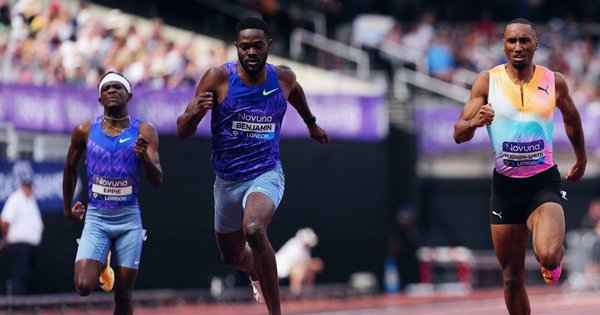
Alison dos Santos, for his part, was the third-fastest man in history heading into last week and had beaten Warholm head-to-head three times already this season. But if you were betting on someone to break Warholm’s record this year, the odds-on favorite would’ve been World/Olympic champ Rai Benjamin, coming off a huge 43.83 personal best in the flat 400m. That being said, the last man to beat Benjamin in a hurdles race was—you guessed it—dos Santos at last year’s Prefontaine Classic.
So where do these performances rank in terms of how unexpected they were this year? And while we’ve already learned the folly of trying to predict the next world record again and again, which is most likely to go down next?
From least to most surprising:
5. Emmanuel Wanyonyi, 2:11.83, 1000 meters (7/10/2026): It felt like the 1000m world record had been living on borrowed time since Marco Arop gave it a scare, running 2:13.13 back in 2024. The combination of Arop and Wanyonyi in their coincident primes, plus all the 1500m training they had to do for Grand Slam Track last year (LOL remember that?), meant that all it really took was the right race being scheduled at the right time with an appropriately-enticing appearance fee. As it turned out, Wanyonyi was pushed to the line by Jake Wightman, not Arop, but given that he could’ve run 1:41 and then jogged in a 30-second 200m and still gotten the record, this one was more of a “when,” not “if.”
4. Josh Kerr, 3:42.66, one mile (7/18/2026): We’ve previously discussed why Hicham El Guerrouj’s 3:43 was fairly gettable in terms of distance records. In short, it’s not an outrageous ask to get an established 3:27 1500m runner to leg out an extra 109 meters. Unlike the 1000m, however, the mile record has been attacked with more frequency and survived until this summer, so it gets a bump up to fourth place as a result.
3. Masai Russell, 12.09, 100m hurdles (8/27/2026): Entering this season, Russell was just 0.05 seconds away from Amusan’s mark, but before 2026, consistency was something of a high hurdle (pun intended) for Russell to clear and the Olympic champ was coming off a disappointing fourth-place finish at Worlds in Tokyo. But when the 12.20s started becoming increasingly routine and Russell lowered her American record to 12.14, the top spot on the list started looking more and more achievable. The one thing Russell had going against her was USAs not taking place at the hurdle-friendly Hayward Field… but now that she’s run 12.20 or faster on four different continents, a fast track is more of a luxury than a necessity.
2. Alison dos Santos, 45.80, 400m hurdles (8/27/2026): Alison dos Santos is a generational talent in the hurdles, to be sure, but the two biggest strikes against him were 1) the perception that Rai Benjamin would get there first and 2) a slight plateauing in his recent results. Since running his prior PB of 46.29 in 2022, he hadn’t come within 0.3 seconds before this season; his last two years featured SBs of 46.63 and 46.65. So knocking 0.49 seconds off his PB and 0.63 seconds off his SB in Zurich was a welcome surprise to be sure. One could also reasonably assume that, with the Diamond League final and World Ultimates still to come, dos Santos would’ve been two or three weeks away from his full and final taper of the year, and that his legs in Zurich wouldn’t be in tip-top shape. And one would be wrong.
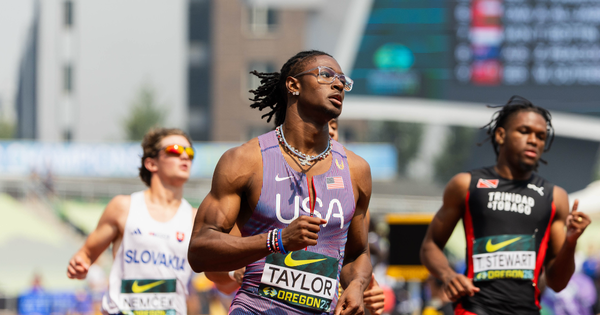
1. Ja’Kobe Tharp, 12.75, 110m hurdles (6/10/2026): Of all the world records set this season, Tharp’s was the one that really came out of nowhere. Well, maybe not nowhere, as the Auburn hurdler won USAs at 19 years old last summer and World Juniors the summer before. But it’s safe to say that no one would’ve placed a Kalshi bet on Tharp lopping 0.26 seconds off his personal best in one race in the prelims of NCAAs. Tharp then proved it was no fluke, running 12.90, 12.85, and 12.89 in his next three races, but given that he wasn’t even in the top five fastest active Americans when the year started, his singular breakthrough was pretty unexpected.
Where next?
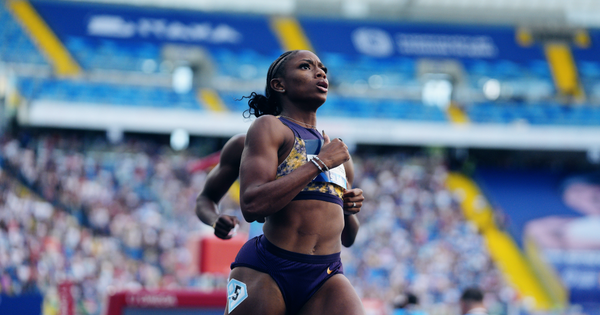
Audrey Werro and/or Keely Hodgkinson and/or Femke Broeders-Bol’s season-long attack on the 800m all-time list is the obvious place to look, but they’re not alone in being well-positioned to lengthen the list of WRs falling in 2026.
One such mark that feels analogous to the 800m, where an established star (Hodgkinson) is being pushed to new levels by the competition (Werro), is the women’s steeplechase, where the second-, third-, and fourth-fastest competitors of all time are going head-to-head several times a season. At 22 years old, World champ Faith Cherotich has risen to the level of—and often above—Winfred Yavi and Peruth Chemutai, the last two Olympic champs, and Zurich saw NCAA champ Doris Lemngole quietly crack the top-ten all time with an 8:55.96 PB behind Cherotich. Beatrice Chebet’s 8:44.32 got a scare from Yavi each of the last two seasons, and with more competition pushing her to the line, it may finally go.
The other obvious one is the men’s pole vault, where Mondo Duplantis is his own best competition… although! We saw something we’d never seen before in Zurich. Manolo Karalis became the only non-Mondo vaulter in history to clear 6.20m, and two, count ‘em, jumpers were both attempting (one more realistically than the other), a new WR of 6.32m at the competition’s end. While Karalis’s ascent has been great to watch, the most likely outcome will be Mondo breaking his own record for the umpteenth time, but maybe a little sweat on his neck is exactly what he needs to soar to new heights.
The last, more outside-the-box, event to watch is the men’s triple jump. In the good ol’ days of the 2010s, Christian Taylor was the heir apparent who seemed best positioned to knock off Jonathan Edwards’s 18.29m WR from 1995, but last month in Birmingham it was Andy Diaz Hernandez who, at 30 years old, put his name in contention with an 18.15m leap to win the European title and join the exclusive 18-meter club. There are now three active members of that nine-member club (although Jordan Diaz Fortun hasn’t jumped in 2026), although, unlike Taylor, none of the three have done it more than once. Diaz Hernandez does have three of the four longest efforts in the world this year, however, and he’ll have another opportunity to go big in Brussels.
Technically, every race is a world record attempt; most of them just have pretty bad odds of coming to fruition. If Zurich taught us anything, however, it’s to stay on our toes. The 2026 season has been full of surprises already, and with the Great Unknown that is a two-day “final” leading into a three-day “championship” in September, anything can happen.
Keep up with all things track and field by following us across Instagram, X, Threads, and YouTube. Catch the latest episodes of the CITIUS MAG Podcast on Spotify and Apple Podcasts. For more, subscribe to The Lap Count and CITIUS MAG Newsletter for the top running news delivered straight to your inbox.
David Melly
Since David began contributing to CITIUS in 2018, he's done a little bit of everything, from podcast hosting to newsletter writing to race commentary. Currently, he coordinates the social media team and manages both the CITIUS MAG newsletter and The Lap Count, supplying hot takes and thoughtful analysis in both short- and long-form. Based on Boston, David breaks up his excessive screen time by training for marathons, crewing trail races, baking sweet desserts, and mixing strong cocktails.