By David Melly
August 12, 2026
Let’s take a trip back in time to 2014.
Guardians of the Galaxy (the first one) was running rampant over the domestic box office, officially pushing the number of MCU films into the double digits. Some truly middling tracks, namely “Fancy” by Iggy Azalea and “Rather Be” by Clean Bandit, were duking it out for song of the summer. And the World U20 Championships were held in Eugene, Oregon.
The natural question whenever a promising junior rises to the top of the age-group heap is whether their ability to dominate the U20 crowd will translate to success at the next level. And now, with the benefit of 12 years of removal, we can confidently provide answers. Let’s look back at the last time Hayward played host to see how things later played out for our then-upstart champions. The long-term results are, frankly, all over the board.
A 17-year-old Joshua Cheptegei won the 10,000m in just his third-ever race outside Uganda. He went on to claim the world record and four global titles at the distance. Mary Cain ran a PB of 8:58.48 to win the 3000m, a year after representing the U.S. in the 1500m at the senior World Championships. This was unfortunately the last major victory of her sadly stymied pro career. And somewhere in between fall the likes of Dina Asher-Smith, who won the 100m, Yomif Kejelcha, the 5000m champ, and Shamier Little, who dominated the 400H.
Just because you didn’t win back in 2014 doesn’t mean you had no shot at making it big as a pro, either. Famously, talented developing athletes can… well, continue to develop. The runner-up in the 100m was a teenager by the name of Trayvon Bromell, who ran 10.28 for silver just one year before his breakout medal-winning performance at the Beijing World Championships. Performing really well at U20s can be an indicator of great things to come, but it’s not actually a great predictor of later success. Conversely, the pecking order among a bunch of 18- and 19-year-olds is far from set and stone as they continue to grow and gain experience.
More recent World U20 breakout stars include Emmanuel Wanyonyi, 2021 800m champ turned 2024 Olympic champ, Faith Cherotich, 2022 steeple champ turned 2025 World champ, and Letsile Tebogo and Tina Clayton, who both won the 100m in both 2021 and 2022. While it’s not necessarily a good thing for myriad other reasons, the youthful side of the sport is inarguably getting more and more professionalized. It wouldn’t be all that surprising to see a decrease over time in how variable long-term outcomes are since more and more U20 athletes are basically seasoned pros by the time they line up at U20 Worlds.
The bigger challenge isn’t so much that talent is hard to translate into results over time; it’s that being a true world-beater is really, really hard, even from one year to the next. In any given U20 cohort there are probably only a couple stars who can spend the next decade racking up senior medals because, simply, the athletes who do that are few and far between. Folks like Salwa Eid Naser, Soufiane El Bakkali, and Karsten Warholm were wunderkinds when they first broke into the World medals in 2017, and nine years later they’re still in the top three in their respective events. Faith Kipyegon winning junior medals in World XC as a barefoot 15-year-old in 2011 then going on to dominate the next 15 years of the 1500m is absolutely the exception, not the rule.
With all that said, there are three performances that stood out to us from all of this year’s action in Eugene, because they’re showing all the signs of big things to come.
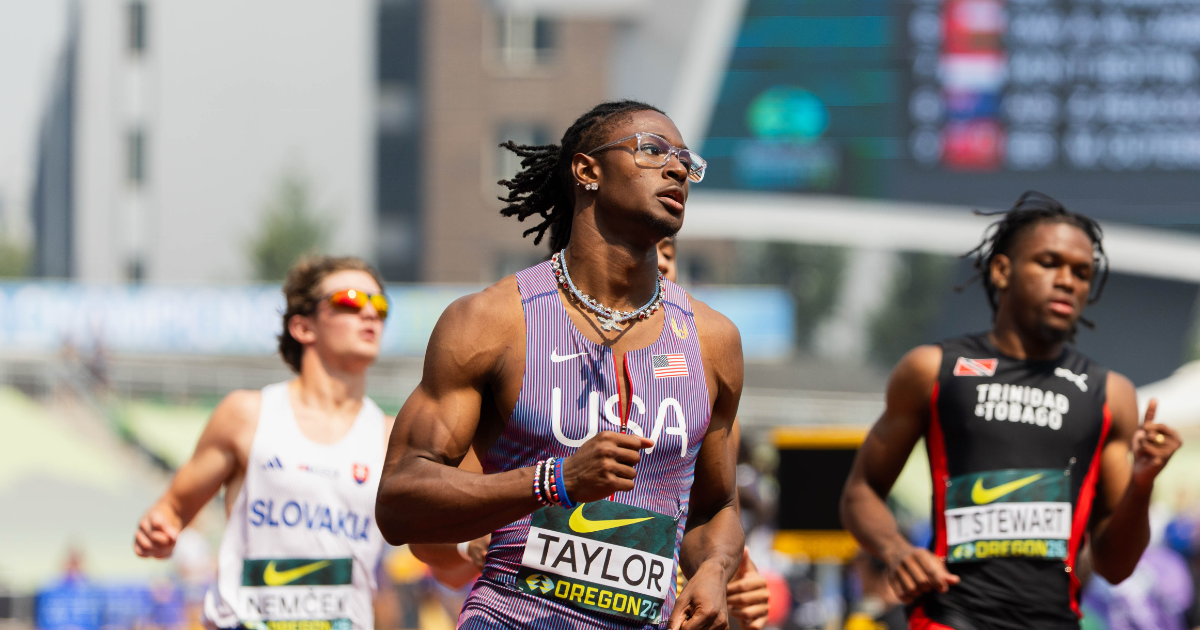
18-year-old Texan Tate Taylor did something no man (boy?) or woman (girl?) has ever done at a World Juniors: win the 100m, 200m, and 4x100m triple gold. Moreover, he never looked to be seriously challenged for any of those three victories, despite the strong fields assembled around him. In the 100m, Taylor secured the first World Athletics-ratified, wind-legal sub-10 of his career, running 9.94, and then backed it up with a 19.83 200m victory. These times aren’t merely impressive for a just-graduated high schooler; they’re competitive internationally at any level. Taylor now has the same 100m season’s best as Ferdinand Omanyala and Ackeem Blake, both of whom can contend in a global final. In the 200m, his 19.75 from U.S. U20s puts him #5 in the world, and his 19.83 from last weekend is faster than Tebogo, Noah Lyles, and Andre De Grasse have run this season.
Taylor is three months older than Australian Gout Gout (who didn’t make the trip due to injury, unfortunately) but they haven’t received nearly the outpouring of hype. Part of that is because Gout was faster, younger, and part is because the U.S. have a much longer and deeper sprint cadre than Australians. But with his performance at USAs, Taylor has rightfully entered the conversation alongside Gout—and others slightly ahead of him like NCAA champ Kayinsola Ajayi—of “next great sprinter.”
His fellow Texan and Team USA teammate Mia Maxwell nearly pulled off the same feat, but the women’s 4x100m missed the final by 0.02 seconds. She did, however, pull off the 100m/200m double, and firmly stamp her name into the “star to watch” category. Maxwell and her twin sister Mariah finished 2-3 in the 60m at U.S. Indoors back in March, so it’s not an exaggeration to say they’re already competing at a pro level, but the new glimmer of greatness we glimpsed from Mia Maxwell this weekend came in the 200m.
Maxwell is certainly known to be stronger in the shorter sprints, but she took a leap forward in the 200m last weekend with a 22.37 personal best, improving on her 22.49 from U.S. juniors. This time last year, she hadn’t broken 23 seconds. More importantly, she did so by beating runner-up Shanoya Douglas of Jamaica by a whopping 0.31 seconds—particularly impressive when you consider that Douglas’s PB is 22.11 and that she’s the national U20 record holder in a country with a long history of sprinting excellence. It’s not just what you run; it’s who you beat, and Maxwell’s breakout weekend showed great promise on both fronts.
Last, but CERTAINLY not least, the most eye-popping performance of the weekend. It’s not unusual to see lightly-raced juniors struggle a bit with pacing, letting their fresh legs and comparative inexperience carry them a bit out ahead of their skis only to pace the price. We saw that in the 800m, where Ugandan Shafek Murungi took the field out in a ridiculous 23.63 200m and 49.17 400m only to close his second lap north of 60 seconds and finish eighth. So when 17-year-old Kenyan Emmanuel Kiprono led the 3000m through 1k in 2:26, it seemed certain that we’d be in store for another hilarious blowup.
Kiprono slowed down… eventually. But by not nearly as much as you’d think. After hitting 1600m in 3:54 and 2000m in 4:55, he did eventually stop clicking off sub-60s, but he brought it back to a 28.55 final 200m and crossed the line in 7:28.28, shattering the championship record by 14 seconds and missing Kejelcha’s world junior record by a few tenths in what was, for all intents and purposes, an unpaced solo effort.
Kiprono is a relative unknown with few other races on his World Athletics profile, but there are two other key data points suggesting this kid may be going places. In January, in what appears to be his first international race, Kiprono took second in the U20 race at World XC, finishing just behind his teammate Frankline Kibet. And in his qualifying race for Eugene, run at 5,900 feet of elevation in Nairobi, Kiprono ran a hand-timed 7:35.4 and beat everyone else in the field by over 20 seconds. He ran just 0.05 seconds slower than Yared Nuguse’s 3000m PB, and the only Americans to ever run faster are Cole Hocker and Grant Fisher, all three of whom are Olympic medalists. Did we mention he’s officially still 17?!
Trying to place futures bets based on World U20s results may seem at first glance like throwing darts while blindfolded, but to the discerning eye, these three performances are likely a sign of much bigger things to come. In all likelihood, there will also be someone who isn’t even mentioned in any of the various Eugene race recaps who becomes a comical “did you realize that” trivia in ten years when they’ve won a World title or two, and the sad reality is others won’t even earn a Wikipedia footnote. That’s part of the fun of World U20s: the possibilities are truly endless, and following the range of outcomes as the athletes step out further onto the global stage will surely be a wild ride.

David Melly
Since David began contributing to CITIUS in 2018, he's done a little bit of everything, from podcast hosting to newsletter writing to race commentary. Currently, he coordinates the social media team and manages both the CITIUS MAG newsletter and The Lap Count, supplying hot takes and thoughtful analysis in both short- and long-form. Based on Boston, David breaks up his excessive screen time by training for marathons, crewing trail races, baking sweet desserts, and mixing strong cocktails.