By David Melly
August 26, 2026
The Diamond League returned last week with a bang. Or two bangs, more precisely: one in Lausanne, Switzerland and another in Silesia, Poland, two days and a few hundred miles apart.
After weeks of national and regional championships where programs are broken up by rounds and padded generously to facilitate doubling, a return to the two-hour straight-final format felt a bit like drinking from a fire hose. (In a good way!)
It caused performances like Letsile Tebogo’s 19.87, Masai Russell’s 12.27, and Marileidy Paulino’s 48.87 to fade into the background—not because they weren’t impressive, but because they were simply expected returns to form after a month off. Paulino, especially, deserves a few more flowers, as she clocked her sixth straight 48-second performance, something no woman in history has ever done.
Something else noticeable was the immediate and dramatic impact that the return of American and Caribbean athletes to the scene had on the dynamics of many events. Commonwealth Games and European Championships are fun because they showcase a subset of performers who don’t normally shine, particularly in the sprints, but the full come-one, come-all Diamond League format was a reminder that the sport is at its best the more global it is.
Rai Benjamin tested something resembling the schedule he may take on at World Ultimates, running 46.67 in the 400m hurdles on Friday in Lausanne then dipping under 44 seconds for the flat 400m for the first time, thanks to a duel with Collen Kebinatshipi. Benjamin ended up at 43.83 behind Kebinatshipi’s 43.56, a great showing from both men as the Motswana athlete picked up his fifth DL victory of the year and Benjamin moved to #3 on the 2026 descending order list in his secondary event.
Speaking of hurdlers: the U.S. men have a streak even longer than Kebinatshipi’s going. The last 14 winners of the 110m hurdles at DL races have all been American, the two most recent being Jamal Britt in Lausanne (13.13) and Ja’Kobe Tharp in Silesia (13.05). Tharp led a dominant 1-2-3-4 finish of U.S. hurdlers, which is impressive in and of itself… until you remember that the most decorated American hurdler of the last decade doesn’t even include Grant Holloway.
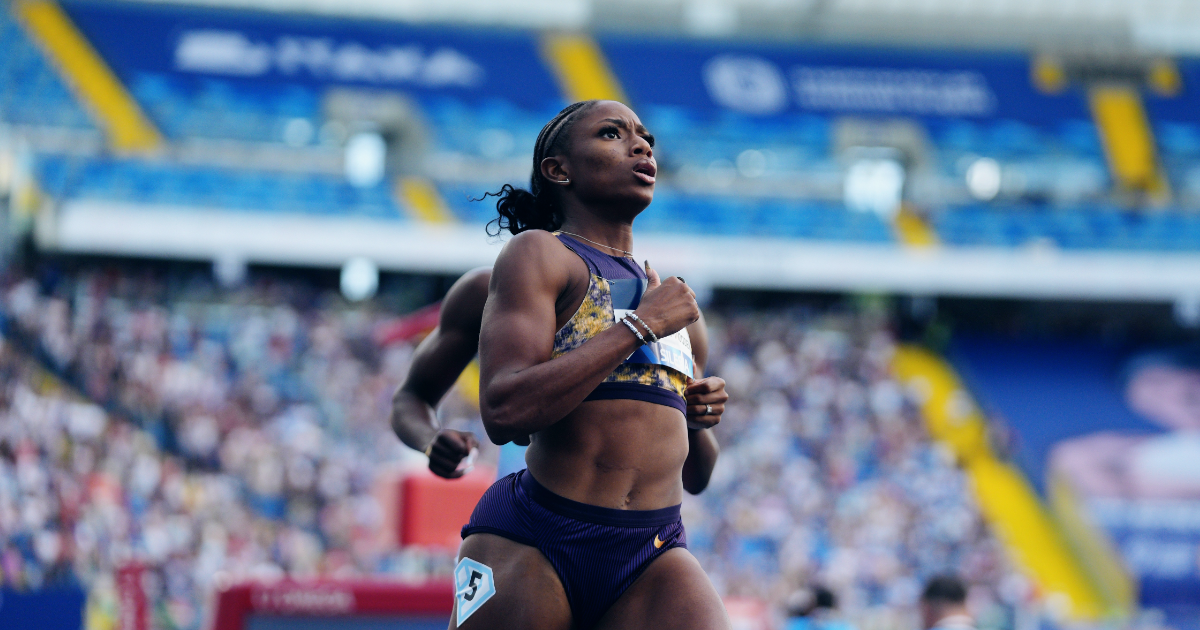
Kayla White beat European champ Amy Hunt in the 200m and Oblique Seville stared down Kenny Bednarek in a record-setting 100m, where for the first time in history all nine finishers broke 10 seconds. Of that group, five are from the Western Hemisphere and four hail from Africa. Lachlan Kennedy, the fastest Australian in history and Commonwealth silver medalist, was the first man out of the final. The man who beat him, Emmanuel Eseme, finished ninth in both the qualifying and the final. This isn’t to diminish the accomplishments of the athletes who’ve spent much of August satisfyingly entertaining us, but to highlight just how worthwhile the reunification of the sprinting fields has been.
But there were three events in particular where the thrill wasn’t just the results themselves, but what they suggest about the races to come, namely the Diamond League final and the World Ultimate Championships—plus another great meet tomorrow in Zurich.
Let’s start with the women’s 800m, an event we’ve (rightfully) spilled plenty of ink on already. Audrey Werro continued doing Audrey Werro things. She put on a show for the home crowd in Lausanne with a 1:55.33 victory, leading two of her countrywomen to top-five finishes as well, which suggests that a nation of 9 million residents may have a good shot one day at the world record in the 4x800m. It’s almost comical how routine Werro has made 1:55 seem this season, especially when you consider that one year ago this week was the first time she’d ever cracked 1:57.
No, the big news wasn’t that Werro won, or that she ran fast. It was the margin by which she broke the tape: just 0.08 seconds ahead of Femke Broeders-Bol, who claimed sole possession of the Dutch national record in 1:55.41, another personal-best. Coming down the homestretch, Werro tapped into the same strength she displayed in holding off Keely Hodgkinson to win in Birmingham, but Broeders-Bol looked even stronger, reeling her in and nearly pipping her at the line. It’s one thing for a 400m runner to move up in distance and enjoy some success; it’s quite another for her to close her final 100 meters in 14.8 seconds, faster than anyone else in a world-class field.
Unfortunately, the reunion of Werro, Broeders-Bol, and Hodgkinson will have to wait as the Olympic champ withdrew from Zurich. But fear not! We’ll get a Femke-Audrey rematch with the extra zest of World silver medalist Georgia Hunter Bell, herself a sub-1:55 runner. Now we get to see where Broeders-Bol stacks up against the Commonwealth Games champ, who hasn’t lost an 800m all year (although she’s only raced three). And based on how the end of that race in Lausanne played out, that 0.08 second gap may shrink even more, or *gasp* disappear entirely—and then we’ll truly have a flip of a three-sided coin on offer for World Ultimates and beyond.
Another event where the intrigue continues to build is the men’s 1500m. Last week, we asked a simple but open-ended question: “WTF is going on?” And after Silesia… we could say the same thing.
Jakob Ingebrigtsen and Cole Hocker made their highly-anticipated returns to the circuit after both battling setbacks earlier in the year (okay… in Ingebrigtsen’s wasn’t a setback so much as a two-year derailment via Achilles injury). For the first two-thirds of Sunday’s race, it looked like they’d Freaky-Friday’d each other, with Hocker getting out on the pacers’ heels early and Ingebrigtsen buried in the crowd, hoping to trust his kick. By the bell lap, Ingebrigtsen had made his way to the front, but he ended up a little boxed coming off the final turn as Phanuel Koech hit the front and then the rail.
All that jockeying for position shuffled Hocker backward while opening a lane for a perfectly-timed kick from 23-year-old Ethan Strand, who slingshotted onto the homestretch and put daylight between himself and the rest of the world en route to a 3:30.77 victory—the first of his short pro career on the DL circuit.
Regardless of who you’re rooting for in this field, this was probably the best-case scenario from a narrative standpoint. Hocker and Ingebrigtsen still finished well—finishing third and fourth, respectively, in a pair of 3:31s—but neither man has the pure fitness nor tactical prowess at the moment to dominate like they can at their best. They’ll go into tomorrow’s race against each other, Timothy Cheruiyot, and Yared Nuguse encouraged knowing they’re healthy and capable, but plenty hungry.
Strand, for his part, continues to show flashes of world-beating brilliance that suggests he’ll have a long and fruitful professional career—and one that may start delivering medals sooner rather than later. As his seventh place, 3:49.13 finish in London showed, he’s not quite at the level of racing the best milers in the world at their best at any time… but he’s getting there, improving in both confidence and consistency. Should he race his way into the Diamond League final (likely) or the World Ultimate Championship (less likely, but possible), it’s clear that his range of outcomes now includes winning.
Last, but certainly not least, the excitement coming out of Silesia could all come down to a very critical 0.05 seconds. That’s the margin by which Melissa Jefferson-Wooden, the World champion, beat Julien Alfred, the Olympic champion, in the 100m. That being said, Alfred’s reaction time to the starting gun was 0.04 seconds slower than MJW’s, meaning that the two sprint superstars covered 100 meters in nearly the same exact time. The detailed results show that Alfred and Jefferson-Wooden were between 0.03 and 0.05 seconds apart at every 10-meter checkpoint in the race, confirming what the eye test tells us: these two athletes are so, so close in ability right now that every time they line up it’s going to be a battle of inches.
That being said, Jefferson-Wooden has not lost a 100-meter race since the Paris Olympic final two years ago. So while the margins are small, there’s an undisputed #1 sprinter in the world right now. But for how long? It’s also worth mentioning that Sha’Carri Richardson finished third in what she called her “worst race of the season,” and the U.S. champ was 0.01 seconds behind her training partner at Pre. They’re also 0.01 seconds apart by season’s best (Richardson is ahead at 10.77), and even though they just raced head-to-head-to-head, it doesn’t feel like those results are set in stone. Quite the opposite.
Should Richardson and Alfred bring their best stuff, MJW will in turn need to bring her best stuff to stay undefeated, which means that results with multiple runners under 10.70 feels like a distinct possibility. That’s only happened once before in history, when Shelly-Ann Fraser-Pryce beat Elaine Thompson-Herah in Lausanne in 2021, shortly after the latter’s second Olympic title. That was a race between two of the all-time greats at the top of their games, and yet it doesn’t feel like hyperbole to say that we might see something similar before the year is out.
One of the oldest adages in showbusiness is that you want to leave the audience wanting more, and last weekend’s results did just that. Putting on a performance that doesn’t let down the crowd and makes them even more excited to shell out for tickets to the next one is a tricky kind of alchemy, but that’s exactly what Silesia and Lausanne delivered. Sure, we were drinking from the firehose earlier, but we’re still thirsty, and that’s going to make the next few weeks of track and field very satisfying.

David Melly
Since David began contributing to CITIUS in 2018, he's done a little bit of everything, from podcast hosting to newsletter writing to race commentary. Currently, he coordinates the social media team and manages both the CITIUS MAG newsletter and The Lap Count, supplying hot takes and thoughtful analysis in both short- and long-form. Based on Boston, David breaks up his excessive screen time by training for marathons, crewing trail races, baking sweet desserts, and mixing strong cocktails.