By David Melly
June 17, 2026
The divide between American track and field fans and international athletics fans might come down to an age-old question of importance: what matters more, an NCAA title or a European Championship?
Traditionalists across the pond will scoff at the notion that a bunch of students meeting up in Eugene should carry the same prestige and clout as a continent-wide professional championship. And World Athletics tends to agree, rating NCAAs a Category “B” meet two rungs below Euros (or, for that matter, NACACs). Some of that, of course, comes down to the long-held beef between World Athletics and the NCAA on drug testing policies. But here’s the thing…
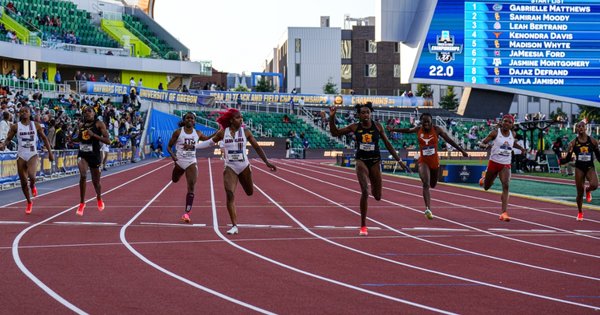
When it comes to the level of competition, particularly in the short sprints, NCAAs is inarguably a world-class meet each year. Only USAs and global championships can consistently claim to be better meets across the board. Diamond League meets are usually better, but… not always.
With the dust settled over Hayward Field, the fastest marks in the world this year in the men’s 100m, 200m, 400m, and 110m hurdles and women’s 100m, 200m, and 400m belong to athletes representing American universities. Now, that’s a slightly misleading stat. The college kids all peaked for June and the pros likely have September circled on their calendars—but the kids are also taking a crack at the all-time lists as well.
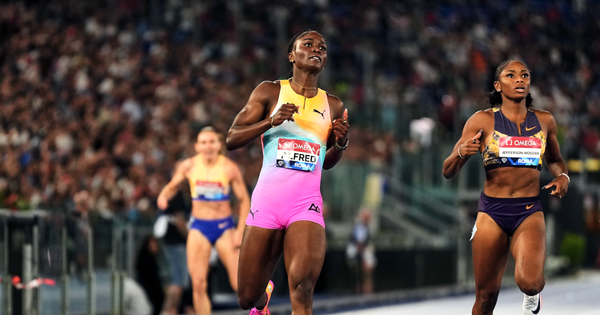
Adaejah Hodge’s 10.63 in the 100m prelims puts her at #5 all-time, and her 21.68 winning mark from the 200m puts her at #8 all-time, tying her with reigning 200m World champ Melissa Jefferson-Wooden. Samuel Ogazi of Alabama ran 43.38 for #4 all-time to win the 400m over Georgia’s Jonathan Simms, who equaled the old world lead of 43.92 in second. And then Simms came back to drop a ridiculous 42.99 split on the Bulldogs’ winning 4x400m.
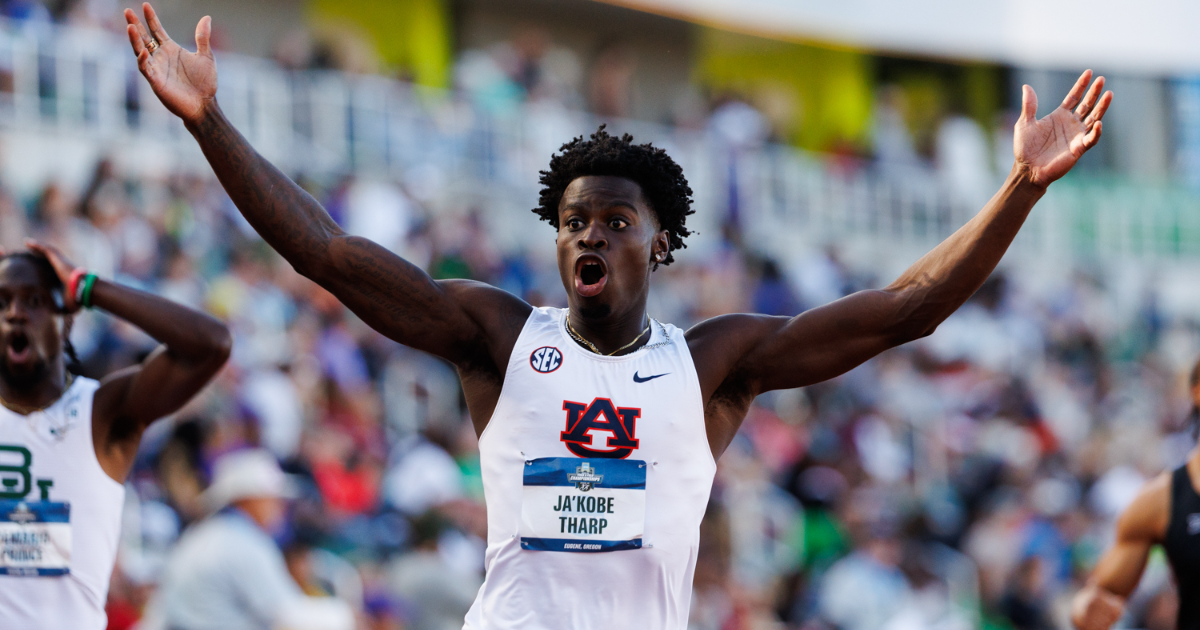
Kanyinsola Ajayi of Auburn followed up his 9.84 100-meter performance at East Regionals with an absurd 9.72 in the final, nudged along by a breeze just over the legal limit at 2.2 m/s. That puts him sixth on the all-conditions 100m list. And of course, Ajayi’s fellow Tiger Ja’Kobe Tharp, who’s already shown he can contend with the best pros by winning USAs last year, delivered the performance of the meet when he broke Aries Merritt’s 12-year-old world record in the 110m hurdle prelims, running 12.75. For good measure, his 12.90 in the final would’ve also been a world lead and all-time top-ten performance.
“But that’s just a few talented future-pros at the top!” you protest in a thick French accent.
That would be true… if the depth weren’t elite as well. Behind Jaiden Reid’s 19.63 collegiate record in the 200m, five total men ran under 20.1. T’Mars McCallum’s 20.09 for fifth would’ve earned him a second place finish if transponded onto the Oslo DL two days earlier. There’s only one meet this year where two women have broken 49 seconds: NCAAs, thanks to Dejanea Oakley and Madison Whyte. No Diamond League has pulled that off in 2026, and in all of 2025, only two—the Rome DL and Worlds—saw multiple women break 49 in the same race.
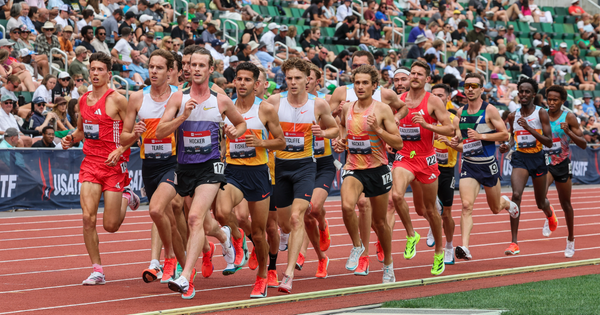
The distance races are harder to compare apples-to-apples because at NCAAs, races are un-rabbited and tend to play out tactically. But that being said, six women ran 1:58.55 or faster in the 800m final, led by Sanu Jallow-Lockhart’s stunning 1:56.85 collegiate record. The record she broke was, of course, Athing Mu’s, who single handedly proved this premise herself by winning Olympic gold two months after claiming the NCAA title.
At least when it comes to sprints, the NCAA championship is one of the best meets in the world. Amateur competition or not, the meet has earned professional-level respect because the athletes that show up year in and year out are world-class. Winning NCAAs is impressive because you can hurdle a 12.98 or sprint a 48.97 and lose.
In a sense, the best European analogue to NCAAs isn’t Euros; it’s Götzis. The Hypomeeting is an annual pilgrimage for the greatest multi-athletes in the world, and even though it isn’t a championship of any kind, World Athletics has placed it in the “GL” category alongside area championships because the level of competition is so high. On paper, Götzis shouldn’t matter at all, but because the best athletes keep competing there, it merits special consideration.
When you look at the meets in the “A” category one slot above NCAAs, it starts to look a lot more like the collegiate championship’s peer group. Commonwealth Games, regular season Diamond Leagues, WA Continental Tour Gold meets. Maybe the “NCAAs matters more than Euros” argument remains the provenance of angry Twitter users for now, but at least for the sake of rankings, it’s long past time for World Athletics to swallow its pride and bump NCAAs up—particularly if it’s going to move one day toward an all-rankings model.
It’ll always be a little strange that a group of colleges in the U.S. all got together and decided that a huge part of higher education is going to be bringing in top athletic talent from all over the world and attaching a billion-dollar sports league to academic institutions across the country. But that’s the world we live in. NCAAs is an important meet because the athletes’ choice to take their talents to Hayward makes it so, and to pretend otherwise is to live in a fantasy.

David Melly
Since David began contributing to CITIUS in 2018, he's done a little bit of everything, from podcast hosting to newsletter writing to race commentary. Currently, he coordinates the social media team and manages both the CITIUS MAG newsletter and The Lap Count, supplying hot takes and thoughtful analysis in both short- and long-form. Based on Boston, David breaks up his excessive screen time by training for marathons, crewing trail races, baking sweet desserts, and mixing strong cocktails.