By Citius Mag Staff
June 10, 2026
You thought we were done with rankings… but we’re just getting started.
In addition to World Athletics’s push to use event-specific rankings more for World Ultimate Championships and Beijing 2027, the organization maintains another rankings list that’s more for discourse than for meet selection: the overall athlete rankings.
These rankings try to answer one of the most fundamental track and field questions: how do you compare athletes across events? It’s no easy task. WA does this in a relatively simple, straightforward way—but also one that’s inherently flawed. The “overall ranking” is simply a consolidated list of every athlete’s individual ranking score (their top performances, graded on the World Athletics scoring tables with placing points awarded for bonus). The problem, of course, is that the WA scoring tables are far from a perfect system, and certain events receive disproportionate consideration.
As we mentioned last week, the top three track athletes in the men’s overall rankings are 400m hurdlers. According to Seb Coe, the eighth best male athlete in the world is one who’s never won a World Championship: Greek pole vaulter Manolo Karalis. And because rankings are updated weekly but include the last 12 months performances, the second-best athlete in the world in June 2026 is a woman who’s pregnant and will not compete this year, Beatrice Chebet.
That said, coming up with a better system is no easy task. Contemplating the best athletes using only 2026 results means that, in theory, an athlete like Melissa Jefferson-Wooden is only being judged on two races. World Indoors is the biggest championship that’s occurred so far on the calendar, but many regular-season Diamond League races have stronger fields than Toruń did. Plus, a particular quirk of this year (the lack of a true World Championship and limited events on the World Ultimate program) means that distance runners aren’t exactly climbing over one another to race high-quality 10,000ms or steeples.
We asked the Citius Mag team to rank the top 25 track and top 25 field athletes since the start of 2026, and the range of responses were interesting. Unlike WA’s point system, there were no hard and fast criteria beyond limiting performances to this calendar year, prioritizing high-level professional competitions, and considering event depth. In a phrase, it’s just vibes. Times and places still matter, but the official team position is that running 10.7 in the 100m at NCAA Regionals is still less important than running 10.8 in Stockholm. So without further ado, here they are:
2026 Track Power Rankings
1. Julien Alfred 🇱🇨
2. Noah Lyles 🇺🇸
3. Keely Hodgkinson 🇬🇧
4. Melissa Jefferson-Wooden 🇺🇸
5. Cooper Lutkenhaus 🇺🇸
6. Audrey Werro 🇨🇭
7. Gabby Thomas 🇺🇸
8. Busang Collen Kebinatshipi 🇧🇼
9. Kenny Bednarek 🇺🇸
10. Alison dos Santos 🇧🇷
11. Shericka Jackson 🇯🇲
12. Masai Russell 🇺🇸
13. Georgia Hunter Bell 🇬🇧
14. Josh Kerr 🇬🇧
15. Soufiane El Bakkali 🇲🇦
16. Jordan Anthony 🇺🇸
17. Yared Nuguse 🇺🇸
18. Peruth Chemutai 🇰🇪
19. Cole Hocker 🇺🇸
20. Birke Haylom 🇪🇹
21. Devynne Charlton 🇧🇸
22. Adaejah Hodge 🇻🇬
23. Emma Zapletalova 🇸🇰
24. Kishane Thompson 🇯🇲
25. Samuel Ogazi 🇳🇬
2026 Field Athlete Power Rankings
1. Mondo Duplantis 🇸🇪
2. Camryn Rogers 🇨🇦
3. Simon Ehammer 🇨🇭
4. Valarie Sion 🇺🇸
5. Jessica Schilder 🇳🇱
6. Ziyi Yan 🇨🇳
7. Ethan Katzberg 🇨🇦
8. Yaroslava Mahuchikh 🇺🇦
9. Chase Jackson 🇺🇸
10. Molly Caudery 🇬🇧
11. Leyanis Perez Hernandez 🇨🇺
12. Sofie Dokter 🇳🇱
13. Andy Diaz Hernandez 🇮🇹
14. Kristjan Čeh 🇸🇮
15. Rumesh Tharanga Pathirage 🇱🇰
16. Miltiadis Tentoglou 🇬🇷
17. Joe Kovacs 🇺🇸
18. Hana Moll 🇺🇸
19. Jordan Scott 🇯🇲
20. Matty Denny 🇦🇺
21. Mattia Furlani 🇮🇹
22. Daniel Ståhl 🇸🇪
23. Anderson Peters 🇬🇩
24. Manolo Karalis 🇬🇷
25. Nicola Olyslagers 🇦🇺
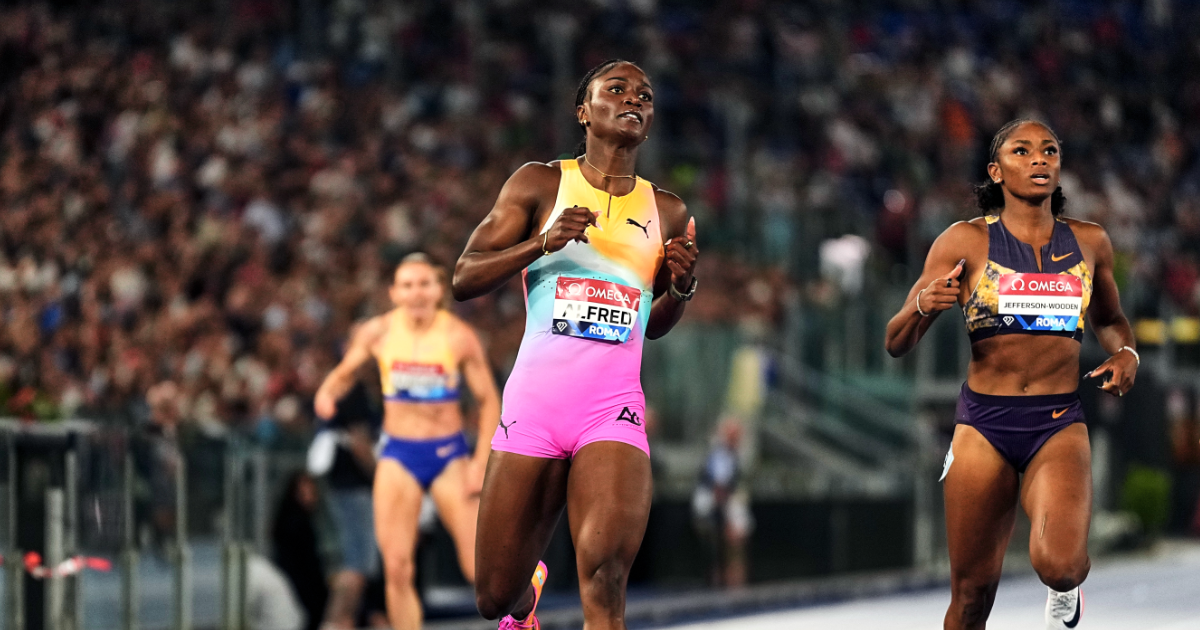
The most intriguing takeaway from these rankings may be that the women’s sprints are heading toward a clash of the titans. Jefferson-Wooden may be the triple World champion, but she just lost to Alfred over 200m in Rome. Neither is a 200m specialist in the way Shericka Jackson or Gabby Thomas is, so with those two getting back to 100% health and fitness, the battle for best female sprinter could also become the battle for best athlete in the world. And that’s not even including in the X factor that is Adaejah Hodge, who’s currently running rampant through the NCAA but has yet to face professional competition this year.
It’s also worth noting that isolating rankings to calendar-year performances could be a harbinger of a very different near future. Ryan Crouser doesn’t make the top 25 right now—could his imperial reign over the shot be coming to an end? Or what about Yulimar Rojas, whose post-Achilles-surgery triple jumping has been sufficient to land on the indoor and outdoor podium, but not good enough for multiple golds and word records? The back half of the season will let us know whether the first few months of 2026 are a blip to be overcome, or a trend toward decline.
They say you can’t compare apples and oranges, but there you have it. “Who’s the best” is usually just fodder for long run debates and comments sections, but it’s also an official practice of World Athletics—and now the Lap Count. And with the direction the sport is being pushed, get ready for much, much more of this in the months and years to come.

Citius Mag Staff