By Kyle Merber
November 18, 2026
Professional track and field should not try to become a team sport. That’s obviously a bad idea that couldn’t possibly go anywhere.
However… if it wanted to try—which it should not!—this is what it could do…
But first, a history lesson. The first dual meet in history was between Oxford and Cambridge in 1864, ending in a 4-4 tie. In 1899, that rivalry developed into the elite British university duo teaming up to take on America’s finest young scholars out of Harvard and Yale, which is a transatlantic battle that’s still waged today.
A few years prior, the Big Meet between Stanford and Cal began in 1893, which would eventually inspire spinoffs like UCLA vs. USC. Today the rivalry makes for some spicy Instagram reels, but in 1967 it packed 25,000 fans into the Los Angeles Memorial Coliseum.
Is it any wonder that the modern fan idealizes this history and is nostalgic for what once was? Today, the full focus is on the individual. Aside from the few schools that can compete for NCAA track titles on the backs of a couple star athletes, no one pays attention to the team scores at basically any level.
But back to stuff people did pay attention to. If there’s any dual meet worth copying at the pro level, it’s the USA vs. USSR series, which, granted, drew crowds thanks in part to the looming threat of nuclear annihilation. Talk about stakes! In 1962, more than 150,000 fans watched the two global superpowers compete over two days in Palo Alto. Over the course of what became a 19-meet series, 15 world records were set.
That right there is the easiest potential solution of how we could reintroduce a team element to the professional ranks, and make it something people care about. It’s not a full major system overhaul, but a one-off opportunity to garner some interest. The key is to lean on real geopolitical rivalries. Ideally those with more intensity than Sweden and Finland, which have battled in the meet known as Finnkampen since 1925. (The problem there is that they’re allies and generally like each other.)
But what about… Team USA vs. The Entire World!
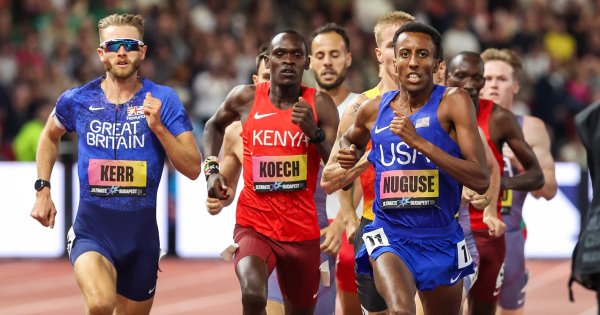
It’s no secret everyone hates us, so let’s lean into it to sell some tickets. Now, by the numbers Team America is getting smacked. At the World Ultimate Championships, the U.S. won 27 medals and everyone else pulled in 58. To even out the talent pool, the meet should be hosted in the United States with half the lanes reserved for the home team. (Loser pays the tariffs?)
But what about run-of-the-mill regular season meets like the Diamond League? There’s some inspiration in the likes of professional cycling, which adds capital and commercial value to the sport, while maintaining the main interests of the average fan: the stars.
Sure, the real fans closely follow which teams are winning. But the focus is still on the individual. The name Tadej Pogačar is well known, but UAE Team Emirates XRG slightly less, and deservedly. The fact that the XRG was added only a couple years ago is irrelevant, and that a decade ago the same team was called Lampre-Merida even more so.
But the addition of XRG meant more money for the team, which has an estimated budget of €60M, with their star athlete estimated to be paid about an eighth of that total. This salary is a bucket of money that cycling’s stars get paid on top of their race winnings and individual sponsors—a bucket that for track athletes is currently as empty as their logoless jerseys.
The methodology for selecting athletes to line up at a Diamond League meet is unlike anything that we can think of that exists in any other sport. The meet organizer, who is sometimes an agent themselves, decides who gets a lane and thus the opportunity to earn prize money. Layer in the fact that they are also negotiating athletes’ appearance fees and conflicts of interest abound, especially since these fees can be much larger than the potential prize. Athletes are measured by how many additional tickets they might sell, and not by their expected performance.
The system is backwards. It is the equivalent of the NFL deciding who will play quarterback for the New York Giants in their game vs. the Eagles. Track and field is missing this middleman: a third party with a vested interest in the performance of the athletes.
The solution is not to create new meets that pit location-based franchises against one another – there are already enough meets. And the few teams we do have are often tied to shoe companies, which are already paying athletes and invested in their exposure. What is needed is an entirely new revenue stream that is motivated by profit.
Track could, theoretically, become a team sport simply by revamping how lanes at elite meets are distributed, changing who pays athletes, and how. Here is the model:
There are four franchises. Each is responsible for selling their own naming rights to a brand, ideally one that conflicts with as few athletes as possible (i.e., not shoe sponsors). That brand gets exposure and certain rights to the athletes’ NIL to promote their product and merchandise. This is brand new revenue for the sport that does not currently exist.
Each franchise has two lanes per Diamond League meet—it is up to them who fills each. Rather than athletes contracting appearance fees with individual meets, athletes get paid by franchises to represent them.
There are infinite ways to structure how rosters get filled, but a potential draft and waiver system to sign free agents would all be part of the process. The goal for each franchise is to sign the best athletes to the team at a price dictated by their perceived value, not by an arbitrary measurement of theoretical tickets sold.
The meets would no longer pay the athletes to appear; the teams would. And an athlete is only as valuable to a team as their ability to help them win. Each team could pay the Diamond League a franchise fee for the season, and those fees help fill the prize pool. After each meet is scored (who cares how for now), the league pays the teams based on their results. The teams pay their athletes a salary and performance bonuses. The meet never writes an athlete a check.
In 2026, the Diamond League reported that they’d pay out $18M in prize and appearance fees across the 15 meet series, with $500,000 in prize money at each of the regular season events and $2.24M for the final. The math would therefore suggest an even split budget between appearance fees and prize money. Four franchises pay the league a bit over $2M with the commitment to spend about the same on securing their rosters. All this in action:
- Billionaire A buys a Diamond League team for $2.25M
- Billionaire A secures a team sponsorship for $1M to name their team, “Team Snickers”
- Team Snickers drafts Faith Kipyegon for $200K + a bonus to run three meets
- Team Snickers adds Linden Hall for $10,000 to run the 1500m in Monaco
- Team Snickers wins Monaco and gets paid $700K from the DL ($200K+ profit)
- Team Snickers uses Faith Kipyegon in a commercial
- In season two, Team Snickers becomes “Team Reese’s” for $1.5M
- In season two, Billionaire B sells one lane to a new franchisee for $1.5M
- Now Billionaire A’s team is valued at $3M
Something like that… Like we said. We shouldn’t attempt anything like this. But if we wanted to, that’s roughly how it might work!

Kyle Merber
Kyle Merber is a former professional miler turned media multi-hyphenate. While he’s not above dropping a quick “back in my day,” he’s far more focused on the present. Since 2021, he has brought his signature analysis and commentary to track fans across the CITIUS MAG network. When he’s not writing The Lap Count or hopping on podcasts, Kyle manages partnerships and pitches a relentless stream of ideas for Chris to consider. He might not be running a 3:52 mile anymore, but he keeps himself in just good enough shape to ensure the athletes still respect him.