By Kyle Merber
September 23, 2026
If you felt like Copenhagen came and went in the blink of an eye, you wouldn’t be alone.
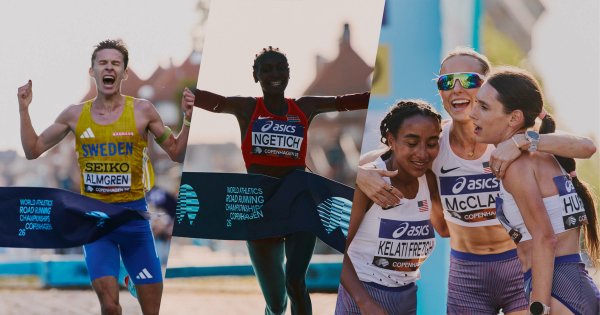
For those reading this newsletter from the Western Hemisphere, it’s highly likely that you slept through at least two-thirds of the 26th World Road Running Championships. The mile and half marathons took place around 4am Eastern on Saturday and Sunday, which is a shame, because the races were pretty great.
And if your reaction to the paragraph above was, “wait—the 26th?!,” that’s also understandable. The event, which was first held in 1992, has been known as the World Half Marathon Championships for most of its existence, except for a brief two-year period where the race distance was 20km. It may be more accurate to say this is just the second edition of the championships in their current format… and last! The 2027 World Road Running Championship won’t feature a road mile like Copenhagen this year or Riga in 2023.
That’s a shame! Because the second and potentially final World Road Mile races were two of the feel-good stories of the whole weekend.
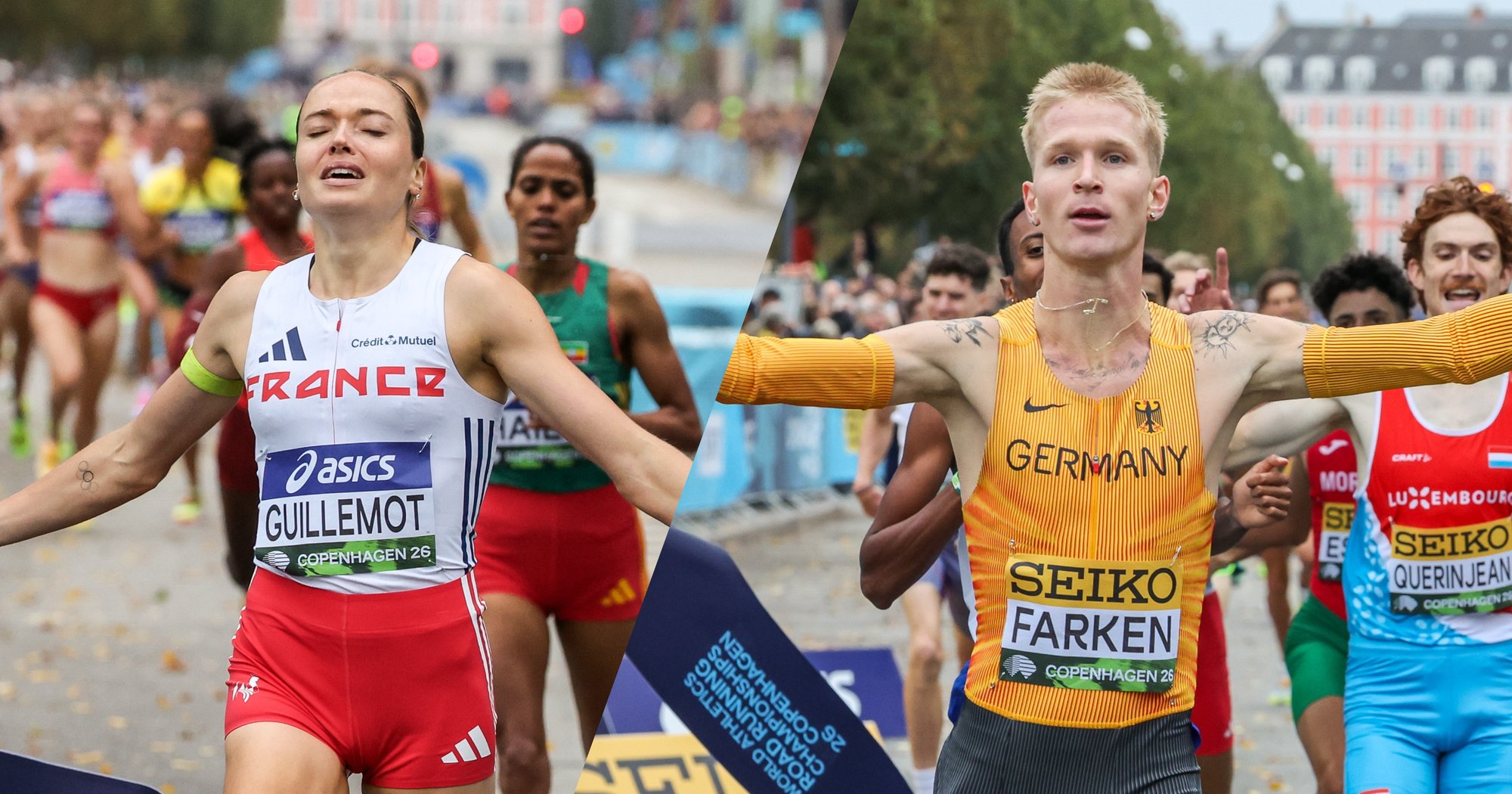
It was a particularly great eight-ish minutes of racing for the On marketing team, as Robert Farken and Agathe Guillemot took gold in the men’s and women’s races, respectively, wearing the company’s newest road-racing shoes (men’s silver medalist Yared Nuguse wore them, too). But even if you aren’t a retired Swiss tennis star, there was plenty to like about the results.
Farken, a 29-year-old German who trains with OAC in Colorado, and Guillemot, a 27-year-old French former heptathlete, aren’t exactly household names to the casual track fan, especially in the U.S. But they’re probably familiar to anyone who’s tuned in to more than half the 15 Diamond Leagues this season or the real freaks who love a World Championship semifinal.
Thanks to his third-place run behind Josh Kerr’s world record in London this summer, Farken is now the German national record holder in both the 1500m and mile and the 16th fastest man in history in the latter at 3:46.82. He’s a two-time Olympian and nine-time national champion whose best career finish in a major championship came just last year, when he took sixth in the 1500m at Worlds in Tokyo. He has 14 races on his card this season, including Millrose, World Indoors, Euros, the Diamond League final, and the World Ultimate Championship, but no signature wins before last weekend.
Guillemot, similarly, is at 19 races in a year that began with her taking the baton in the World Cross Country 4x2km relay and carrying the French team to a silver medal finish. At the Paris Diamond League, she broke her own national record with a 3:56.24 run for third behind Freweyni Hailuand Georgia Hunter Bell, which was surely the highlight of her summer before last weekend. As a 3:56 runner, she’s something of a French Nikki Hiltz or Sinclaire Johnson: she can hang in DL races and World finals, but hadn’t yet cracked the podium. In Diamond League races this year, she finished between third and sixth five times, and she finished a heartbreaking fourth at both the European Championships and World Indoors.
In addition to crossing paths on their warmups at literally dozens of races, Guillemot and Farken have a lot in common. They’ve spent the better part of their 20s being really, really good at middle-distance running. But not the best (at least on a global scale). They show up to pretty much every race they can get into and put in an honest effort, but they don’t have the hardware or career earnings of a Jakob Ingebrigtsen or Faith Kipyegon. And they’re generally fun, likable personalities to the fans who do know them well – as evidenced by Guillemot’s post-race dip and Farken’s YouTube channel.
Perhaps the perfectly painful metaphor for the specific combination of achievement and frustration of being this very specific level of runner came earlier this month at World Ultimates, where both Guillemot and Farken found themselves at the front of the rabbitless 1500m fields. They were saddled by fate with the unenviable task of making things honest over the first half of the race, and of course, that meant they got resoundingly outkicked. They finished eighth and 11th, respectively.
Congrats! You made it to Budapest by virtue of being one of the 12 best milers in the entire world this year. Your reward? The ignominious role of being a de facto pacer for your rivals. In a sport where, at best, we think of fourth place as first loser, it’s hard to find ways to articulate admiration and appreciation for finishing in the middle of a truly elite pack, time and time again.
But being so close to the top means it only takes a slight shake-up to put a gold medal within reach. In this case, the secret sauce came in the form of an outdoor course with a slightly different field of competitors at the end of a long season. Haters will say that Farken and Guillemot only claimed gold because several of their rivals from Budapest and Brussels weren’t on the start line, but both had to take down a few true studs to break the tape. On the women’s side, Guillemot powered past Hailu, a two-time World Indoor champ, to a 4:22.74 win, and on the men’s, Farken beat his training partner Nuguse, an Olympic medalist, and broke the tape in 3:51.80.
With the road mile global championship going the way of the dodo—maybe forever—the results in Copenhagen as a perfect example of why the race should stay on the calendar. Two extremely capable but underappreciated middle distance runners showed up, represented their countries, and were finally rewarded for years of top-tier running with their moment in the sun. If this race simply produced a third iteration of a Diamond League or World Ultimate final, with the same cast of characters finishing in more or less the same order, perhaps it would be superfluous and deserving of the ax. But that’s not what happened here.
Ultimately, the business of sports is all about the construction of moments that make an impression. Something that sticks with the hardcore fans and the passing casuals, the analysts and even the athletes themselves. Whether it’s at the water cooler on Monday morning or passed on in bedtime stories to grandchildren decades later, the whole point of a well-executed sporting event is that it’s both thrilling at the time and memorable after the fact. If taking things to the roads means that we get more of those moments for runners who keep just barely missing out on the track, that’s even better. Let’s keep doing it.

Kyle Merber
Kyle Merber is a former professional miler turned media multi-hyphenate. While he’s not above dropping a quick “back in my day,” he’s far more focused on the present. Since 2021, he has brought his signature analysis and commentary to track fans across the CITIUS MAG network. When he’s not writing The Lap Count or hopping on podcasts, Kyle manages partnerships and pitches a relentless stream of ideas for Chris to consider. He might not be running a 3:52 mile anymore, but he keeps himself in just good enough shape to ensure the athletes still respect him.