By Chris Chavez
April 29, 2026
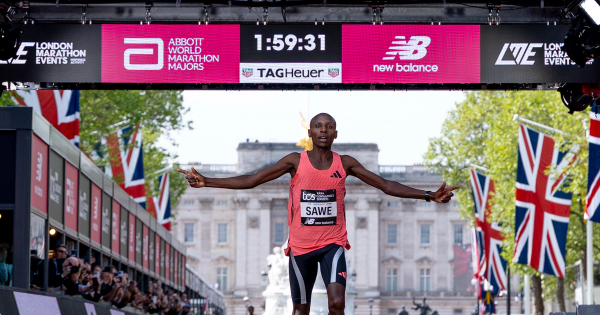
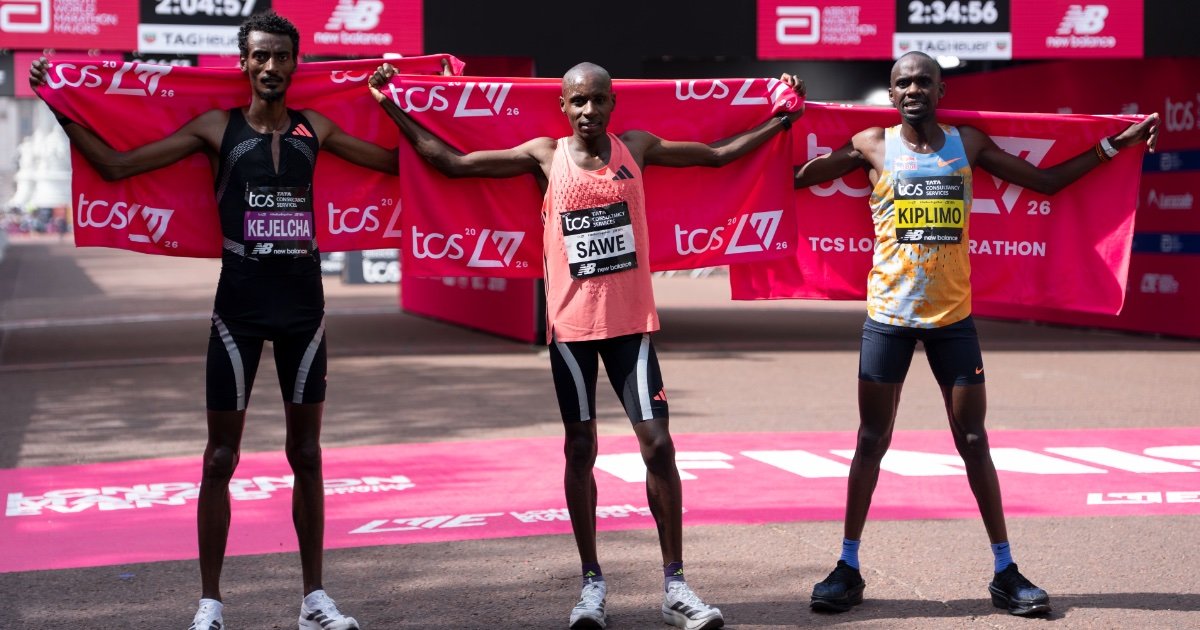
Sabastian Sawe's 1:59:30 performance at the London Marathon—along with Yomif Kejelcha's 1:59:41 in his marathon debut—has sparked a mainstream conversation about the factors propelling the marathon to unprecedented times. Much of the attention centers on the footwear, with adidas’ Adizero Adios Pro Evo 3 being 30% lighter than its predecessors. However, fueling is another key element that has been much more difficult to explain.
To put it simply: modern elite marathoners aim to consume roughly twice the carbohydrates during competition that they did just a few years ago.
We reached out to Maurten and Santamadre, Sawe’s and Kejeclha’s fueling sponsors, for insights on how each of them planned to fuel during the race. Both companies spent extensive time with these athletes to monitor them as they trained their digestive systems during workouts, in order to handle aggressive carb intake without the sort of gastric distress that can derail a race.
Note: What was shared with us were the plans for the race. In certain cases, athletes missed or opted to pass on bottles. At the time of publication, Maurten was looking to verify which bottles Sawe had missed.
Sebastian Sawe, 1:59:31
The Maurten research team was embedded with Sawe’s camp in Kenya for 32 days across six trips between last and this April. They were training his gut to absorb the raceday carbohydrate load by mimicking race-day protocol in training.
The hydrogel technology they have developed over the past 10 years now allows athletes to absorb 90–120 grams of carbs per hour without GI distress. In addition, they worked in sodium bicarbonate to his raceday nutrition plan. More commonly called “bicarb,” it’s essentially a blood buffer that neutralizes the lactic acid buildup that causes the burning sensation in muscles during high-intensity effort. Sawe used both of Maurten’s bicarbonate products on race day. Taking bicarb early is deliberate since it peaks in the bloodstream roughly 60–90 minutes after ingestion, so by consuming it 2+ hours before the race, that would peak Sawe’s body’s buffering capacity right at the start.
Sawe told the media in the press conference that he had two pieces of bread and tea with honey as his breakfast before the race.
Yomif Kejelcha, 1:59:41
Kejelcha, who was on Sawe’s shoulder until 41K, took a bit of a different fueling approach.
The Santamadre team shared Kejelcha’s fueling plan with the targeted amounts at each station. A few things stood out to me, if I’m reading it correctly. Kejelcha planned to take roughly 60ml of fluid at most stations, which is estimated at less than half of Sawe’s intake (though it’s worth noting runners often toss bottles quickly and don’t hit their targets exactly). He skipped his 5K bottle entirely and again took nothing at 40K.
“We took advantage of the pre-race window to reduce digestive load as much as possible. We knew exactly how much fluid the athlete loses and how much energy his body consumes, as we had monitored him 24/7 over the previous three months: body temperature, breathing rate, heart rate and oxygen saturation,” Santamadre co-founder Alfonso Beltrá López said in a statement. “We also controlled his caloric load in detail. The strategy was to provide 287.4g of carbohydrates between the pre-race and in-race fueling, in addition to the 580g of glycogen we had built up during the two-day carb-loading phase before the race.”
I didn’t know as much about their products beforehand but the Unusual Fuel (taken by Kejelcha at 15K, 25K, 35K) is a high-carb drink mix: 100g of carbs and 500mg of sodium per 500ml. Unusual Gel 45 is a 45g carb gel in a 1:1 glucose-to-fructose ratio, available with or without caffeine. He used the caffeinated version pre-race and at 20K.
Then there’s Reset Gel (10K, 30K), which is an interesting one. It’s billed as a “CNS fatigue blocker with 300mg of tart cherry polyphenols.” It also contains 30g of carbs, and kicks in about 17 minutes after use, so his two doses overlapped to cover most of the second half.
“We used RESET Gel at 10K and 20K, a gel designed to help control muscle damage and reset fatigue,” Lopez added. “It was one of the key parts of our strategy, exactly as we had seen in the specific training sessions.”
Finally, the Prototype he sipped for 75 minutes pre-race is a new product in the works. Santamadre says more is coming on that in the months ahead.
Jacob Kiplimo, 2:00:28
Three-time World Cross Country champion Jacob Kiplimo is also supported by Maurten and finished third in 2:00:28 (No. 3 all-time and also under the previous world record).
He also took a different approach than Sawe:
Jacob Kiplimo’s fueling protocol
- 6:00 a.m. — Bread (small breakfast)
- 7:00 a.m. — Bicarb System 15
- Pre-race — Drink Mix 320
In-race plan:
- 5K — 240ml Drink Mix 320
- 10K — 230ml Drink Mix 320
- 15K — 220ml Drink Mix 320
- 20K — 200ml Drink Mix 320
- 25K — Water + Gel Caf 100
- 30K — 180ml Drink Mix 320
- 35K — 170ml Drink Mix 320
- 40K — 150ml Drink Mix 320
Sawe front-loads with a fixed 160ml of Drink Mix 320 at every station from 5K through 40K. (Plus a Gel 100 Caf 100 added at 20K on top of his regular drink)
Meanwhile, Kiplimo starts higher (240ml at 5K) and carefully tapers his volume down across the race: 240, 230, 220, 200, then he takes water and a caffeine gel only, before resuming with 180, 170, and 150ml to close. His total volume per station is actually higher early on, but he’s taking in less and less as the race gets harder.
The other notable difference is the bicarb. Sawe takes Bicarb System 12. Kiplimo takes Bicarb System 15.
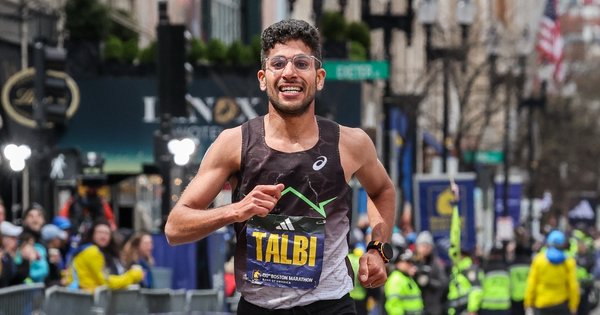
What’s fascinating is how dialed this is for an athlete who’s also racing, covering moves and responding to surges while running so fast. As Zouhair Talbi (who ran 2:03 at Boston last week) told the CITIUS MAG Podcast, many of these Kenyan runners don’t tend to nurse fluids that deliberately.
So the next step would be to watch back the tape and see how much he’s actually guzzling early and if this is just the target, or if he’s hitting these numbers exactly. We wish someone were able to collect all the bottles and then also see/share how much was actually consumed!
Keep up with all things track and field by following us across Instagram, X, Threads, and YouTube. Catch the latest episodes of the CITIUS MAG Podcast on Spotify and Apple Podcasts. For more, subscribe to The Lap Count and CITIUS MAG Newsletter for the top running news delivered straight to your inbox.

Chris Chavez
Chris Chavez launched CITIUS MAG in 2016 as a passion project while working full-time for Sports Illustrated. He covered the 2016 Olympics in Rio de Janeiro and grew his humble blog into a multi-pronged media company. He completed all six World Marathon Majors and on Feb. 15th, 2025 finally broke five minutes for the mile.