By Kyle Merber
April 29, 2026
Galen Rupp enjoyed about the exact degree of marathon success you’d expect from a multiple-time NCAA champ: he was an Olympic medalist, won a world major, and took home a couple of national titles. And yet, he now has a slower personal best (2:06:07) than an American that nobody had ever heard of, set in a race that you didn’t know existed.
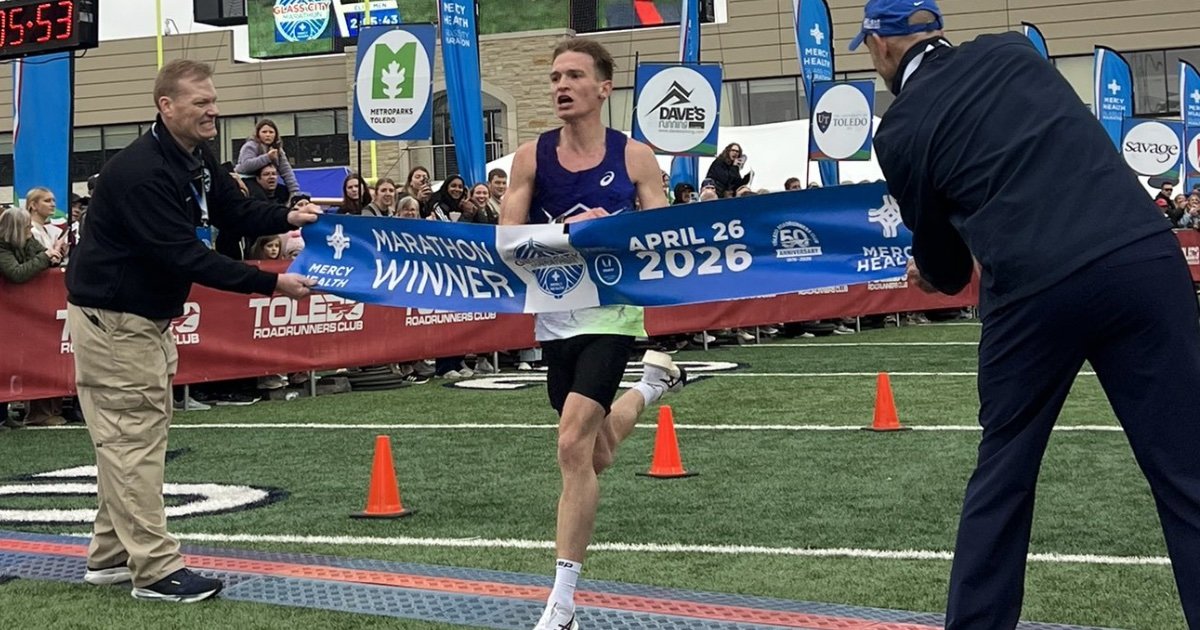
Vincent Mauri’s 2:05:53 debut at the Glass City Marathon in Toledo has forced every single mid-pack NCAA runner to look in the mirror and ask, “Could I do that?”
There have been recent accusations that American athletes aren’t brave anymore. But what else do you call a kid who has never even run a half marathon before, who goes out and starts clicking off a bunch of solo 4:45 miles and winds up running the fourth fastest marathon ever by an American… lucky?
Mauri’s best finish at an NCAA Cross Country Championship was 68th, and last year he walked away from a collegiate career that started at Arizona State and finished at Notre Dame with a 5000m best of 13:34.03. Every college coach in the country would be happy to have a guy like that on their roster—three seconds faster than Rupp was in high school. A solid runner who can contribute to the team score at conference and shore up depth at NCAAs in cross. But few coaches would peg him as the next great American anything!
In a way, this feels like deja vu. In February, some dude named Ethan Shuley popped onto everyone’s radar when he dropped a 2:07:14 on our heads in Osaka. He was a strong but not sensational prep runner (4:13/9:07), but his one result from a stint at BYU was an 8:45 3000m.
Last March, Matthew Richtman won the Los Angeles Marathon in 2:07:57. While at Montana State, he was an All-American, finishing 26th at NCAA XC in 2023. In theory, someone of Richtman’s caliber is the perfect candidate to land a day job then continue competing after college in hopes of maybe one day sneaking under 2:16 for an Olympic Trials qualifier. But in Richtman’s case, none of the 25 guys that beat him at NCAAs have ever run faster than he has over 26.2.
Dakotah Popehn went from a 16:45 5000m to an Olympian. Annie Frisbie never made nationals on the track and now boasts a 2:22:00 PB. Elena Hayday only mustered out a 17:10 5000m during her brief time at Minnesota, and she just ran 2:24 in Boston. Maybe the NCAA is actually a quite poor predictor of marathon success?
The longest race that a collegiate athlete (outside of the NAIA) will compete in is 20 miles shorter than where most distance runners’ careers end up. Thirty minutes isn’t long enough to require fueling, and training for that distance is fundamentally different than stacking weeks of marathon-specific work. How many potential 2:05 guys never came to fruition because they were caught in the wrong event, in a system that wasn’t built for them?
Talent comes in all shapes and sizes. Some athletes can come right off the couch and be competitive– the boys who ran sub-five miles in middle school or the freshman girls who were their high school team’s top runner immediately. When we talk about “talent,” this is usually the archetype that comes to mind.
But then there are the workhorses who are built like Bruce Willis in Unbreakable. No matter how much they push, their body can handle it. That’s talent, too. And it’s arguably the sort that lends itself to longer term success in a sport where moving on up isn’t just the chorus to The Jeffersons’ theme song.
That latter category of talent doesn’t always thrive in the NCAA. Athletes like that are constrained by regimented programs with coaches who may be balancing 25+ training plans, which all eventually converge to look the same. For a coach, health wins championships. And exploring the upper limits of a teenager’s ability to withstand mileage is rarely worth the risk of an MRI. Even then, athletes like Shuley and Mauri have robust injury histories—you probably wouldn’t have assumed their futures would be brightened with higher volume and longer races.
So how do you tell who has the long-term potential to be great on the roads? According to a brief text exchange with Steve Magness, who has coached both NCAA standouts and elite marathoners, there are a few indicators. The first is that cross country results matter more than success on the track—that’s not a huge surprise.
But he also called out a third category of talent we haven’t previously addressed: the high responder. Magness described them as, “A grower more than a shower… meaning their talent may not show up initially, but as the training load increases, they keep making jumps.”
This perfectly describes Vincent Mauri. Despite having worked with a long list of great coaches, there were probably too many in too short a short period of time. He never had the chance to build consistently. It took being self-coached for the epiphany… and just as importantly, the sort of free reign to hammer mid-five-minute-pace miles as a default.
Super shoes and fueling made the sub-two hour marathon possible. But it’s stories like this one out of Ohio that will inspire future 32nd place finishers at indoor ACCs to believe they can run faster than their heroes.
Kyle Merber
Kyle Merber is a former professional miler turned media multi-hyphenate. While he’s not above dropping a quick “back in my day,” he’s far more focused on the present. Since 2021, he has brought his signature analysis and commentary to track fans across the CITIUS MAG network. When he’s not writing The Lap Count or hopping on podcasts, Kyle manages partnerships and pitches a relentless stream of ideas for Chris to consider. He might not be running a 3:52 mile anymore, but he keeps himself in just good enough shape to ensure the athletes still respect him.